
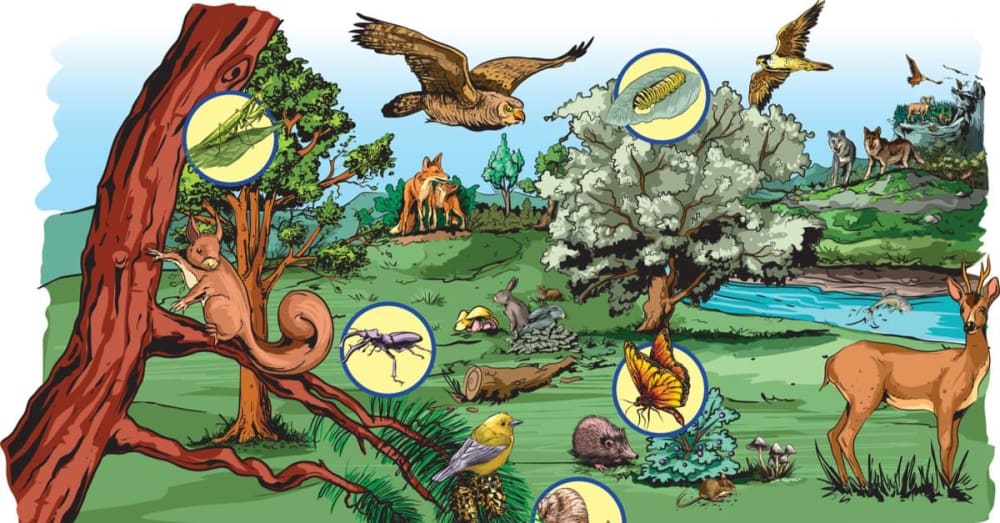
Understanding how energy and nutrients move through ecosystems is one of the foundations of ecology. Two of the most important concepts used to explain these movements are the food chain and the food web. While they are closely related, they are not the same. Each offers a different way of visualizing feeding relationships among organisms and helps scientists, students, and environmentalists understand how ecosystems function, respond to disturbances, and maintain balance.
In this in-depth guide, we will explore what food chains and food webs are, how they differ, why both are important, and how they apply to real-world ecosystems. By the end, you will have a clear and thorough understanding of these two essential ecological models.
Understanding Energy Flow in Ecosystems
Before diving into the differences between a food chain and a food web, it is important to understand the broader concept of energy flow in ecosystems.
All ecosystems rely on energy, and most of this energy originates from the sun. Plants and other photosynthetic organisms capture solar energy and convert it into chemical energy through photosynthesis. This energy is then transferred from one organism to another through feeding relationships.
Energy transfer in ecosystems follows several key principles:
- Energy flows in one direction, from producers to consumers and eventually to decomposers.
- Only a small fraction of energy is transferred between trophic levels, with most lost as heat.
- The structure of feeding relationships determines the stability and productivity of an ecosystem.
Food chains and food webs are models that help us visualize and understand these energy pathways.
What Is a Food Chain?
A food chain is a simple, linear representation of how energy and nutrients pass from one organism to another in an ecosystem. It shows a direct sequence of who eats whom, starting with a producer and ending with top predators or decomposers.
Basic Structure of a Food Chain
A typical food chain includes the following components:
Producers (Autotrophs)
These organisms make their own food using sunlight or chemical energy. Examples include plants, algae, and some bacteria.Primary Consumers (Herbivores)
These organisms eat producers. Examples include deer, rabbits, and zooplankton.Secondary Consumers (Carnivores or Omnivores)
These organisms eat primary consumers. Examples include frogs, birds, and small fish.Tertiary Consumers (Top Predators)
These organisms eat secondary consumers and usually have no natural predators. Examples include lions, hawks, and sharks.Decomposers
Though not always shown in simple food chains, decomposers such as bacteria and fungi break down dead organisms and recycle nutrients back into the ecosystem.
Example of a Food Chain
A grassland food chain might look like this:
- Grass → Grasshopper → Frog → Snake → Hawk
This shows a straightforward sequence of energy transfer, with each organism feeding on the one before it.
Purpose of a Food Chain
Food chains are useful because they:
- Provide a simple and clear illustration of feeding relationships.
- Help beginners understand the concept of trophic levels.
- Show how energy moves from producers to top predators.
However, food chains are highly simplified and rarely represent the true complexity of natural ecosystems.
What Is a Food Web?
A food web is a more complex and realistic model that shows all the interconnected food chains within an ecosystem. Instead of a single linear pathway, it displays a network of feeding relationships, illustrating how organisms can have multiple food sources and predators.
Structure of a Food Web
In a food web:
- Each organism may occupy multiple trophic roles.
- Arrows connect many species, showing who eats whom.
- Energy flows along multiple interconnected pathways rather than a single line.
For example, in a forest ecosystem:
- A mouse might eat seeds, berries, and insects.
- The mouse might be eaten by owls, snakes, foxes, or hawks.
- Insects might feed on multiple plants and be eaten by birds, reptiles, and amphibians.
All these connections form a web-like structure, which is why it is called a food web.
Purpose of a Food Web
Food webs are valuable because they:
- Reflect the complexity of real ecosystems.
- Show how species are interdependent.
- Help scientists understand how disturbances affect entire ecosystems rather than just one feeding pathway.
Key Differences Between a Food Chain and a Food Web
Although both food chains and food webs describe feeding relationships, they differ significantly in structure, realism, and ecological insight. Let’s explore these differences in detail.
1. Structure: Linear vs. Network
Food Chain Structure
A food chain follows a single linear pathway:
- One producer
- One consumer at each level
- One predator-prey relationship per step
For example:
- Phytoplankton → Zooplankton → Small Fish → Large Fish → Shark
This straight-line structure makes food chains easy to understand but oversimplified.
Food Web Structure
A food web forms a complex network of interconnected food chains:
- Multiple producers
- Multiple consumers at each level
- Many predator-prey interactions
For example, phytoplankton may be eaten by several species of zooplankton, which in turn may be eaten by many types of fish, birds, and marine mammals.
Key Difference
- Food chain: Linear and simple
- Food web: Networked and complex
This difference in structure is one of the most fundamental distinctions between the two concepts.
2. Realism: Simplified Model vs. Natural Complexity
Food Chain Realism
Food chains are largely theoretical models. In nature, organisms rarely depend on just one food source or have only one predator. A rabbit, for instance, eats many types of plants and is preyed upon by foxes, hawks, snakes, and humans.
Thus, food chains often fail to represent the full range of interactions occurring in ecosystems.
Food Web Realism
Food webs are much more ecologically realistic because they show:
- Multiple feeding relationships per organism
- Overlapping diets
- Interconnected predator-prey dynamics
Food webs better capture how ecosystems actually function and how species are linked through shared energy pathways.
Key Difference
- Food chain: A simplified teaching tool
- Food web: A realistic ecological model
3. Stability: Fragile vs. Resilient Systems
Food Chain Stability
Because a food chain is linear, it is fragile. If one organism in the chain is removed or declines significantly, the entire chain can collapse.
For example:
- If grasshoppers disappear from a grassland food chain, frogs lose their main food source, snakes lose frogs, and hawks lose snakes. The disruption cascades through the chain.
Food Web Stability
Food webs are more stable and resilient. Since organisms have multiple food sources and predators, the loss of one species does not necessarily destroy the entire system. Other feeding pathways can compensate, allowing energy to continue flowing.
For example:
- If one insect species declines, birds may switch to other insects or seeds.
- Predators may adapt their diets rather than starve.
Key Difference
- Food chain: Less stable and more vulnerable to disruption
- Food web: More stable and adaptable to environmental changes
4. Energy Flow: Single Pathway vs. Multiple Pathways
Energy Flow in a Food Chain
In a food chain, energy flows through a single pathway from producers to top consumers. This makes it easy to trace energy transfer but does not reflect the many routes energy can take in nature.
Energy Flow in a Food Web
In a food web, energy flows through multiple interconnected pathways. This allows energy to move through the ecosystem in diverse ways, increasing system flexibility and reducing reliance on any single species.
Key Difference
- Food chain: One-directional, single energy route
- Food web: Multiple energy routes interconnected
5. Educational Use: Introductory Tool vs. Analytical Framework
Food Chain in Education
Food chains are commonly used in elementary and middle school education because:
- They are easy to understand and visualize.
- They clearly demonstrate trophic levels.
- They introduce basic ecological concepts without overwhelming complexity.
Food Web in Ecology and Research
Food webs are used in advanced education and scientific research because:
- They allow analysis of ecosystem stability.
- They reveal keystone species and trophic cascades.
- They support modeling of environmental change, biodiversity loss, and climate impacts.
Key Difference
- Food chain: Introductory teaching model
- Food web: Advanced analytical and research tool
Similarities Between Food Chains and Food Webs
Despite their differences, food chains and food webs share several important similarities.
Both Describe Feeding Relationships
Both models show who eats whom and how organisms depend on one another for survival.
Both Represent Energy Transfer
In both cases, energy originates with producers and moves through consumers to decomposers.
Both Use Trophic Levels
Both models include producers, primary consumers, secondary consumers, and higher-level consumers.
Both Help Explain Ecosystem Balance
Both help scientists and students understand how populations interact and how disruptions can affect ecosystems.
These similarities highlight that food chains and food webs are not competing ideas but complementary tools for understanding ecological systems.
Real-World Examples of Food Chains and Food Webs
To better understand the difference, let’s examine how food chains and food webs operate in real ecosystems.
Example 1: Grassland Ecosystem
Food Chain
- Grass → Grasshopper → Frog → Snake → Hawk
This simple chain shows one possible energy pathway in a grassland.
Food Web
In reality:
- Grass is eaten by grasshoppers, rabbits, deer, and mice.
- Grasshoppers are eaten by birds, frogs, lizards, and spiders.
- Frogs are eaten by snakes, raccoons, birds, and fish.
- Snakes are eaten by hawks, owls, and foxes.
All these interactions form a complex web rather than a single chain.
Example 2: Marine Ecosystem
Food Chain
- Phytoplankton → Zooplankton → Small Fish → Tuna → Shark
This shows a simple marine energy pathway.
Food Web
In reality:
- Phytoplankton feed many species of zooplankton.
- Zooplankton feed small fish, whales, jellyfish, and seabirds.
- Small fish feed larger fish, seals, birds, and humans.
- Large predators feed on a variety of species.
This interconnected structure makes marine ecosystems far more complex than a single chain suggests.
Example 3: Forest Ecosystem
Food Chain
- Oak Tree → Caterpillar → Bird → Hawk
Food Web
In reality:
- Oak trees feed caterpillars, deer, squirrels, and insects.
- Caterpillars feed birds, spiders, and reptiles.
- Birds eat insects, seeds, fruit, and small mammals.
- Hawks eat birds, rabbits, snakes, and rodents.
Again, the food web better captures the true feeding dynamics of the ecosystem.
Role of Decomposers in Food Chains and Food Webs
Decomposers play a crucial role in both food chains and food webs, even though they are often omitted from simple diagrams.
What Are Decomposers?
Decomposers include bacteria, fungi, and detritivores such as earthworms and insects. They break down dead plants and animals into simpler substances, returning nutrients to the soil and water.
Why Are They Important?
- They recycle nutrients, allowing producers to grow.
- They prevent the accumulation of dead organic matter.
- They connect all trophic levels by processing waste and remains.
In food webs, decomposers often form their own complex networks known as detrital food webs, which operate alongside grazing food webs that begin with living plants.
Why Understanding the Difference Matters
Knowing the difference between a food chain and a food web is not just an academic exercise. It has real-world implications for environmental management, conservation, and sustainability.
1. Ecosystem Conservation
Conservation efforts require understanding how species interact. A food web perspective reveals:
- Keystone species, whose removal can destabilize entire ecosystems.
- Indirect effects, where changes to one species impact many others.
- Resilience factors, such as alternative food pathways.
Food chains alone cannot capture these complex dynamics.
2. Predicting Ecological Disturbances
When a species is overharvested, invaded, or driven extinct, its effects ripple through the ecosystem.
- In a food chain, the impact seems linear and predictable.
- In a food web, the impact is multidirectional and can affect many unrelated species.
Food web analysis helps scientists predict and manage such cascading effects.
3. Managing Fisheries and Agriculture
Food web models help policymakers:
- Understand predator-prey dynamics in fisheries.
- Predict how removing one species affects others.
- Design sustainable harvesting strategies.
In agriculture, food web thinking supports integrated pest management and soil ecosystem health.
4. Understanding Climate Change Impacts
Climate change alters species distributions, migration patterns, and productivity.
Food webs help scientists:
- Track how warming oceans affect plankton and fish populations.
- Understand how drought affects plant growth and herbivore survival.
- Predict ecosystem shifts as species interactions change.
Food chains alone cannot adequately represent these complex feedback loops.
Limitations of Food Chains and Food Webs
While both models are useful, they also have limitations.
Limitations of Food Chains
- Oversimplify real ecosystems.
- Ignore omnivory and diet variation.
- Fail to represent indirect interactions.
Limitations of Food Webs
- Can become overly complex and difficult to interpret.
- Often lack quantitative data on energy flow.
- May oversimplify spatial and seasonal variations.
To overcome these limitations, ecologists often use energy pyramids, biomass pyramids, and ecosystem modeling tools alongside food webs.
Trophic Levels in Food Chains and Food Webs
Both food chains and food webs organize organisms into trophic levels, which describe their position in the flow of energy.
Common Trophic Levels
Producers (Level 1)
Plants, algae, and photosynthetic bacteria.Primary Consumers (Level 2)
Herbivores that eat producers.Secondary Consumers (Level 3)
Carnivores and omnivores that eat herbivores.Tertiary Consumers (Level 4)
Top predators that eat secondary consumers.Quaternary Consumers (Level 5, sometimes)
Apex predators at the top of the food web.
In food chains, organisms occupy a single trophic level, while in food webs, organisms may occupy multiple trophic levels depending on their diet.
Omnivores and the Complexity of Food Webs
One major reason food webs are more realistic than food chains is the prevalence of omnivores.
Omnivores eat both plants and animals, meaning they can act as:
- Primary consumers when eating plants.
- Secondary or tertiary consumers when eating animals.
For example:
- Humans eat plants, herbivores, and carnivores.
- Bears eat berries, insects, fish, and mammals.
- Pigs eat roots, fruits, insects, and small animals.
Food chains struggle to represent omnivory, while food webs naturally accommodate it.
Human Impact on Food Chains and Food Webs
Humans play a powerful role in shaping modern ecosystems, and understanding food webs is essential to managing these impacts.
Overfishing and Hunting
Removing top predators can cause trophic cascades, where:
- Herbivore populations increase.
- Plant populations decline.
- Ecosystem structure shifts dramatically.
Food webs help reveal these cascading effects more accurately than food chains.
Habitat Destruction
Deforestation, urbanization, and pollution disrupt food webs by:
- Eliminating producers.
- Fragmenting habitats.
- Removing key species.
Food web analysis helps identify which species are most critical to ecosystem function.
Invasive Species
Invasive species can:
- Outcompete native organisms.
- Introduce new predators or prey.
- Restructure entire food webs.
Understanding existing food webs helps predict and mitigate invasive species impacts.
Summary: Food Chain vs. Food Web
Let’s summarize the key differences and similarities.
Food Chain
- Linear sequence of feeding relationships
- Simplified model
- One energy pathway
- Less stable
- Best for introductory learning
Food Web
- Network of interconnected feeding relationships
- Realistic model
- Multiple energy pathways
- More stable and resilient
- Best for ecological analysis and conservation
Shared Features
- Both describe energy flow
- Both include trophic levels
- Both explain ecological interactions
- Both help us understand ecosystem balance
Final Thoughts
The difference between a food chain and a food web lies primarily in simplicity versus complexity, theoretical clarity versus ecological realism, and single pathways versus interconnected networks. Food chains offer a clean and accessible introduction to energy transfer, while food webs provide a more accurate and powerful framework for understanding how ecosystems truly function.
In the natural world, no organism exists in isolation. Every species is part of a vast network of interactions that shape survival, reproduction, and ecosystem stability. Food webs capture this reality, showing that life on Earth is not organized in neat lines but in intricate, dynamic networks of dependence and exchange.
By understanding both food chains and food webs — and especially the differences between them — we gain deeper insight into the complexity of nature and the delicate balance that sustains life across ecosystems.