
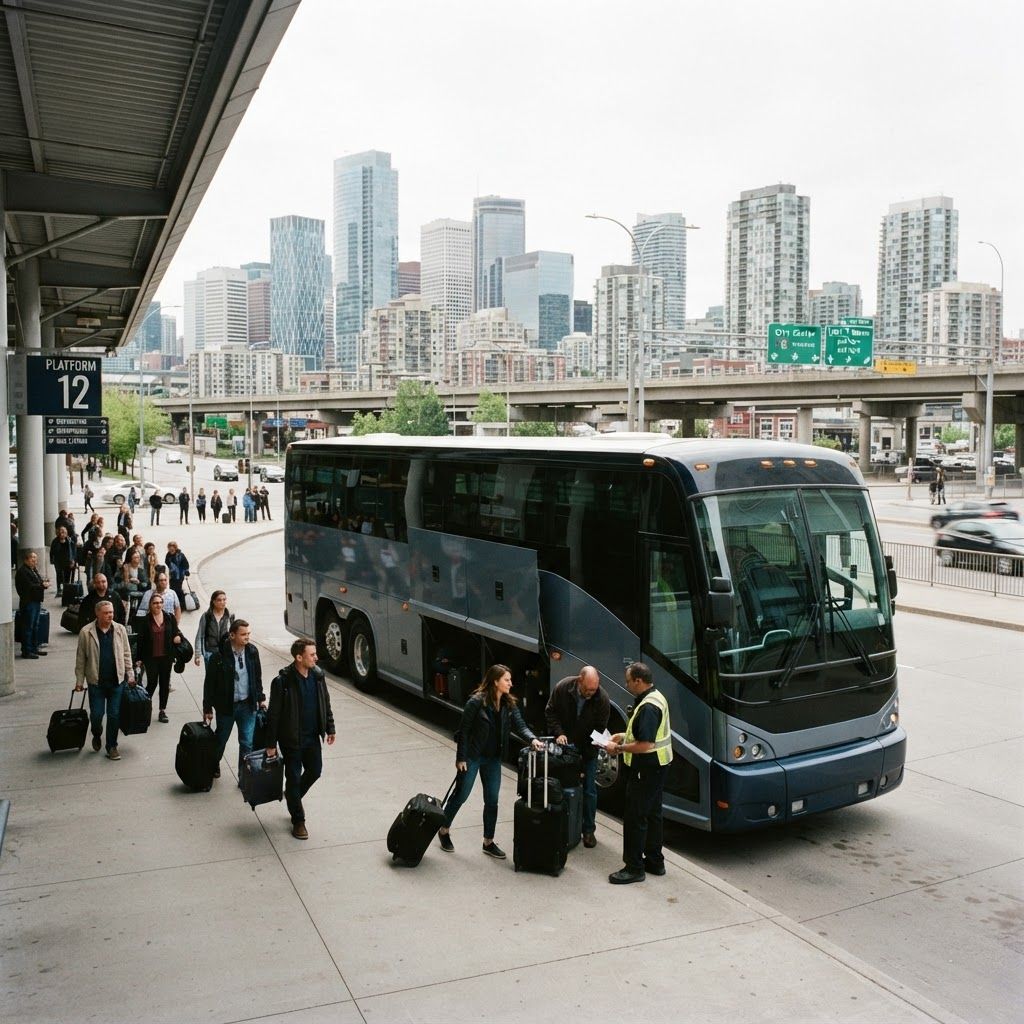
Why Bus Travel Works Well from St. Louis
Geography has always been St. Louis's transportation advantage, and it applies to buses as much as to freight. The city sits roughly 300 miles from Chicago, 250 from Kansas City, 285 from Memphis, 310 from Nashville and 240 from Indianapolis. Every one of those distances falls in the range where intercity bus travel is genuinely competitive with flying once you account for airport arrival time, security screening and ground transportation at both ends.
Add a large student population moving between St. Louis and Chicago, Columbia and Champaign, a substantial immigrant community with family connections across the Midwest and South, and a busy convention and youth sports calendar generating charter demand, and the region supports a diverse bus market spanning cut-rate curbside carriers to luxury motorcoach fleets.
Understanding the Segments
The bus market divides into distinct categories that serve different needs. Intercity scheduled carriers run fixed routes on published timetables with ticketed seats, and this is where the low fares live. Charter and tour operators rent an entire vehicle with a driver for a group, priced hourly or daily. Shuttle services handle repeating short-haul routes such as airport and campus connections. And specialty operators cover student athletics, senior group travel and corporate transportation with equipment and staffing tailored to those groups.
The Gateway Transportation Center downtown, adjacent to the Amtrak station and MetroLink, functions as the region's primary intercity bus hub, which makes bus-to-rail and bus-to-light-rail connections unusually convenient compared with many American cities.
The Ten Best Bus Companies Serving St. Louis
1. Greyhound Lines
Greyhound remains the backbone of American intercity bus travel and offers the broadest route network from St. Louis by a wide margin. Its value is connectivity: from the downtown terminal you can reach small cities and towns across Missouri, Illinois, Arkansas, Tennessee and beyond that no other carrier serves. Modern coaches include reclining seats, power outlets and onboard restrooms. For travelers heading somewhere off the major corridors, it is frequently the only scheduled option.
2. Megabus
Megabus pioneered the low-cost curbside model in the United States and serves the St. Louis to Chicago corridor with particular strength. Double-decker coaches with panoramic upper-deck seating, reserved seats, onboard connectivity and fares that can drop into single digits when booked far ahead make it the best value in the market for major city pairs. The trade-off is limited route coverage focused on high-volume corridors.
3. FlixBus
FlixBus brought a European operating model to American intercity travel and has expanded aggressively through the Midwest. Its app-first booking, live vehicle tracking, flexible cancellation terms and competitive pricing appeal to younger travelers, and its partnership network with regional operators extends its effective reach considerably beyond its own fleet. Onboard amenities are consistently solid.
4. Burlington Trailways
Burlington Trailways specializes in the routes major carriers underserve, connecting St. Louis with Iowa, Nebraska and points across the upper Midwest. Its coaches are well maintained, its schedules are reliable, and it interlines with other Trailways members to create through-ticketing across a wide network. For travelers heading northwest, it is often the most direct option available.
5. Jefferson Lines
Jefferson Lines runs an extensive network across the central United States, connecting St. Louis northward through Iowa and Minnesota and westward across the plains. Its long operating history and interline agreements make it valuable for multi-leg journeys, and it serves numerous smaller communities that would otherwise have no scheduled intercity service at all.
6. Vandalia Bus Lines
Vandalia is one of the region's established charter operators, serving school districts, athletic programs, church groups and corporate clients across Illinois and eastern Missouri. Its fleet spans full-size motorcoaches to smaller shuttle vehicles, which lets it right-size equipment to group needs rather than forcing customers into oversized coaches. Safety record and driver training programs are strong.
7. Gateway Coach Charter Services
Charter operators in this tier serve the convention, wedding and corporate market with premium motorcoaches featuring leather seating, onboard restrooms, entertainment systems and luggage capacity for extended trips. For conference organizers moving hundreds of attendees between downtown hotels and America's Center, or wedding parties shuttling guests between venues, these operators handle the logistics planning as much as the driving.
8. Illinois Central School Bus and Student Transportation Providers
Contracted student transportation is a large and specialized segment across the bi-state region. Providers here manage route optimization, driver background screening and certification, special needs transportation with trained aides, and increasingly GPS tracking systems that let parents and administrators monitor buses in real time. For districts, the value proposition is transferring fleet maintenance, insurance and driver recruitment burdens to a specialist.
9. Winery and Brewery Tour Bus Operators
Missouri wine country and the region's substantial craft brewery scene support a healthy tour bus segment. Operators run scheduled and private trips to Augusta, Hermann, Ste. Genevieve and local brewery clusters, handling tasting reservations and meals alongside transportation. The safety benefit is the point: these trips exist specifically so nobody has to drive, and reputable operators build their entire model around that.
10. Metro Transit Bus Service
The regional transit agency operates the metro area's fixed-route bus network, connecting neighborhoods across St. Louis City, St. Louis County and the Metro East in Illinois, with integrated transfers to MetroLink light rail. Recent network redesign work has concentrated service on high-frequency corridors, which meaningfully improved practical usability for daily riders. For local travel, discounted passes and integrated rail transfers make it by far the lowest-cost option available.
Trends in Regional Bus Transportation
Several shifts are visible. Fleet modernization has accelerated, with connectivity, power outlets and improved seating now standard rather than premium. Electrification is beginning in transit fleets, with battery-electric buses entering service and reducing both emissions and operating cost. Digital ticketing and live tracking have become baseline expectations. Driver shortages remain the industry's central constraint, which has pushed wages up and occasionally thinned schedules. And demand has recovered strongly on corridors where flying is disproportionately expensive relative to distance.
How to Choose and Travel Well
Book intercity tickets as far ahead as possible, since low-cost carriers price dynamically and early fares can be a fraction of walk-up prices. Confirm exact departure location, because curbside carriers do not always use the main terminal. Verify baggage allowances before arriving, as they vary widely between operators. For charters, request certificates of insurance and ask about driver hours-of-service compliance for long itineraries. Arrive twenty minutes early for boarding. And for local travel, compare a transit pass against parking costs downtown, where the math usually favors the bus.
Final Thoughts
Bus travel from St. Louis is affordable, increasingly comfortable and well suited to the region's geography. Greyhound provides reach, Megabus and FlixBus deliver value on major corridors, Trailways and Jefferson connect the underserved routes, charter operators handle groups professionally, and Metro Transit anchors local mobility. For a region defined by its position at the center of the country, the bus remains one of the most sensible ways to use that position.