
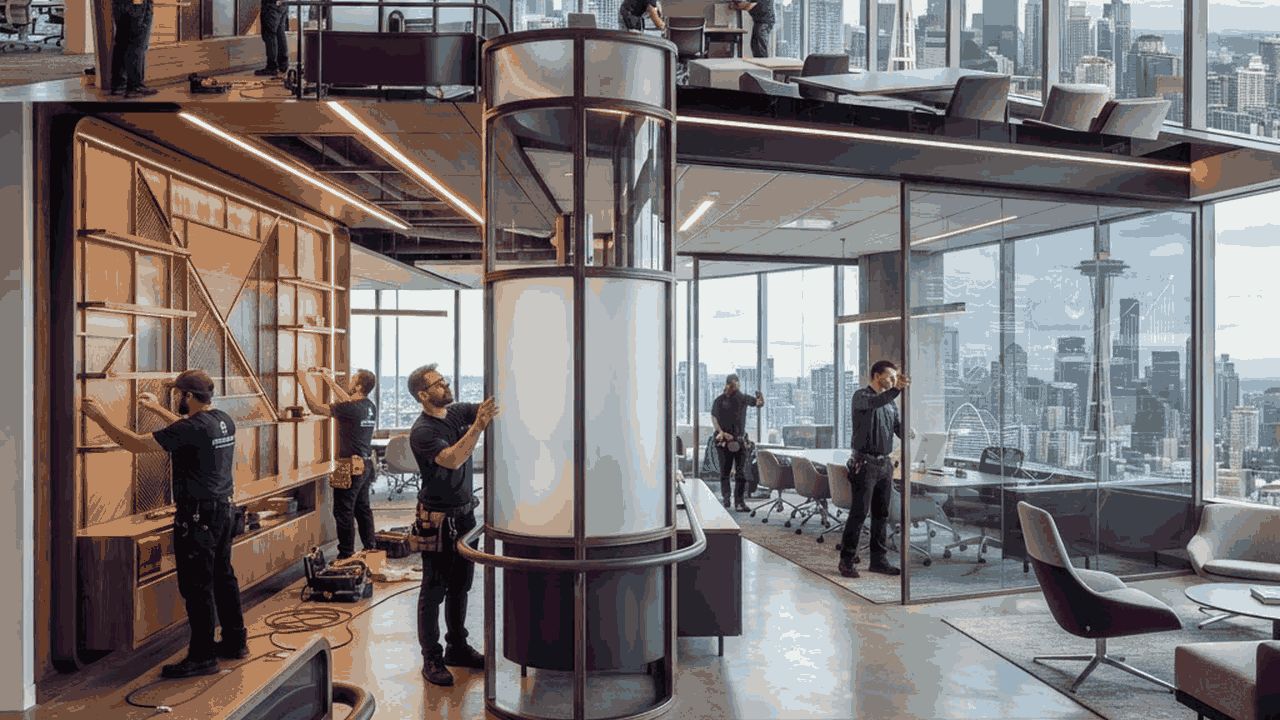
Interior Fitouts in a Changing Workplace
Commercial interiors must now support flexible attendance, hybrid collaboration, wellness, accessibility, and changing technology. In Washington, fitout teams also navigate stringent energy rules, downtown logistics, occupied buildings, and short lease-driven schedules. The strongest companies align design, permits, procurement, building systems, furniture, and move-in requirements.
1. GLY Construction
GLY Construction has extensive experience with corporate interiors, technology workplaces, and life-science environments around Seattle and Bellevue. Its teams bring detailed preconstruction and building-systems coordination to fast-moving projects. The firm is especially relevant where a fitout includes dense mechanical infrastructure or sophisticated audiovisual systems.
2. Lease Crutcher Lewis
Lease Crutcher Lewis delivers commercial interiors for major employers, institutions, and hospitality clients. Its special-project capabilities support phased work, occupied renovations, and demanding finish packages. Local market depth helps with trade availability and landlord coordination.
3. Sellen Construction
Sellen Construction’s portfolio includes prominent workplaces and cultural interiors. The Seattle builder can draw on substantial self-perform and management resources while maintaining close attention to finish quality. It is well positioned for large headquarters projects or renovations tied to broader base-building work.
4. BNBuilders
BNBuilders works across technology, research, healthcare, and commercial interiors. Its experience in technically intensive spaces supports laboratories and workplaces where utilities, controls, and commissioning are as important as visual design. Collaborative planning can also help clients phase work around operations.
5. Skanska USA Building
Skanska provides interior construction for corporate and institutional clients, backed by formal safety, sustainability, and project-control systems. The firm’s scale suits larger multi-floor programs or portfolios requiring consistent reporting. Its resources are particularly useful when stakeholder groups extend beyond Washington.
6. Turner Construction
Turner delivers complex fitouts and renovations with strong national purchasing and technical capabilities. In Seattle, the company can support high-security, data-rich, healthcare, and corporate environments. Owners should evaluate the dedicated local team and its direct experience with the relevant building type.
7. JTM Construction
JTM Construction is a Seattle commercial builder with experience in offices, hospitality, retail, and building repositioning. Its knowledge of urban project logistics and local buildings can reduce uncertainty in renovations. The firm is a practical contender for visible, schedule-sensitive interior work.
8. Venture General Contracting
Venture General Contracting handles commercial, multifamily, hospitality, and tenant-improvement projects in the region. Its range helps when interior work intersects with structural changes or broader property upgrades. Early field investigation is a key service for older buildings.
9. Abbott Construction
Abbott Construction has longstanding Pacific Northwest experience in healthcare, commercial, retail, and tenant improvement work. Occupied healthcare interiors demand exceptional infection control, phasing, and communication, capabilities that also benefit other sensitive environments.
10. Schuchart
Schuchart serves Seattle-area clients with commercial interiors and renovation expertise. The company has experience delivering tailored workplace environments where craftsmanship, responsiveness, and coordination with property management are central. Its project scale can suit clients seeking focused attention.
Features Defining Modern Fitouts
Leading projects prioritize adaptable rooms, acoustic control, inclusive design, healthy materials, and lighting that supports comfort. Demountable partitions and modular power can simplify future changes. Electrification and energy-code compliance should be assessed early because existing building capacity may constrain design. Reuse of furniture, ceilings, doors, and equipment can reduce embodied carbon and disposal expense.
Technology requires equal attention. Wireless coverage, room scheduling, access control, audiovisual systems, and occupancy data should be coordinated before ceilings close. A fitout contractor should maintain a clear matrix of owner-furnished and contractor-furnished items so nothing is missed at turnover.
Selecting the Right Fitout Team
Ask candidates to explain preconstruction milestones, procurement plans, shutdown procedures, and quality-control methods. Review experience in the exact building and jurisdiction when possible. Confirm how landlord standards, permits, commissioning, furniture installation, and move management will be handled. The best interior fitout company combines schedule speed with disciplined planning, excellent finishes, and minimal disruption to neighboring tenants and ongoing operations.