
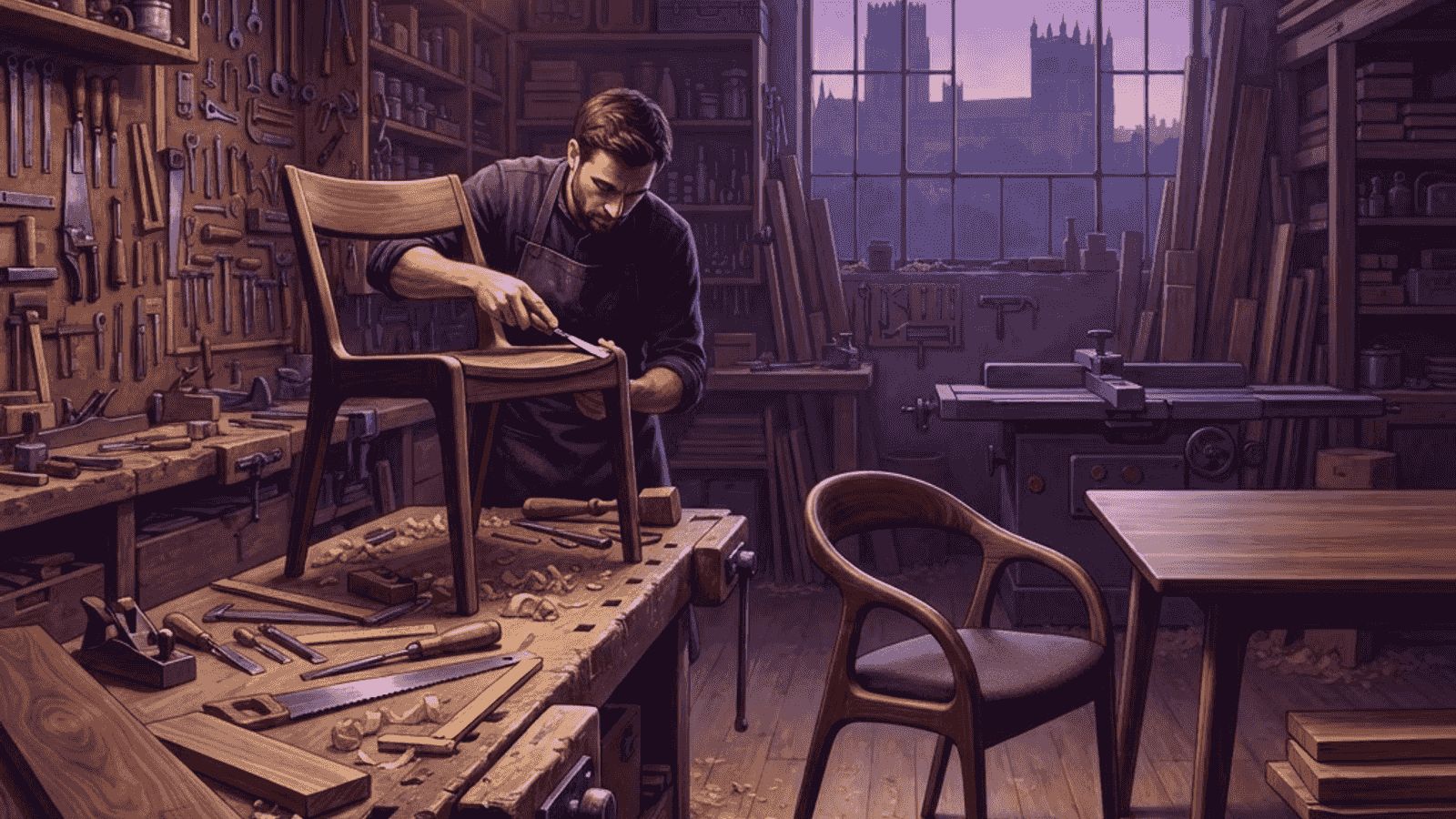
Furniture Making in County Durham
Furniture manufacturing in County Durham operates across two distinct worlds that rarely overlap. On one side sit small workshops and cabinetmakers producing bespoke pieces, fitted kitchens, staircases and commissioned joinery, where the value lies in craftsmanship, material selection and one-off design. On the other sit contract manufacturers producing furniture in volume for offices, educational institutions, healthcare facilities and hospitality, where performance standards, durability testing, delivery scheduling and installation logistics dominate.
The county supports both. Demand from Durham University, regional hospitals, schools, local authority buildings and a substantial hospitality sector sustains contract work, while a strong market for heritage property renovation across the city and county keeps skilled joinery workshops busy. The region's timber trade, upholstery skills and metalworking capability round out the supply base.
Ten Furniture Manufacturers and Makers
Barker and Stonehouse
A North East founded furniture retailer with strong regional heritage, this business commissions and supplies quality furniture ranges and maintains close relationships with manufacturers, offering customers access to well-made pieces across many styles.
Ercol
A respected British furniture manufacturer known for solid timber construction and enduring designs, Ercol supplies retailers and specifiers across the region seeking longevity rather than disposable furniture.
Hypnos Beds
Manufacturing handmade beds and mattresses in the UK using traditional upholstery techniques and sustainable materials, Hypnos supplies both domestic customers and the hospitality sector.
Senator Group
A major British contract furniture manufacturer producing office seating, desking and collaborative furniture, Senator supplies workplace fit-out projects including commercial and public sector schemes in the North East.
Bisley
Manufacturing steel storage and office furniture in the UK, Bisley is widely specified for workplace and educational projects where durability and standardisation matter more than bespoke design.
Deanestor
Specialising in fitted furniture for healthcare, education and student accommodation, Deanestor manufactures and installs casework for institutional projects, a category particularly relevant given Durham's university and health sector presence.
Ryedale Furniture Workshops
Regional bespoke cabinetmaking workshops of this type produce handmade kitchens, freestanding furniture and fitted joinery for period properties, working directly with clients and architects on individual commissions.
Weardale Joinery and Cabinetmaking
County Durham joinery businesses of this kind combine architectural joinery with furniture making, producing staircases, doors, window replacements for listed buildings and matching furniture pieces to order.
Morleys Furniture Group
Supplying office and contract furniture with design and installation services, this type of provider manages complete workplace furnishing projects from specification through to commissioning.
Northern Upholstery Services
Regional upholstery manufacturers and re-upholsterers produce and refurbish seating for hospitality, healthcare and domestic clients, extending furniture life and supporting contract maintenance programmes.
Bespoke and Contract Are Different Purchases
Commissioning bespoke furniture is a design process. The client and maker discuss function, materials, dimensions and finish, and the maker produces drawings or samples before construction. Lead times are longer, cost per item is higher, and the result is unique and repairable. This route suits period properties in Durham City where standard sizes simply do not fit, and where matching existing joinery or heritage detail is required.
Contract furniture is a specification process. Buyers define performance requirements, often referencing standards for strength, stability, durability and fire performance, particularly for healthcare and educational settings. Volume, delivery phasing, installation and warranty terms become central. Cost per item is lower, and replacement parts and matching future orders are usually available.
Confusing the two causes most procurement disappointment. Asking a bespoke workshop to compete on price for two hundred identical desks wastes everyone's time, and expecting a volume manufacturer to produce a single curved reception counter for a listed building rarely ends well.
Timber, Materials and Sustainability
Material choice determines both quality and environmental impact. Solid hardwood offers longevity and repairability but costs more and requires proper moisture control. Engineered boards provide dimensional stability and efficient material use, and quality depends heavily on the core, the surface and the edge treatment rather than appearance alone.
Certified sourcing has become standard in public and institutional procurement, with recognised chain of custody certification evidencing responsible forestry. Buyers increasingly also ask about formaldehyde emissions from boards and adhesives, recycled content in metal and textile components, and end-of-life recyclability.
Durability remains the most important sustainability factor. Furniture that survives twenty years of institutional use, and can be reupholstered or repaired rather than replaced, outperforms lighter products with better material credentials. This is why refurbishment and reupholstery services form a growing part of the regional market.
How to Commission Furniture Successfully
Begin with a clear brief covering function, dimensions, environment, expected usage intensity and budget. For bespoke work, agree the design in drawings and confirm material samples and finishes before production begins, since colour and grain expectations cause most disputes. Establish payment stages, lead time and who is responsible for delivery access and installation.
For contract purchases, request test certification against relevant furniture standards rather than accepting general claims of commercial grade. Confirm warranty length and what it covers, spare part availability, and whether future matching orders will be possible. Ask about installation methodology and site protection, particularly in occupied buildings such as schools and hospitals.
In all cases, visit a workshop or view completed installations. Furniture quality is visible in joinery detail, drawer action, edge finishing and consistency of finish in ways no photograph conveys.
Final Thoughts
Furniture manufacturing relevant to County Durham covers handmade joinery for heritage properties, institutional casework for universities and hospitals, workplace furniture for commercial fit-outs and upholstery services extending product life. Choosing the right category of maker for the specific requirement, then verifying either craftsmanship or certification accordingly, is what separates a satisfying commission from an expensive compromise.