
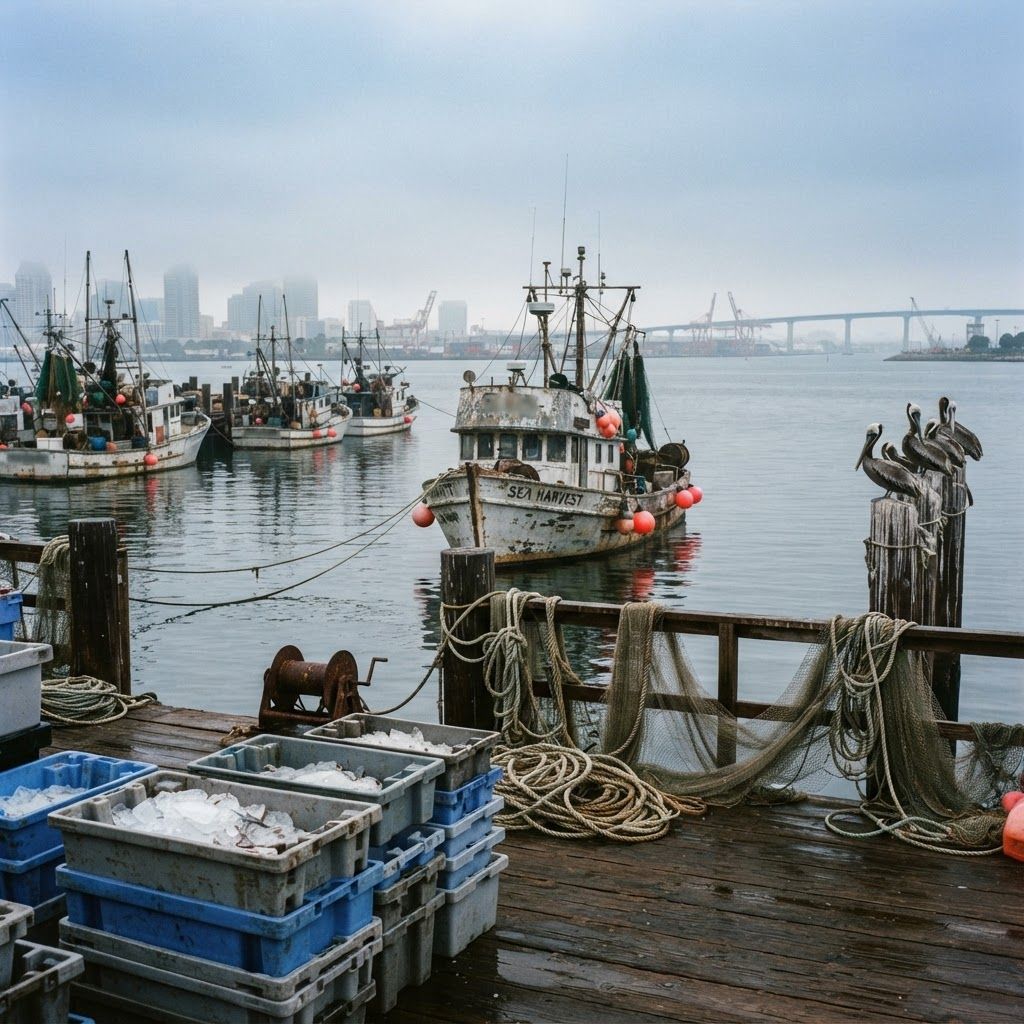
Chula Vista and the Working Waterfront
The Chula Vista bayfront is one of the most consequential stretches of undeveloped waterfront in Southern California, and its relationship with the fishing industry runs deep. San Diego Bay supported commercial fishing operations for generations, and the tuna industry that once made San Diego the tuna capital of the world left behind infrastructure, expertise, and family businesses that still shape the regional seafood trade.
Today the picture is more varied. Wild capture fisheries operate under tight quota management. Aquaculture has emerged as the growth engine. Processing and distribution companies serve both retail and food service markets across the county and into Baja California. And a strong local appetite for fresh seafood, reinforced by the culinary traditions of the region, sustains demand that imported frozen product cannot fully satisfy.
Understanding the Modern Seafood Supply Chain
Seafood moves through more hands than most food categories. Harvesters land the catch. Offloading and primary processing follow, often within hours. Wholesalers and distributors aggregate product and manage cold chain logistics. Retailers and restaurants handle the final sale. At each step, temperature control and documentation determine both quality and legality.
Traceability has become the central competitive issue. Buyers increasingly require documentation of species, harvest method, and origin, both for regulatory compliance and to satisfy customers. Companies that invested early in digital traceability systems now win accounts that competitors cannot access, regardless of price.
1. Commercial Wild Capture Fleets
Local commercial vessels target a mix of species including spiny lobster, sea urchin, rock crab, swordfish, and various rockfish and groundfish. These operations work under strict quota, gear, and seasonal regulation administered through state and federal fishery management. Their product commands premium pricing precisely because of its freshness and local provenance.
2. Offshore Aquaculture Ventures
Offshore finfish aquaculture represents the most significant growth opportunity in the region. Projects proposed and developing in federal waters off Southern California aim to produce species such as California yellowtail and white seabass at commercial scale. Proponents emphasize the water efficiency and low feed conversion of marine finfish compared with land based protein, while regulatory review addresses environmental safeguards.
3. Shellfish and Oyster Growers
Shellfish cultivation has a natural fit with local conditions. Oysters, mussels, and clams filter feed, requiring no supplemental feed input, and actively improve water clarity. Growers in the broader Southern California and Baja California region supply restaurants that market provenance heavily, and demand for named local varieties continues to strengthen.
4. Seafood Processing Companies
Processors convert landed and farmed product into the forms buyers need, handling filleting, portioning, freezing, smoking, and packaging. Facilities serving the Chula Vista area operate under food safety plans and often maintain multiple certifications to serve retail, food service, and export customers. Their yield efficiency and cold chain discipline determine profitability across the entire chain.
5. Wholesale Seafood Distributors
Distributors are the connective tissue of the industry. They aggregate product from multiple sources, maintain refrigerated warehousing, and deliver daily to restaurants, markets, and institutional kitchens. The best of them offer species substitution guidance when supply shifts, which is invaluable to chefs building menus around availability.
6. Sustainable Sourcing and Certification Focused Suppliers
A distinct segment of the industry has built its identity around verified sustainability. These companies work exclusively with fisheries and farms meeting recognized standards, provide full chain of custody documentation, and often publish sourcing details openly. Institutional buyers, including hospitals and universities with sustainability commitments, increasingly source only from this segment.
7. Direct to Consumer and Dock to Door Programs
Community supported fishery programs apply the subscription model to seafood, delivering whatever the boats landed that week directly to members. This structure gives fishermen predictable revenue and better margins while introducing consumers to underutilized species. Local dockside markets in the San Diego area have proven remarkably popular.
8. Bait, Tackle, and Sportfishing Support Businesses
Recreational fishing is economically substantial in its own right. Companies supplying live bait, tackle, charter services, and vessel support serve a large community of anglers working San Diego Bay and offshore waters. This segment also funds a meaningful share of fishery science and habitat work through licensing and excise revenue.
9. Cold Storage and Logistics Providers
Refrigerated warehousing and transport are foundational infrastructure that most consumers never consider. Providers offering blast freezing, frozen and chilled storage, and temperature controlled transport enable both import and export activity. Proximity to the border crossing gives operators here access to binational seafood flows.
10. Research and Hatchery Institutions
Hatcheries and marine research programs supply juvenile fish for both aquaculture and stock enhancement, and they generate the science that fishery management depends on. Institutions in the San Diego region have contributed significantly to breeding programs, disease management, and feed development for marine finfish culture.
Trends Defining the Next Decade
Aquaculture will supply an increasing share of seafood consumption, and Southern California is positioned to participate meaningfully if permitting frameworks mature. Traceability technology, including digital catch documentation, is moving from voluntary to expected. Climate driven shifts in species distribution are already forcing fleets to adapt targets and gear. And consumer willingness to try underutilized species has grown, which helps distribute pressure away from a handful of popular stocks.
Choosing a Seafood Partner
For restaurants and retailers, evaluate suppliers on cold chain integrity, documentation quality, delivery consistency, and honesty about availability. A distributor who tells you a species is not good this week has just earned your trust. In a category where quality degrades by the hour, reliability is not a convenience, it is the entire product.