
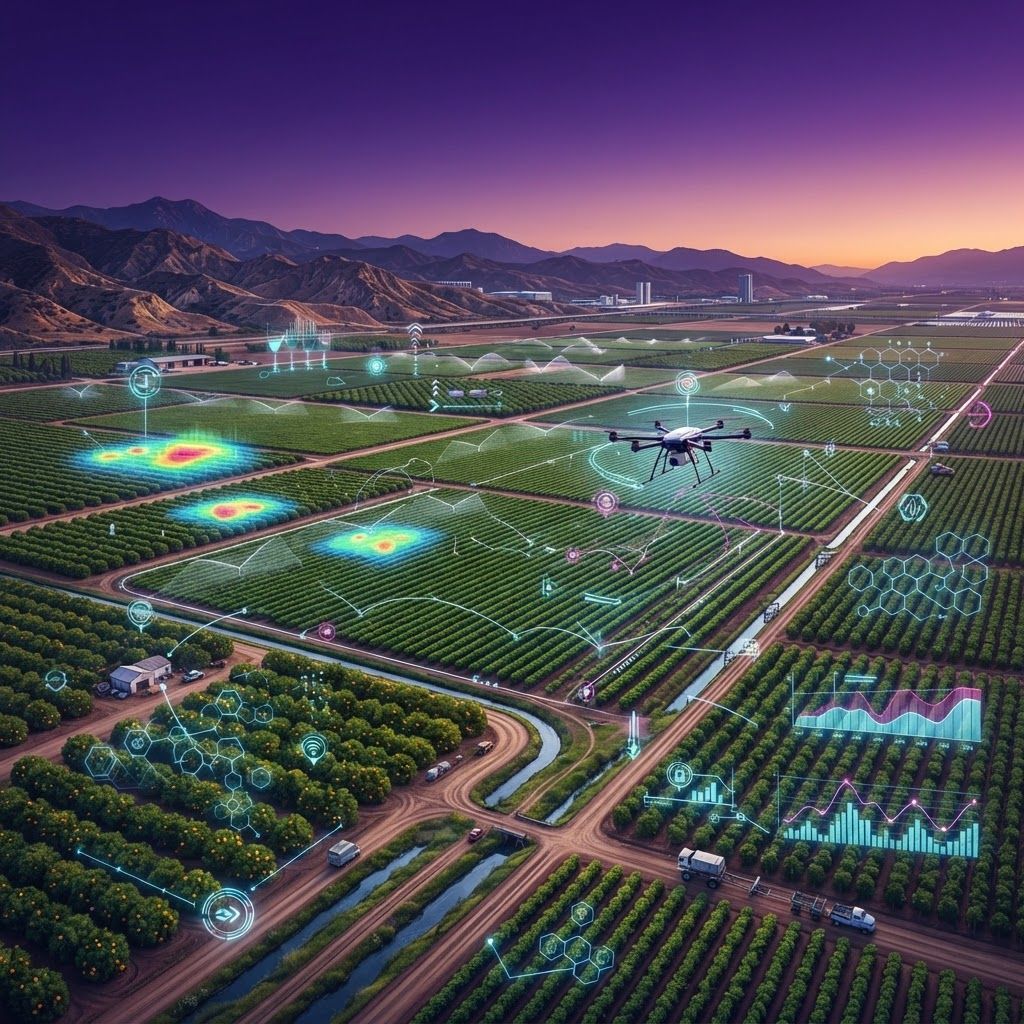
Agriculture in San Bernardino County Today
San Bernardino is often described in terms of warehouses and freeways, but agriculture remains a meaningful part of the county's identity and economy. The region's farming history is inseparable from citrus: navel orange groves planted in the late nineteenth century made the Inland Empire famous, supported by packing houses, rail shipping and an elaborate irrigation infrastructure. Urban growth has since replaced much of that acreage, yet farming did not disappear. It relocated, specialized and modernized.
Today the county's agricultural output comes from several distinct zones. Remaining valley-floor operations grow citrus, avocados, nursery stock and specialty crops on smaller parcels. The high desert around Lucerne Valley, Newberry Springs and Barstow supports alfalfa, hay, pistachios and livestock forage under center-pivot and flood irrigation. Chino Valley, historically one of the densest dairy regions in the United States, retains dairy and forage operations even as land converts to other uses. Increasingly, controlled-environment agriculture — greenhouses, hydroponics and indoor vertical farms — is establishing itself precisely because proximity to Southern California consumers matters more than land quality.
Leading Farming Companies and Operations
1. Sun World International. Sun World is a significant force in California specialty crop agriculture, known for developing and licensing proprietary table grape and stone fruit varieties. Its model is instructive: rather than competing purely on production cost, the company invests in plant breeding and intellectual property, then partners with growers who cultivate its varieties. That approach has shaped how premium fruit reaches Southern California retailers.
2. Limoneira. A long-established California citrus and agribusiness company, Limoneira combines farming with packing, marketing and agricultural real estate. Its diversified structure — lemons, avocados, oranges and specialty citrus, plus water rights and land assets — reflects how successful California growers manage risk in an era of volatile water availability and shifting consumer demand.
3. Wonderful Citrus and affiliated operations. Large integrated growers of citrus, pistachios and almonds have become dominant in California's tree-crop sector. Their relevance to San Bernardino is both direct, through desert nut acreage in the county's eastern reaches, and indirect, in setting the technology and marketing benchmarks that smaller growers must respond to.
4. Chino Valley dairy operations. Family dairies in and around the Chino Valley once formed one of the highest-density milk-producing regions in the country. Those that remain have modernized aggressively, adopting methane digesters, water recycling, nutrient management plans and precision feeding. They are also a major driver of demand for alfalfa and corn silage grown in the county's desert districts.
5. High desert alfalfa and hay producers. Operations in Lucerne Valley, Newberry Springs and the Mojave River basin supply hay to dairies, horse owners and export markets. These growers manage some of the most demanding water economics in the state, and many have invested in laser leveling, drip systems, soil-moisture monitoring and drought-tolerant varieties to maintain viability.
6. Nursery and ornamental growers. The Inland Empire hosts a substantial nursery industry producing landscape trees, shrubs, succulents, bedding plants and turf for the enormous Southern California landscape market. Because plants are perishable and freight-sensitive, proximity to metropolitan buyers is a durable competitive advantage. Many nurseries have also shifted assortments toward drought-tolerant and native species in response to water regulation.
7. Controlled-environment and greenhouse growers. A newer category with real momentum, indoor and greenhouse operations grow leafy greens, herbs, tomatoes, berries and microgreens close to consumption. Their pitch is compelling: dramatically lower water use per unit of output, year-round production, no pesticide runoff and delivery windows measured in hours. Capital intensity and energy cost remain the central challenges.
8. Egg and poultry producers. California egg operations in the region have rebuilt facilities substantially to comply with cage-free and space requirements. The resulting investment in ventilation, automation and biosecurity has made surviving producers considerably more sophisticated than their predecessors.
9. Community-scale and organic direct-market farms. Small farms selling through farmers markets, community-supported agriculture subscriptions and restaurant accounts serve a growing appetite for local produce. Their advantage is relationship and freshness rather than scale, and they frequently pioneer varieties and practices that larger growers later adopt.
10. Urban agriculture and educational farms. Nonprofit and institutional farms attached to schools, universities and community organizations play an outsized role relative to their acreage. They train the next generation of growers, demonstrate water-efficient techniques and improve food access in neighborhoods with limited fresh-produce availability.
Trends and Challenges
Water is the defining issue. Groundwater regulation under California's sustainability framework, competition with municipal demand and recurring drought cycles have forced growers to treat every acre-foot as a strategic asset. The practical consequences include conversion from flood to drip irrigation, adoption of soil-moisture sensing and remote-sensed evapotranspiration data, fallowing of marginal acreage and, in some cases, water transfers becoming more valuable than crop production.
Labor is the second pressing constraint. Rising wages, overtime rules and workforce availability have accelerated mechanization and pushed growers toward crops that can be harvested with machines. Technology adoption follows: drones for crop scouting, satellite imagery for stress detection, automated irrigation control and increasingly capable harvest robotics.
Land pressure is the third. With warehouse and residential development commanding high prices in the Inland Empire, agricultural land faces continuous conversion pressure. This pushes conventional farming outward into the desert while making high-value, low-acreage models such as greenhouses and nurseries relatively more attractive near the urban edge.
What This Means for Buyers and Partners
Businesses sourcing from San Bernardino County agriculture should evaluate growers on water strategy, food-safety certification, harvest scheduling reliability and cold-chain capability. Restaurants and retailers seeking local product will find the strongest options among direct-market farms and greenhouse producers, while volume buyers of forage, citrus or nuts will work with larger established operations. Investors and service providers should note that the fastest-growing opportunities lie in water efficiency technology, controlled-environment infrastructure and post-harvest logistics.
Final Thoughts
Agriculture in San Bernardino County has proven remarkably adaptive. It has survived urbanization, water scarcity and labor transformation by specializing, mechanizing and moving closer to the specific advantages the region offers — climate, market proximity and infrastructure. The companies leading this sector are not simply farming; they are managing water portfolios, breeding proprietary varieties, running data-driven irrigation systems and building direct relationships with consumers. For anyone studying the future of agriculture in an urbanizing, water-constrained landscape, the Inland Empire is one of the most instructive places to look.