
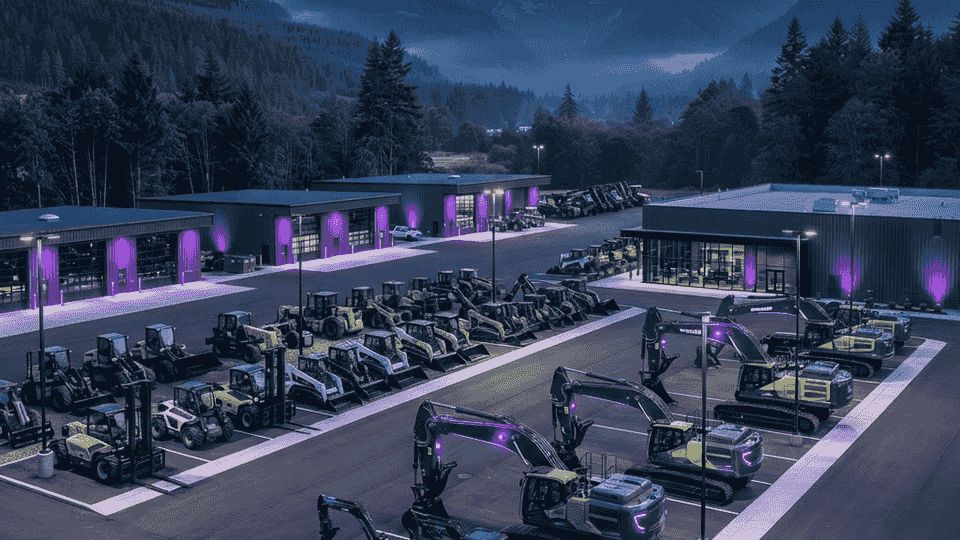
Washington Wholesale and Industry Overview
Construction firms, farms, warehouses, utilities, landscapers, and public agencies across Washington rely on equipment suppliers for far more than machinery. Parts access, field service, operator training, financing, and rental flexibility determine whether an asset produces value over its full life. Conditions vary from congested Seattle jobsites to orchards near Wenatchee and large projects east of the Cascades. These ten distributors offer compelling capabilities for professional equipment buyers.
Washington contractors are adopting compact machines, grade-control systems, telematics, electric warehouse equipment, and lower-emission powertrains. Labor constraints make attachments and automation increasingly valuable. Buyers are also using rentals and certified used equipment to preserve capital while matching machines to project duration.
1. Papé Machinery
Papé Machinery has deep Pacific Northwest roots and serves construction, forestry, agriculture, material-handling, and other equipment markets through specialized divisions. Its regional branch structure supports sales, rentals, parts, and service. Washington operators value a supplier familiar with local terrain, industries, and seasonal demands.
2. Modern Machinery
Modern Machinery is a longstanding heavy-equipment distributor serving the Pacific Northwest. The company supports construction, mining, aggregate, forestry, and material-handling customers with machinery, parts, rentals, and service. Technical field support is a major consideration for remote or high-utilization fleets.
3. N C Machinery
N C Machinery represents Caterpillar equipment in western and central Washington and provides machines, power systems, rentals, parts, and service. The breadth supports earthmoving, paving, marine, industrial, and power applications. Fleet technology and rebuild capabilities can extend asset life for larger operators.
4. Western States Equipment
Western States Equipment serves Caterpillar customers in eastern Washington and neighboring regions. Its construction and power-system capabilities are relevant to contractors, municipalities, and resource industries. Local parts and field-service capacity can be decisive where jobsites are far from major cities.
5. Sonsray Machinery
Sonsray Machinery distributes construction equipment and supports customers with sales, rentals, parts, and service. Its product mix is useful for earthmoving, roadwork, utilities, and site development. Buyers should compare attachment availability and mobile-service coverage for their operating area.
6. Sunbelt Rentals
Sunbelt Rentals provides a broad rental fleet spanning aerial, earthmoving, material handling, power, climate control, trench safety, and specialty categories. Washington businesses can scale equipment to project demand without taking on full ownership. Delivery coordination and application expertise are important advantages for complex jobs.
7. United Rentals
United Rentals supports contractors and industrial customers with general and specialty equipment rental. Its range includes access, earthmoving, power, fluid solutions, trench safety, and temporary infrastructure. Multi-location account management can benefit companies working across several Washington markets.
8. Star Rentals
Star Rentals is a Pacific Northwest equipment rental company with strong Washington familiarity. It offers construction equipment, tools, safety products, and service for contractors and industrial users. Local relationships and practical jobsite knowledge make it a notable regional option.
9. Toyota Material Handling
Toyota Material Handling dealers supply forklifts, warehouse equipment, automation, parts, and service. Distribution centers around Kent, Tacoma, and the Interstate 5 corridor may benefit from fleet analysis and planned maintenance. Battery, charging, ergonomics, and uptime should be evaluated together.
10. Raymond West
Raymond West provides material-handling equipment, warehouse systems, automation, racking, telematics, and support. The systems approach is useful for Washington operations redesigning storage and order flow rather than simply replacing forklifts. Consulting and integration capabilities distinguish it from basic equipment sales.
Industry Trends to Watch
Telematics now helps managers track utilization, idle time, maintenance, and operator behavior. Electrification is expanding first in warehouses and compact applications, although charging infrastructure and duty cycles require careful study. Safety technology, machine control, and remote diagnostics can improve productivity, but only when teams receive proper training and data is actively reviewed.
How to Choose the Right Washington Partner
Define the application, material, capacity, terrain, hours, transport limits, and required attachments before requesting quotes. Compare total ownership cost, including fuel or charging, preventive maintenance, wear items, insurance, depreciation, and resale. Ask for service response metrics and parts availability by branch. A distributor with strong lifecycle support will often create more value than the lowest initial bid.
Practical Evaluation Checklist
Before committing, ask two or three shortlisted providers to quote the same representative order so comparisons remain fair. Record product cost, freight, minimum quantities, estimated arrival, payment terms, warranty coverage, and return conditions in one worksheet. Check references from businesses of a similar size and confirm who will handle routine questions or urgent exceptions. Review samples, specification sheets, invoices, and packaging for consistency. Finally, establish measurable expectations for fill rate, quality, response time, and delivery, then review actual performance after the first several orders. This disciplined process turns an appealing catalog into an evidence-based sourcing decision.
Final Perspective
Washington buyers should treat this list as a research starting point rather than a universal ranking. Availability, account eligibility, territories, product lines, and service levels can change. Build a written scorecard, verify current terms directly with each business, and begin with a measured order or pilot program. The strongest long-term relationship will align dependable quality and responsive service with the specific needs of your customers, team, location, and growth plan.