
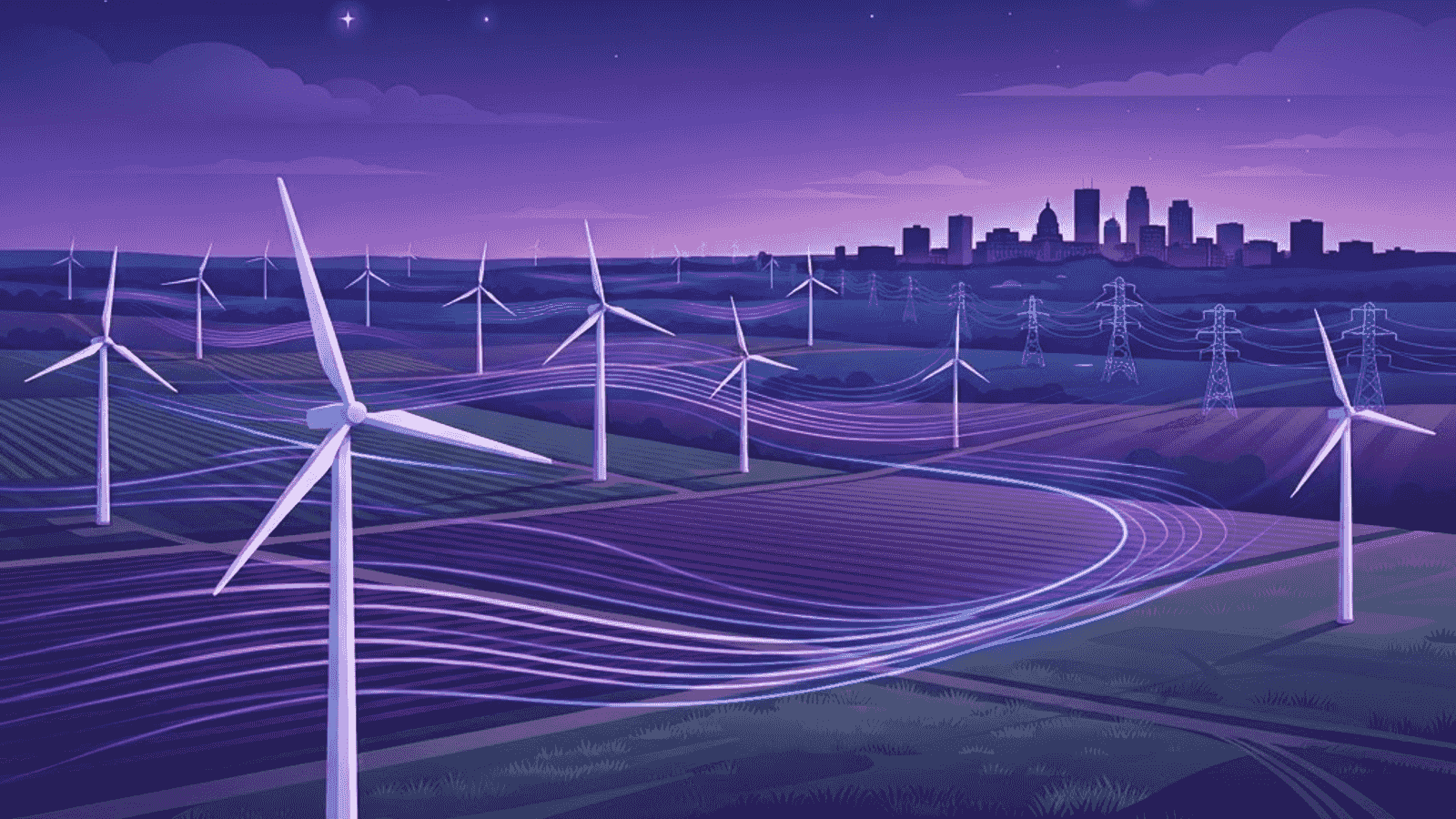
Wind generation has fundamentally changed Minnesota's electricity mix. The state ranks among the national leaders in wind's share of total generation, driven by excellent resource quality along the Buffalo Ridge in the southwest and across the western prairie. While turbines themselves are located in rural counties, much of the industry's commercial, regulatory and financial activity runs through the Twin Cities, and St. Paul in particular because state energy regulation is administered there.
How Wind Energy Works in Minnesota
The state's wind sector operates through several models. Utility owned wind farms are developed and operated directly by electric utilities as part of their generation portfolio. Independent power producers develop projects and sell output under long term power purchase agreements. Community wind projects, a model Minnesota helped pioneer, involve local ownership by farmers, cooperatives or investor groups. Distributed wind serves individual farms and businesses at smaller scale.
Regulatory oversight is concentrated in St. Paul. The Minnesota Public Utilities Commission reviews resource plans, issues site permits for large wind energy conversion systems and approves power purchase arrangements. The Department of Commerce provides analysis and energy program administration. Developers, utilities, cooperatives and advocacy organizations all maintain a presence in the capital city because of this concentration.
Transmission is the sector's central constraint. Wind resource is strongest where population is sparse, so moving power to demand centers requires substantial transmission investment. Regional planning through the Midcontinent Independent System Operator determines which projects can interconnect and when.
The Top 10 Wind Energy Organizations Connected to St. Paul
1. Xcel Energy
The largest wind energy provider serving Minnesota customers, Xcel has procured and developed extensive wind capacity and consistently ranks among the top utility wind owners nationally.
2. Great River Energy
A generation and transmission cooperative supplying member cooperatives across Minnesota, with substantial wind contracts and investment in long duration storage to complement variable generation.
3. Minnesota Power and Allete Clean Energy
The clean energy arm of Allete develops, owns and operates wind facilities across multiple states, with Minnesota roots and significant wind generation in its portfolio.
4. Invenergy
A major independent developer with wind projects in Minnesota, handling development, financing, construction and long term operation of utility scale facilities.
5. NextEra Energy Resources
One of the largest wind operators in North America with Minnesota assets, providing scale in development capability and power marketing.
6. Juhl Energy
A Minnesota company that helped establish the community wind model, developing locally owned projects and providing operations and maintenance services to wind facilities.
7. National Renewable Solutions and Comparable Minnesota Developers
Minnesota based developers focus on identifying sites, securing landowner agreements, obtaining permits and bringing projects to construction ready status.
8. Minnesota Public Utilities Commission and Department of Commerce
Based in St. Paul, these bodies shape the wind sector directly through resource plan approval, site permitting, environmental review and program administration.
9. Clean Grid Alliance
A St. Paul headquartered advocacy organization working to advance wind, solar and storage development in the Midwest through policy engagement and transmission advocacy.
10. Minnesota Rural Electric Association and Member Cooperatives
Cooperatives across the state purchase and in some cases own wind generation, and their collective procurement decisions significantly influence Minnesota's renewable capacity.
Trends in Wind Energy
Repowering has become a major activity. Many Minnesota wind farms built in the early expansion period are now being upgraded with longer blades, taller towers and modern nacelles, substantially increasing output from existing sites without new land use.
Turbine scale continues to increase. Modern units generate several times the output of early machines, improving capacity factors and reducing cost per megawatt hour, though transportation and crane logistics grow more challenging.
Hybrid projects pairing wind with solar and battery storage are increasingly favored because they use shared interconnection capacity more efficiently and produce a smoother output profile.
Interconnection queue reform and transmission expansion have become the sector's dominant policy priorities, since generation can be built faster than the grid can accommodate it.
Landowner and community engagement practices have matured as well, with more attention to setbacks, sound modeling, wildlife impacts, decommissioning bonds and local tax revenue arrangements.
Considerations for Businesses and Communities
For large energy consumers, wind participation typically occurs through renewable energy purchase programs offered by utilities, virtual power purchase agreements or renewable energy certificates rather than direct ownership. Each has different accounting, risk and additionality implications worth analyzing carefully.
For rural landowners, lease terms deserve close legal review, including compensation structure, term length, setbacks from structures, road and drainage restoration, decommissioning security and assignment rights.
For municipalities and cooperatives, the key questions are resource adequacy, cost stability and how variable generation is balanced with firm capacity and storage.
For distributed scale projects, the economics depend heavily on site specific wind resource at hub height, which requires measurement rather than regional averages. Small wind is far more site sensitive than solar.
Understanding Wind Project Development
Wind projects progress through a lengthy development sequence that helps explain their timelines. Site prospecting evaluates wind resource using meteorological data and measurement campaigns, since hub height conditions differ meaningfully from surface readings. Land acquisition follows, involving easements or leases across multiple parcels and often dozens of landowners.
Interconnection application then places the project in a regional queue where studies determine what network upgrades are required and who pays for them. This stage now frequently governs overall schedule.
Permitting proceeds concurrently, including state site permitting, environmental review addressing wildlife and water resources, county and township approvals, and consultation obligations. Power purchase negotiation or utility resource plan approval secures revenue certainty.
Only after these stages resolve does construction begin, followed by commissioning and long term operations and maintenance. Understanding this sequence clarifies why announced projects often take several years to deliver electricity.
Final Thoughts
Wind is the backbone of Minnesota's renewable electricity supply, and St. Paul functions as the sector's regulatory and policy center even though generation occurs hundreds of miles away. As the state pursues its carbon free electricity standard, the constraint has shifted from resource availability or turbine technology to transmission capacity and interconnection timelines. Organizations engaging with wind energy should focus their diligence there.