
The Automotive City That Builds No Cars
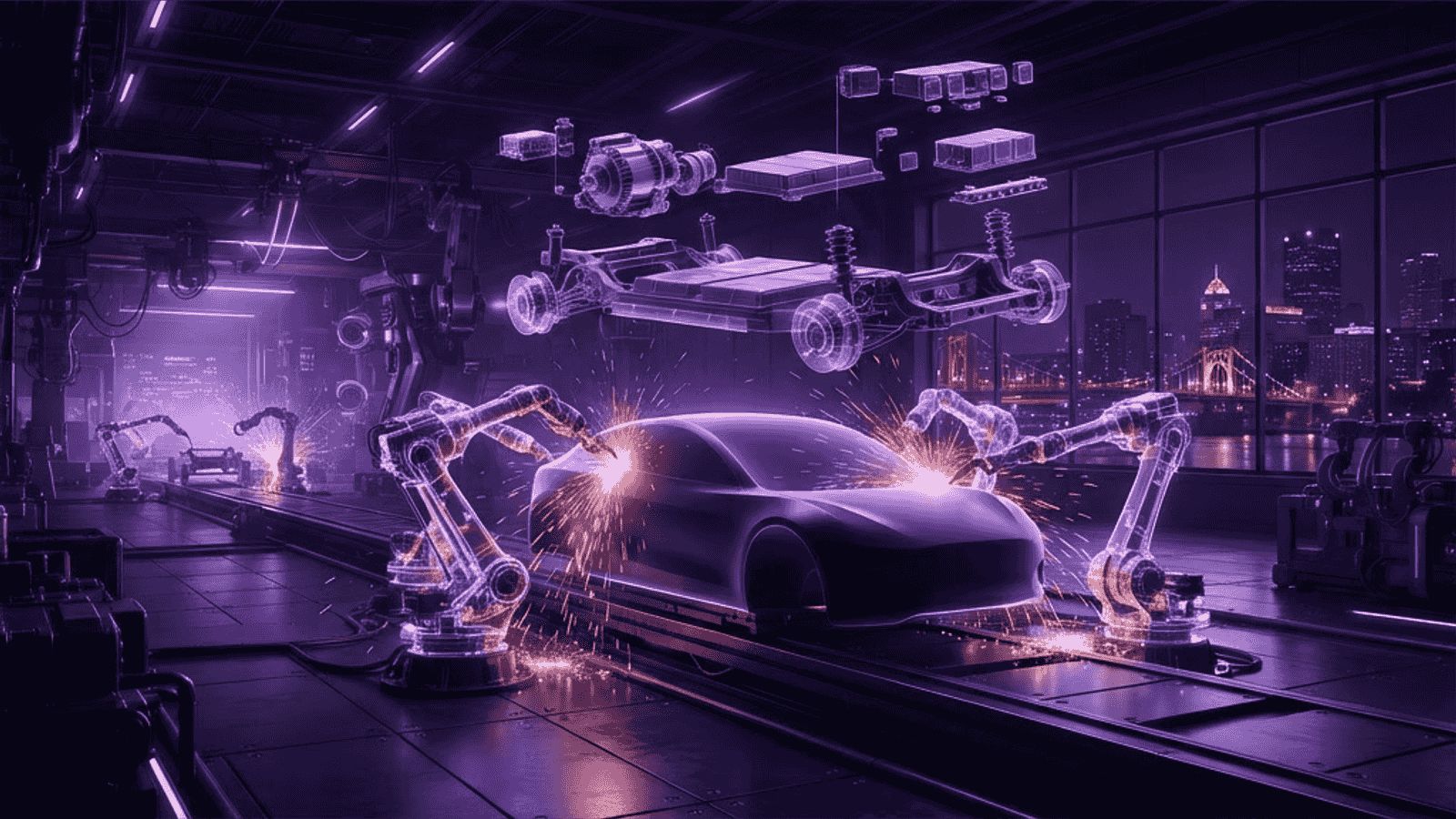
There is no final assembly plant in Allegheny County. No sedan rolls off a Pittsburgh line the way one does in Detroit or Spring Hill. And yet in the past decade Pittsburgh has become one of the places where the future of the automobile is actually determined. The reason is that the industry's center of gravity has shifted from stamping and assembly toward software, sensing, materials, and electrification, and Pittsburgh happens to be exceptionally strong in exactly those areas.
The catalyst was Carnegie Mellon's robotics program, which produced the teams that won early autonomous vehicle challenges and then seeded a cluster of self-driving companies in the Strip District and Lawrenceville. Around that cluster grew a supporting ecosystem: sensor developers, simulation companies, mapping firms, and test operations. Layered beneath it sits an older and quieter automotive presence, the metal formers, forgers, coating specialists, and component makers descended from the region's steel economy who supply tier-one and tier-two parts to assembly plants elsewhere.
Ten Companies Shaping Automotive Work in Pittsburgh
1. Aurora Innovation — With major Pittsburgh operations, Aurora develops autonomous driving systems focused on commercial trucking. Their work spans perception software, custom lidar, vehicle integration, and the safety case methodology that regulators and carriers require.
2. Argo AI Alumni Network and Successor Ventures — Argo's Pittsburgh operation trained hundreds of autonomy engineers, and the companies formed by that talent after its wind-down continue to anchor local automotive software work in perception, planning, and simulation.
3. Motional — Maintains Pittsburgh engineering operations working on driverless technology for ride-hailing applications, drawing on the region's robotics labor pool for machine learning and vehicle systems roles.
4. Stack AV — A Pittsburgh autonomous trucking company founded by veterans of the region's self-driving industry, developing full-stack autonomy for freight with an emphasis on partnership with established carriers and manufacturers.
5. Alcoa and Howmet Aerospace — With deep Pittsburgh roots, these companies produce aluminum products and precision forged components, including wheels and structural parts. Lightweighting is central to electric vehicle range, which has made aluminum expertise more valuable, not less.
6. PPG Industries — Headquartered in Pittsburgh, PPG is one of the world's leading suppliers of automotive coatings, including basecoats, clearcoats, and the electrocoat primers that prevent corrosion. Nearly every major automaker uses PPG chemistry somewhere in its paint shop.
7. Wabtec Corporation — Primarily rail, but Wabtec's work on heavy-duty braking, electric drive systems, and battery-electric locomotives develops competencies that overlap substantially with commercial vehicle electrification.
8. Kennametal — Produces cutting tools and tooling systems used throughout automotive machining, from engine block boring to transmission gear cutting. Tooling determines cycle time and tolerance on the plant floor.
9. Universal Stainless and Alloy Products — A western Pennsylvania specialty steel producer supplying alloys used in powertrain, fastener, and high-stress automotive applications where standard carbon steel is inadequate.
10. Regional Metal Forming and Stamping Suppliers — A cluster of southwestern Pennsylvania stampers, forgers, and machining shops supply brackets, structural components, and assemblies to automotive tier-one customers, forming the unglamorous foundation of the region's automotive economy.
The Forces Reshaping the Industry Locally
Electrification has changed which suppliers matter. An electric vehicle needs fewer machined engine parts and far more thermal management, high-voltage connection, battery enclosure, and lightweight structural work. Pittsburgh's aluminum, specialty alloy, and coatings companies sit on the winning side of that transition, while shops dependent on internal combustion machining face a harder adjustment.
Autonomy has settled into a more sober phase. The initial expectation of rapid consumer robotaxi deployment gave way to focused commercial applications: long-haul trucking on fixed routes, yard operations, and geofenced ride services. Pittsburgh companies have concentrated on validation, safety argumentation, and operational design domains rather than demonstrations.
Software-defined vehicle architecture is pulling automotive work toward capabilities Pittsburgh has in abundance. As cars consolidate dozens of separate controllers into a few high-performance computers running updatable software, automakers need embedded systems engineers, cybersecurity specialists, and simulation infrastructure. That is a regional strength.
Simulation and testing have become products in themselves. Proving a driving system safe requires billions of virtual miles, and the tooling to generate, run, and analyze those scenarios is a growing local business.
How to Engage With the Regional Automotive Sector
For manufacturers seeking suppliers, verify quality system certification appropriate to automotive work, and ask about production part approval processes and statistical capability data. Automotive customers demand documented process capability, not just acceptable samples.
Ask about capacity and tooling ownership. Understand who owns the dies or fixtures, since that determines your options if the relationship ends.
For companies evaluating autonomy or software partners, ask how safety is argued rather than how impressive the demonstration is. Mature organizations discuss operational design domains, failure mode analysis, and independent validation.
For engineers considering the market, note that Pittsburgh automotive employment is concentrated in perception, controls, embedded software, materials science, and simulation rather than traditional plant roles. The career path here looks more like technology than manufacturing.
Conclusion
Pittsburgh's automotive relevance rests on a genuine insight: as vehicles become computers with wheels, wrapped in advanced materials and coated in specialty chemistry, the places that matter are the places with software talent, materials expertise, and industrial discipline. Pittsburgh has all three. No cars are assembled here, and the region still shapes what gets assembled elsewhere.