
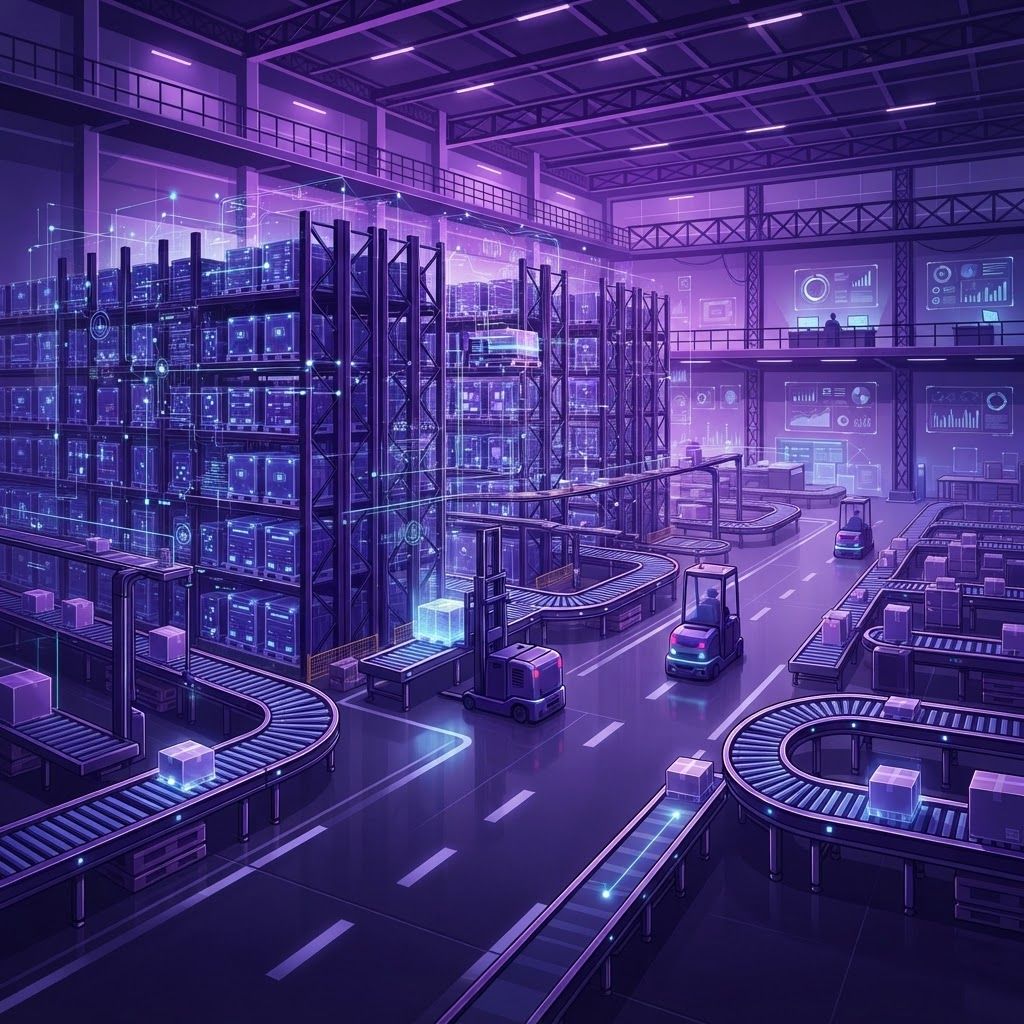
Why Warehousing Boomed in Laredo
For decades Laredo was primarily a place freight passed through. That has changed fundamentally. As manufacturers shifted production from Asia to Mexico, they needed places to stage inventory, consolidate shipments, hold safety stock, and perform final processing before goods entered the American market. Laredo, sitting precisely at the point where Mexican production meets American distribution, became the logical location.
The result has been sustained industrial development, with millions of square feet of warehouse space built around the bridge corridors and along the highway approaches. For companies evaluating the market, the important thing is understanding that warehouses here are not interchangeable. Bonded status, foreign trade zone designation, cross-dock configuration, temperature control, and security certification all define what a facility can actually do for you.
1. Prologis
Prologis is among the largest industrial real estate owners globally and has a meaningful presence in border logistics markets. Its facilities are typically modern, well specified, and located strategically relative to crossings and highways. For companies leasing their own space rather than buying third-party services, developers in this tier offer the building quality and expansion flexibility that growing operations require.
2. DHL Supply Chain
DHL's contract logistics operation provides managed warehousing rather than empty space, handling receiving, putaway, inventory management, picking, packing, labeling, kitting, and outbound shipping under performance agreements. For companies that want inventory managed rather than a building to staff themselves, this model transfers operational risk to a specialist with established systems.
3. Ryder Supply Chain Solutions
Ryder combines warehousing with dedicated transportation, which creates useful integration for shippers whose inbound and outbound flows need coordination. Its facilities support value-added services and its transportation arm handles both drayage from the border and outbound distribution. Single-provider accountability across storage and movement reduces the finger-pointing that occurs when problems span vendors.
4. Bonded Warehouse Operators
Bonded warehouses allow imported goods to be stored without immediate payment of duties, which are deferred until the goods enter commerce or avoided entirely if re-exported. In a border city where a significant share of inventory is destined for markets on either side, this cash flow benefit is substantial. Bonded operators must meet strict customs supervision requirements, and the discipline that entails generally makes them well-run facilities.
5. Foreign Trade Zone Facility Operators
Foreign trade zone designation goes further, permitting storage, manipulation, assembly, and manufacturing under customs supervision with significant duty and tax advantages. Goods can be processed, repackaged, or combined before formal entry, and duty may be assessed on the finished product classification rather than components. For manufacturers and importers with meaningful duty exposure, an operator with zone status can produce savings that dwarf the storage cost difference.
6. Cross-Dock and Transloading Facilities
Cross-dock operations move freight from inbound to outbound vehicles with minimal or no storage, which is the dominant model for border trailer interchange. Facilities in this category compete on dock door count, yard capacity, staging space, and turn speed. Because trailer transfer is intrinsic to cross-border trucking, Laredo has an unusually large concentration of high-quality cross-dock capacity.
7. Temperature-Controlled and Cold Storage Providers
Refrigerated and frozen storage serves produce, food products, pharmaceuticals, and other temperature-sensitive goods moving through the border. Cold storage is capital intensive and specialized, requiring redundant refrigeration, temperature monitoring and recording, and food safety compliance programs. Providers in this segment should be able to demonstrate documented temperature integrity and relevant certifications.
8. Public Warehousing and Third-Party Logistics Providers
Public warehouses rent space and services by the pallet or square foot on flexible terms, without requiring a long lease commitment. This suits seasonal inventory, market testing, overflow capacity, and small to mid-sized companies whose volumes cannot justify dedicated space. Many combine storage with fulfillment services, shipping direct to customers or retailers on the client's behalf.
9. Contract and Dedicated Warehouse Operators
At larger volumes, dedicated facilities operated exclusively for one client become economical. Dedicated arrangements allow processes, layout, technology, and staffing to be designed around specific requirements rather than compromising across multiple tenants. Contracts typically run multiple years with defined performance metrics, and the model suits stable high-volume operations such as automotive supply and large-scale retail distribution.
10. Yard Management and Trailer Storage Operators
A distinctively border-specific service, trailer yards provide secure parking and staging for equipment awaiting crossing, customs release, or onward dispatch. Yard capacity in Laredo is a genuine constraint during peak periods, and operators offering managed yard services with gate control, trailer tracking, and switching capability solve a real problem for carriers and shippers alike.
How to Evaluate a Warehouse
Start with the physical building. Clear height determines how much racking can be installed and therefore effective capacity per square foot. Dock door count and configuration determine throughput. Column spacing affects racking layout efficiency. Floor condition matters for equipment and safety. Yard and truck court dimensions determine whether trailers can maneuver during busy periods. Then examine location relative to the specific bridge you use, since crossing choice affects transit and dwell substantially.
Next assess operations. Ask about inventory accuracy rates, order accuracy, on-time shipping performance, and how these are measured and reported. Review the warehouse management system and whether it can integrate with your systems through electronic data interchange or application programming interfaces. Inquire about labor stability, since turnover directly affects accuracy and productivity. Verify insurance coverage and understand liability limits for stored goods.
Security and Compliance
Border warehousing carries elevated security expectations. Look for controlled access, perimeter fencing, camera coverage with retention, alarm monitoring, and documented visitor procedures. Participation in voluntary trade security partnership programs signals that the operator has implemented audited supply chain security practices, which also accelerates customs processing for freight moving through the facility. For high-value goods, ask specifically about segregated secure storage areas.
Cost Structure
Warehousing costs come in layers. Storage is charged per pallet position, per square foot, or per cubic foot, often with monthly minimums. Handling charges apply to receiving and shipping. Value-added services such as labeling, kitting, and repackaging are priced per unit or per hour. Accessorial charges cover special handling, inventory counts, and after-hours work. Long-term leases shift cost from operating expense to fixed commitment. Comparing providers requires modeling your actual activity profile rather than looking at storage rates alone, because handling charges frequently exceed storage costs for fast-moving inventory.
Trends Shaping the Market
Nearshoring continues driving demand, and industrial development around Laredo has expanded accordingly, though quality space in prime locations remains competitive. Automation is advancing steadily, with warehouse execution software, pick-to-light systems, and increasingly robotics improving accuracy and reducing labor dependence. Sustainability features including efficient lighting, solar installations, and water management are becoming standard in new construction. Data integration is the most consequential trend, as shippers increasingly expect unified visibility spanning inventory, transportation, and customs status across two countries.
Final Thoughts
Warehousing in Laredo has matured from simple storage into a sophisticated set of services built around the specific advantages of the border location. Choose bonded or foreign trade zone facilities if duty deferral matters, cross-dock operators for pure transfer volume, contract logistics for managed inventory, public warehousing for flexibility, and temperature-controlled specialists for sensitive goods. Evaluate on building specification, measured operational performance, systems integration, and security certification, and the border becomes a genuine supply chain asset.