
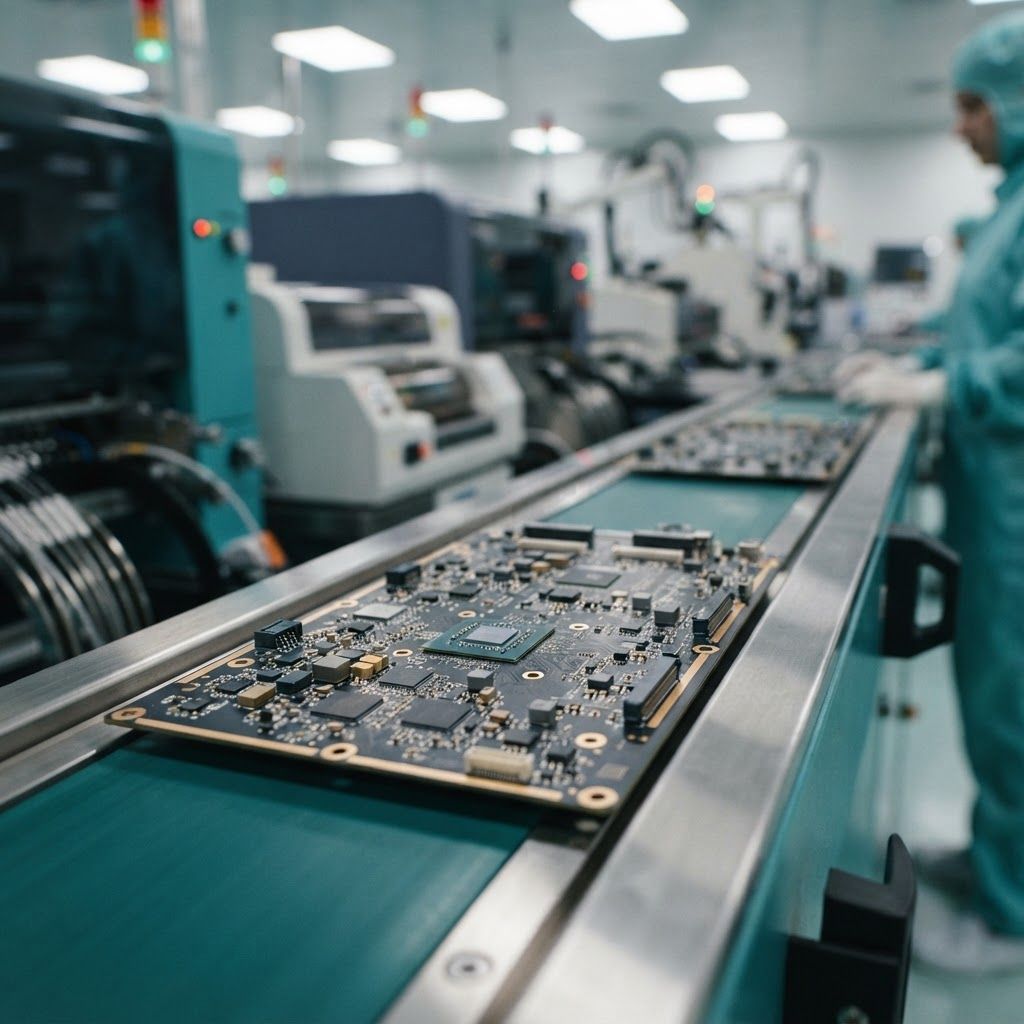
Electronics Manufacturing in the Dallas-Fort Worth Corridor
North Texas has quietly become one of the most important electronics regions in the United States. Decades of semiconductor investment, telecommunications engineering, and defense electronics created a workforce fluent in circuit design, radio frequency engineering, and high-reliability manufacturing. Frisco sits in the middle of that corridor, close to fabrication facilities, contract assemblers, test laboratories, and the logistics infrastructure needed to move components globally.
Local demand comes from several directions. Hardware startups need low-volume prototype assembly. Industrial and energy companies need ruggedized controllers and sensors. Medical device firms need documented, regulated production. Consumer product companies need cost-optimized high-volume assembly. Each requires a different type of manufacturing partner.
Ten Electronics Manufacturers and Assembly Partners
Texas Instruments anchors the regional semiconductor ecosystem with analog and embedded processing products and substantial North Texas fabrication capacity.
Benchmark Electronics provides engineering services and contract manufacturing across medical, industrial, and aerospace markets with design-for-manufacturability support.
Sanmina offers printed circuit board assembly, complex system integration, and testing for high-reliability applications requiring rigorous process control.
Circuit Technology serves regional customers with quick-turn assembly, ideal for prototype iterations and pilot production runs.
Advanced Circuits supplies fabricated printed circuit boards with fast lead times widely used by engineering teams validating designs.
SMT Corp of Texas handles surface mount assembly for mid-volume production with automated optical inspection and functional testing.
Elite Electronic Engineering-style test laboratories in the region provide electromagnetic compatibility and environmental qualification testing required before product release.
Flex operates design and manufacturing services spanning industrial, automotive, and health markets, useful for products scaling into global distribution.
Jabil supports engineering, supply chain, and manufacturing programs for companies moving from pilot builds toward mass production.
Dallas Electronics Assembly completes the list with box build, cable harness, and enclosure integration services for industrial customers.
Preparing a Design for Manufacturing
The transition from working prototype to manufacturable product breaks more hardware projects than any technical failure. A production-ready package includes complete schematics, gerber files, a fully specified bill of materials with approved alternates, assembly drawings, test procedures, and firmware programming instructions.
Component selection deserves early attention. Choosing parts with multiple sources and long expected availability prevents redesign when a single supplier discontinues a device. Engineers should also verify that footprints match physical packages exactly, since a single mismatched land pattern can scrap an entire panel.
Design for testability is equally important. Adding test points, boundary scan access, and a defined functional test sequence allows the assembler to catch defects rather than shipping them downstream. Without a test plan, yield problems surface at the customer.
Industry Trends
Supply chain resilience has replaced pure cost minimization as the dominant strategy. Companies now qualify multiple assemblers, hold strategic buffer inventory for long-lead semiconductors, and design with substitution flexibility. Domestic capacity investment has expanded significantly, improving lead times for North Texas customers.
Miniaturization and integration continue. Higher density interconnect, fine-pitch components, and system-in-package approaches demand more advanced assembly equipment and inspection capability. Meanwhile, connected devices have made security a manufacturing concern, with secure provisioning of keys and firmware happening on the production line rather than in the field.
Automation and analytics have improved quality. Automated optical inspection, X-ray inspection for hidden joints, and statistical process control on solder paste deposition have reduced defect rates substantially compared with a decade ago.
Evaluating a Manufacturing Partner
Match capability to volume. A quick-turn prototype shop excels at five boards in three days but is not structured for fifty thousand units. Conversely, a large global manufacturer may not prioritize a small pilot program. Being realistic about volume prevents mismatched relationships.
Ask about certifications relevant to the application, quality management systems, and workmanship standards followed for solder joints and cleanliness. For regulated products, confirm documentation practices, traceability by lot, and change control procedures.
Review communication structure. Assign a single technical contact on each side, define how engineering change orders are processed, and agree on how deviations are reported and approved during a build rather than after.
Cost Drivers in Electronics Assembly
Component cost usually dominates, followed by panel utilization, number of unique part numbers, placement count, hand-assembly operations, and test time. Reducing unique part numbers by standardizing passive values across a design lowers both procurement complexity and setup cost. Eliminating through-hole components where surface mount alternatives exist removes manual labor.
Practical Advice for Hardware Startups
Build in stages and expect at least two or three design iterations before production. Budget for tooling, test fixtures, and certification testing, which are frequently omitted from early financial models. Order components for pilot builds early, since lead times on controllers and power devices can extend for months. Finally, document everything; institutional memory held in one engineer's head becomes a serious liability at scale.
Final Thoughts
Frisco benefits from proximity to one of the strongest electronics ecosystems in the country, spanning semiconductor manufacturing, contract assembly, and specialized testing. Companies that succeed here invest in design for manufacturability early, qualify more than one supply option, and choose partners whose volume profile genuinely matches their own rather than the most impressive name available.