
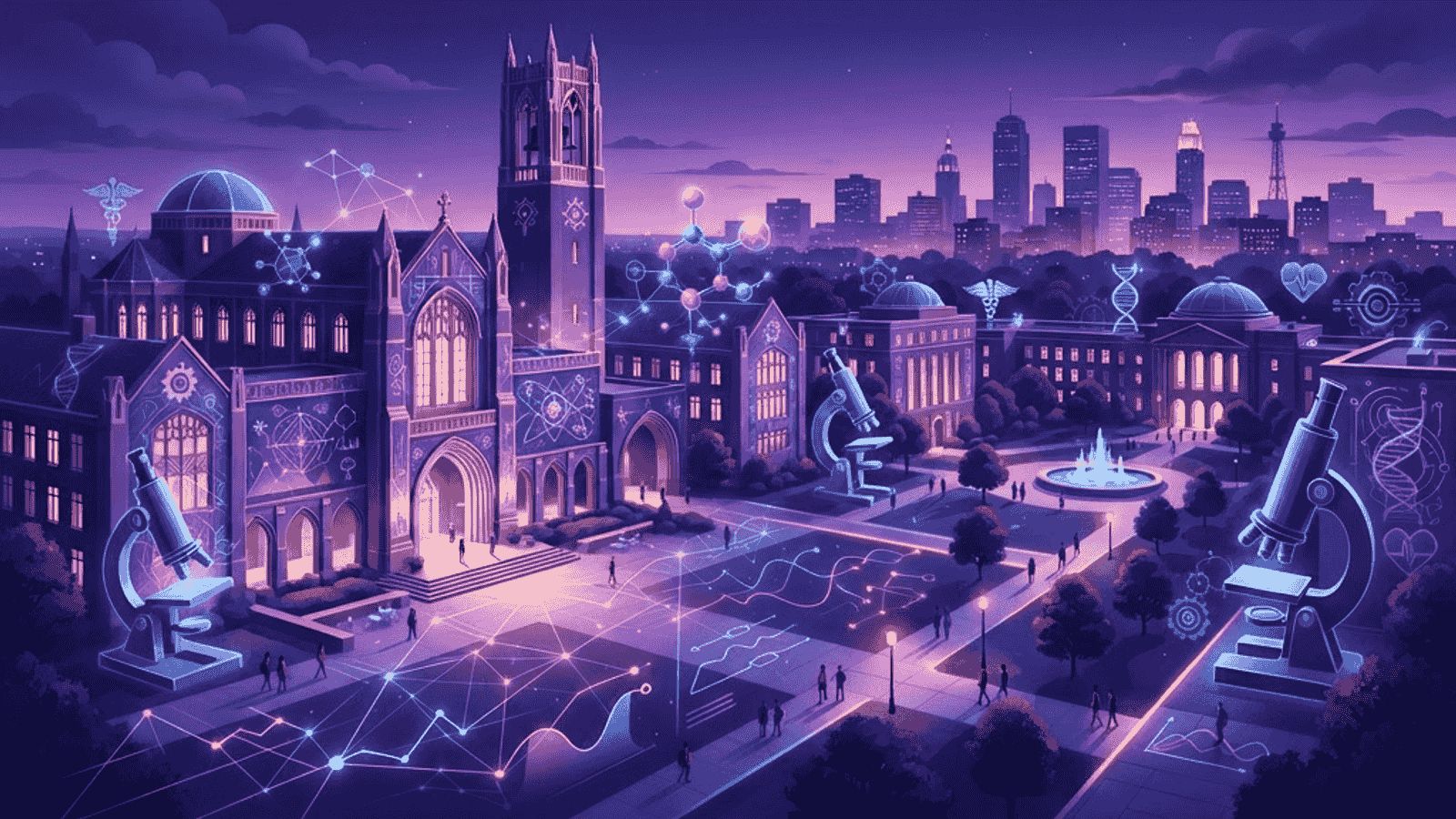
A Research Cluster in the Heart of the City
Newark's university district is unusual in American urban geography. Within walking distance you will find a comprehensive public research campus, a polytechnic university, a medical school, a dental school, a law school, and a public health school. Together they form one of the largest concentrations of higher education and biomedical research in New Jersey, employing thousands and generating substantial federal research funding.
For students, the practical implication is access. Graduate researchers collaborate across institutions, professional students rotate through nearby hospitals and courthouses, and undergraduates find internships in insurance, banking, healthcare, and technology firms located downtown. The institutions below were evaluated on research output, graduate and professional program strength, faculty distinction, facilities, and graduate career placement within the regional economy.
How This List Was Evaluated
Assessment focused on doctoral and professional program depth, research expenditures and grant activity, specialized centers and institutes, clinical or practicum infrastructure, accreditation and licensure pass rates where applicable, and the strength of alumni networks in the New York and New Jersey metropolitan employment market.
1. Rutgers University-Newark
Rutgers University-Newark is the intellectual anchor of the city. As one of three regional campuses of Rutgers, The State University of New Jersey, it offers doctoral programs, professional schools, and nationally recognized research centers. Its School of Criminal Justice is among the most respected in the field, the School of Public Affairs and Administration is a leader in urban governance research, and the campus is repeatedly cited for exceptional student diversity. Institutes studying immigration, ethnicity, and urban policy give scholars direct access to Newark as a living research environment.
2. New Jersey Institute of Technology
NJIT operates as New Jersey's public polytechnic university, granting doctorates in engineering, computer science, applied physics, and management. It hosts major research centers in areas including solar-terrestrial physics, big data, and resilient infrastructure, and its architecture and design college is the state's only accredited program of its kind. Strong industry sponsorship, a well-developed cooperative education pipeline, and consistently high graduate salary outcomes define its reputation.
3. Rutgers Biomedical and Health Sciences
Rutgers Biomedical and Health Sciences coordinates the university's health science enterprise, with a substantial Newark footprint. It brings medical, dental, nursing, public health, and biomedical research units under a single academic structure, enabling interdisciplinary work on cancer, infectious disease, neuroscience, and health disparities. For graduate students, the scale of shared core facilities and clinical data is a significant advantage.
4. Rutgers New Jersey Medical School
Rutgers New Jersey Medical School trains physicians in a high-acuity urban setting, with affiliations that expose students to trauma surgery, transplant medicine, and complex chronic disease management. Its research portfolio spans tuberculosis and emerging infections, cardiovascular science, and neurology. Residency programs across specialties make it a major driver of physician supply for northern New Jersey.
5. Rutgers School of Dental Medicine
As New Jersey's only dental school, Rutgers School of Dental Medicine combines predoctoral education with specialty residencies in orthodontics, periodontics, endodontics, oral surgery, and pediatric dentistry. Its Newark clinics deliver a large volume of community care, giving students unusually broad clinical experience while addressing genuine local access needs.
6. Rutgers School of Public Health
Rutgers School of Public Health offers master's and doctoral training in epidemiology, biostatistics, health systems, urban health, and environmental and occupational health. Newark's environmental justice challenges, including port-related air quality and legacy industrial contamination, provide immediate research relevance, and students frequently partner with municipal agencies and community organizations on applied projects.
7. Seton Hall University School of Law
Seton Hall University School of Law is Newark's law school and a recognized leader in health law, compliance, and intellectual property. Its downtown location places students beside the federal district court, state courts, and major corporate legal departments, which supports an extensive externship program. Full-time and part-time divisions accommodate both traditional students and working professionals.
8. Rutgers School of Nursing
Rutgers School of Nursing prepares nurses from the undergraduate level through doctoral study, including advanced practice specializations and the Doctor of Nursing Practice. Newark clinical placements expose students to community health, emergency care, and chronic disease management in underserved populations, and simulation laboratories support competency-based training. Demand for graduates across the region remains consistently strong.
9. Rutgers Business School
Rutgers Business School maintains a significant Newark presence offering MBA, specialized master's, and doctoral programs in areas such as supply chain management, analytics, finance, and accounting. Its supply chain program is nationally ranked, which is fitting given the city's role as a global logistics gateway. Executive education and part-time evening formats serve working managers throughout the corridor.
10. Pillar College
Pillar College operates at the smaller end of the spectrum, serving adult learners with accredited bachelor's and master's programs rooted in a Christian educational mission. Its counseling, business, and education programs are structured for students already in the workforce, with cohort learning, accelerated terms, and recognition of prior learning. It fills a meaningful niche for degree completion within the city.
Research and Innovation Trends
Newark's academic institutions are increasingly oriented toward applied urban problem solving: health equity, environmental exposure near the port, artificial intelligence and data science, and workforce development for logistics and technology employers. Technology transfer and startup incubation have expanded, with university-affiliated accelerators supporting local ventures. Cross-institutional collaboration is also rising, since shared geography makes joint appointments and combined degrees practical.
Choosing a University
Graduate and professional applicants should evaluate faculty research alignment first, then funding structure, then clinical or practicum access. Ask about placement outcomes for the specific program rather than the institution overall, and speak with current students about advising quality. For working professionals, scheduling format and cohort support often determine completion more than prestige.
Final Thoughts
The universities of Newark deliver something rare: serious research capacity embedded in a working city with genuine problems to solve. Students who engage with that context, through clinics, courts, laboratories, or community partnerships, tend to graduate with both credentials and unusually practical experience.