
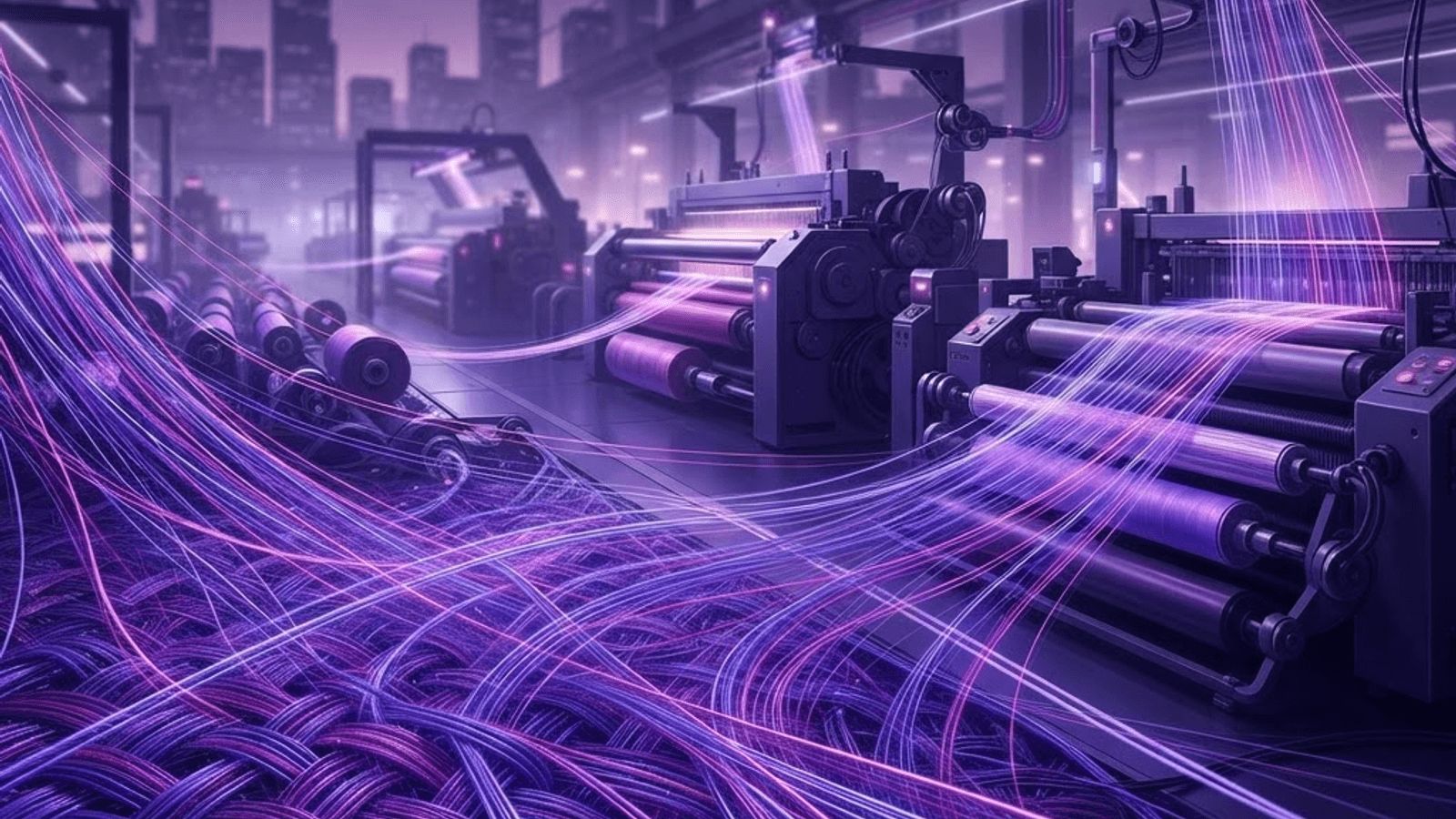
A Different Kind of Textile Industry
When people hear textile manufacturing, they usually imagine apparel. Akron's version of the industry looks almost nothing like that. The city's textile capability grew directly out of its rubber heritage, because tires require fabric reinforcement, industrial hoses require braided textile layers, and conveyor belts require woven carcasses that can survive years of abrasion and tension. The result is a regional cluster focused on technical textiles: engineered materials designed for performance rather than fashion.
Technical textiles in Northeast Ohio serve tire cord and reinforcement, industrial belting, filtration media, protective apparel for workers, automotive interior and structural fabrics, medical textiles, and geotextiles used in civil construction. These are demanding applications with specification-driven purchasing, long qualification cycles, and customers who care far more about tensile strength, elongation, and chemical resistance than about appearance.
Why the Cluster Persists
Three factors keep this industry in Akron. The first is materials science depth, including polymer chemistry, adhesion science, and coatings expertise that allow fabrics to bond reliably with rubber and thermoplastics. The second is proximity to customers, since tire, automotive, and industrial equipment manufacturers across Ohio, Michigan, and Indiana buy locally to shorten supply chains. The third is workforce continuity, with multigenerational knowledge of weaving, coating, and finishing processes that is difficult to reconstruct elsewhere.
The Top 10 Textile Manufacturers Serving Akron
1. Bridgestone Americas Akron Operations
Akron's tire technology presence includes extensive work on reinforcement materials, where textile cord construction, adhesion systems, and composite structures determine tire durability and performance. The research capability here anchors much of the region's technical fabric knowledge.
2. Goodyear Tire & Rubber Company
Headquartered in Akron, Goodyear's innovation center conducts materials development that includes fabric reinforcement architecture, coated textile systems, and engineered composites central to modern tire construction.
3. Highland Industries Ohio Operations
A technical textile producer supplying coated and laminated fabrics for automotive airbags, industrial reinforcement, and specialty applications requiring tightly controlled mechanical properties.
4. Gates Industrial Corporation Regional Plants
Manufacturer of power transmission belts and industrial hose, where textile reinforcement layers are integral to product performance. The company's Ohio-area operations serve automotive and heavy industry customers throughout the Midwest.
5. Continental Contitech Northeast Ohio Facilities
Industrial rubber and fabric products including conveyor belting, air springs, and hose, all of which rely on engineered textile carcasses produced to demanding tolerance requirements.
6. Akron Rubber Development Laboratory
A testing and development organization serving the regional materials industry, providing physical testing, failure analysis, and formulation support for rubber-to-textile bonding and composite performance validation.
7. Applied Felts and Regional Nonwovens Producers
Nonwoven and felt producers in the region supply filtration media, liner materials, and cured-in-place pipe liners used in municipal water and sewer rehabilitation across Ohio.
8. Shaw Industries and Regional Floorcovering Operations
Carpet and floorcovering manufacturing in the broader Ohio region contributes tufting, backing, and coating capability, with backing systems drawing on the same polymer expertise found in Akron.
9. Mount Vernon Mills and Industrial Fabric Suppliers
Producers of flame-resistant and protective fabrics supply workwear used across Ohio's manufacturing, utility, and energy sectors, where garment performance is governed by safety standards rather than style.
10. Regional Custom Sewing and Cut-and-Sew Operations
Smaller Akron-area contract manufacturers provide industrial sewing, heat sealing, and custom fabrication for covers, filtration assemblies, safety products, and short-run specialty textile components.
Technology Changing the Sector
Technical textiles are becoming more sophisticated. Smart textiles embedding conductive yarns for sensing and heating are moving from prototype to commercial use in automotive and protective equipment. Digital pattern optimization reduces material waste in cutting operations. Automated inspection using machine vision catches weaving and coating defects that once passed undetected. And recycled content is increasingly specified by automotive customers, pushing producers toward recycled polyester and bio-based fiber blends.
Sustainability Pressures and Opportunities
Textile processing is water and energy intensive, and dyeing and finishing operations face tightening discharge requirements. Ohio producers have responded with closed-loop water systems, solvent recovery, and heat recovery on finishing lines. A larger opportunity lies in end-of-life recovery. Tire and belt recycling streams contain substantial textile fractions that are currently underutilized, and the region's polymer research capability makes it a plausible location for developing separation and reuse technology.
Sourcing From Akron Textile Manufacturers
Buyers evaluating regional suppliers should request material specifications with test methods identified, ask about qualification lead time for new constructions, verify quality certifications relevant to their industry, and confirm minimum order quantities, which are often higher for woven goods than buyers expect. Proximity is a genuine advantage for iterative development work, because being able to visit the plant during a trial run shortens qualification dramatically compared with overseas sourcing.
The Outlook
Akron will not compete on commodity fabric. Its future in textiles lies where engineering content is high and the value of local materials expertise justifies domestic production: reinforcement for demanding mechanical applications, protective materials, filtration, and emerging smart textile products. That is a smaller industry than the one that existed a century ago, but a considerably more defensible one.