
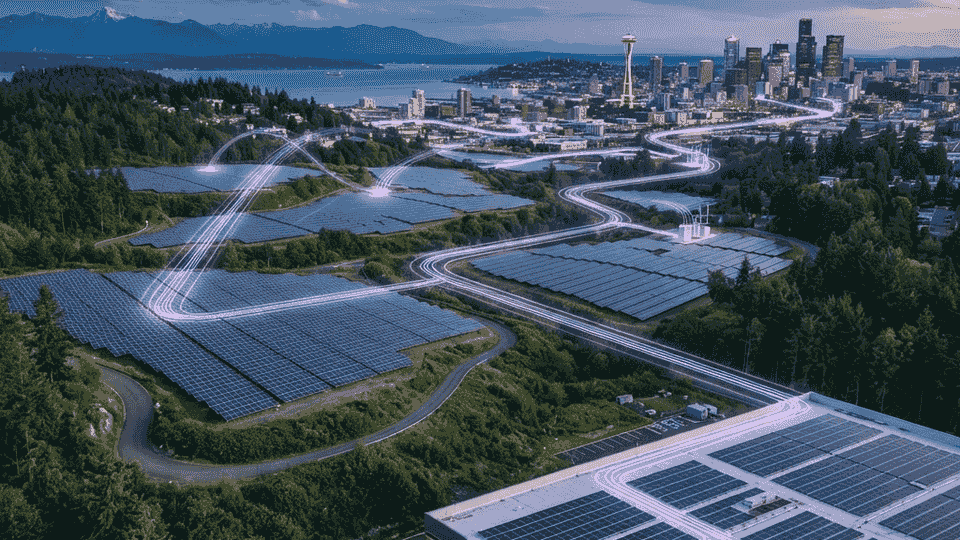
Solar Power in Washington
Washington may be famous for cloudy winters, but solar panels generate electricity from daylight rather than heat and can deliver meaningful annual production. Long summer days, improving equipment, utility programs, and federal incentives have strengthened project economics. Results vary significantly by roof orientation, shade, snow, local rates, interconnection rules, and the availability of net-metering capacity.
The companies below reflect different service areas and project types. Some focus on homes, others on commercial systems, and others on large development. Consumers should obtain several site-specific proposals and compare production assumptions, equipment, warranties, financing terms, monitoring, workmanship, and service responsibility.
1. A&R Solar
Seattle-based A&R Solar is one of Washington’s established residential and commercial solar contractors. Its employee-owned model and long regional track record distinguish it in a market where post-installation support matters. The company works with rooftop solar, batteries, and related electrification needs while designing around Pacific Northwest roofs and utility requirements.
2. Puget Sound Solar
Puget Sound Solar has served the Seattle area for decades and is closely associated with the region’s early solar adoption. It offers residential and commercial installations, electrical work, and complementary clean-energy services. Local experience can be especially valuable in jurisdictions with varied permitting processes, older buildings, and complex roof conditions.
3. Northwest Electric and Solar
Northwest Electric and Solar serves western Washington with solar, battery storage, electric-vehicle charging, and electrical services. This broader electrical capability supports homeowners who want to coordinate panels with backup power or transportation electrification. Integrated planning can prevent avoidable panel upgrades and help equipment work as one system.
4. Artisan Electric
Seattle-based Artisan Electric installs solar and related electrical systems for homes and businesses. The company’s regional focus and electrical expertise make it relevant for urban projects where roof space, service capacity, and code compliance require careful design. Customers should ask how production estimates account for shade and Washington’s seasonal variation.
5. Western Solar
Bellingham-based Western Solar serves homes and commercial properties in northwestern Washington. Its proximity to Whatcom and Skagit communities supports local permitting knowledge and ongoing service. The company’s portfolio demonstrates that solar can be practical even in the state’s cloudier northwest corner when systems are appropriately designed.
6. South Sound Solar
South Sound Solar serves Olympia, Tacoma, and nearby communities with residential and commercial installations. A South Puget Sound specialist can understand local utilities, municipal requirements, and tree-heavy sites. Property owners should evaluate shading honestly because removing trees is not always desirable or necessary if arrays can be repositioned.
7. Sunergy Systems
Sunergy Systems has operated in the Puget Sound market with residential solar, storage, and electrical solutions. Its experience across varied housing stock is valuable for homeowners considering equipment life, roof replacement timing, and backup goals. Battery proposals should clearly distinguish whole-home backup from limited critical-load support.
8. Blossom Solar
Blossom Solar serves Washington homeowners with solar installations and energy-storage options. The company participates in a competitive residential market where straightforward communication and accurate design are key differentiators. Buyers should look beyond a monthly-payment pitch and review cash price, escalators, dealer fees, ownership, and transfer terms.
9. Sphere Solar Energy
Sphere Solar Energy is a Washington installer serving residential and commercial customers. Its project work reflects growing demand for local clean-energy contractors capable of navigating design, permitting, interconnection, and commissioning. A quality proposal should identify major equipment models and explain who handles warranty service.
10. OneEnergy Renewables
Seattle-based OneEnergy Renewables develops larger solar projects rather than functioning primarily as a residential installer. Its expertise includes land acquisition, permitting, utility interconnection, engineering coordination, and project finance. This makes the company relevant to utilities, landowners, institutions, and communities exploring solar at scale.
How to Evaluate a Solar Proposal
Compare projected annual production, not only system size. Ask what weather data, shading model, panel degradation, and inverter losses support the estimate. Confirm contractor licensing, structural review, roof penetrations, warranties, monitoring access, and the schedule for utility approval. If storage is included, identify usable capacity, supported circuits, expected runtime, and replacement assumptions.
Washington customers should verify current incentives and utility policies rather than relying on an old advertisement. Rules and program capacity can change. A reputable installer will explain uncertainty, avoid unrealistic savings guarantees, and present a system tailored to the property. With sound design and transparent economics, solar can be a durable energy investment across the state.