
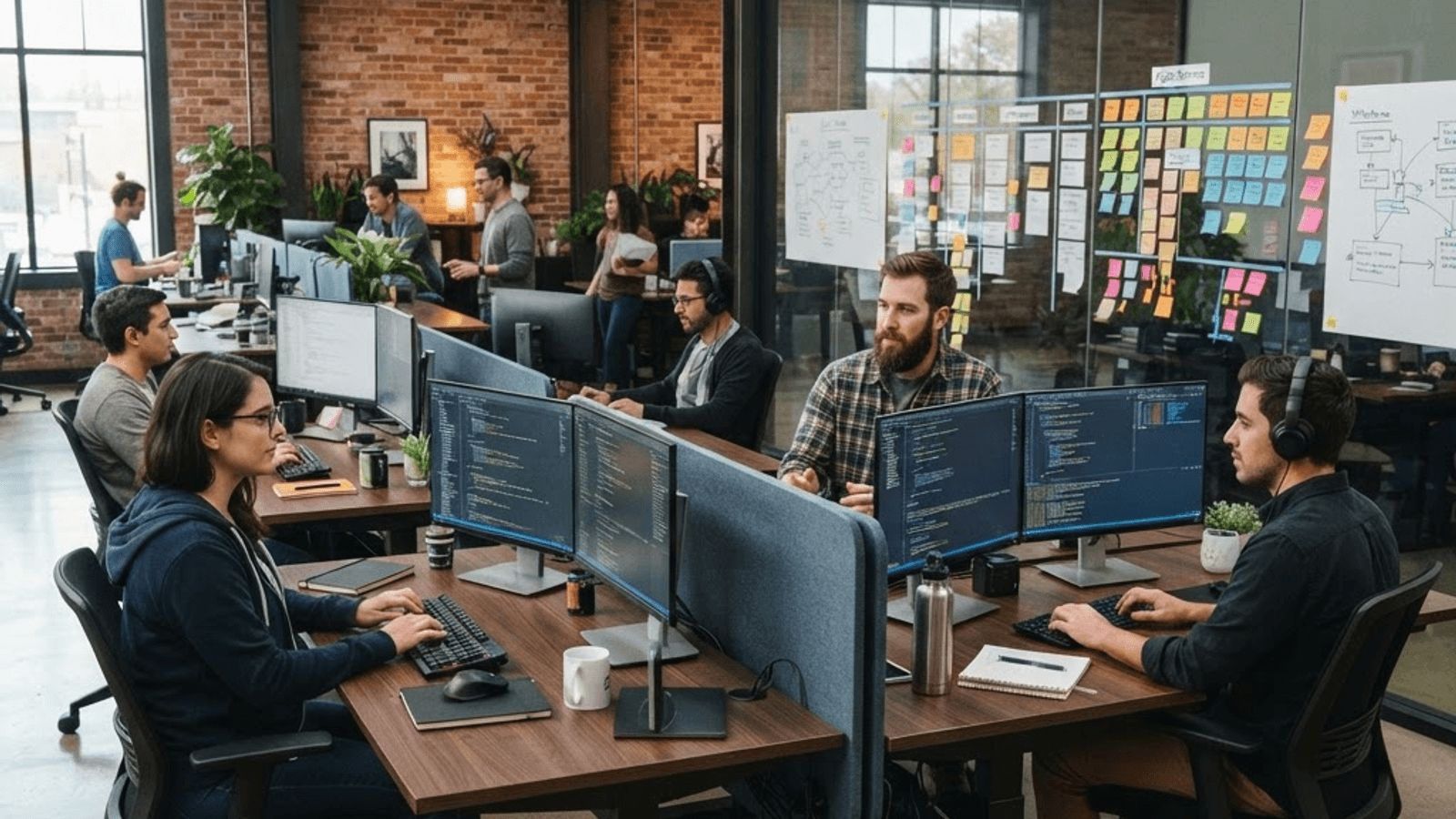
St. Louis Became a Software City Without Anyone Announcing It
The region’s technology sector grew from its industrial base rather than in spite of it. Agricultural companies needed data platforms to serve farmers, which produced one of the strongest agricultural technology clusters in the world. Federal geospatial intelligence investment anchored a mapping and analytics ecosystem. Large financial services and brokerage operations built substantial engineering organizations. Academic medical centers and genomics research produced health technology and bioinformatics companies.
Around that base, an entrepreneurial infrastructure developed: incubators and accelerators in the Cortex Innovation District, venture funds focused on the Midwest, and a downtown geospatial corridor anchored by major federal investment. The result is a market where a software engineer can build a full career across multiple substantial employers, and where cost of living makes compensation go considerably further than on either coast.
What Defines the Local Software Landscape
Three characteristics stand out. First, the strongest companies solve industry-specific problems rather than building horizontal tools, which means domain knowledge is valued as highly as pure engineering skill. Second, enterprise and B2B software dominates over consumer applications, reflecting the customer base. Third, engineering cultures here tend to be pragmatic and delivery-focused rather than trend-driven, which many experienced engineers consider a feature.
For buyers, this matters because local vendors often understand regulated, operationally complex industries better than coastal competitors. For engineers, it means opportunities concentrated in data platforms, geospatial systems, financial technology, healthcare interoperability, and industrial software.
The Ten Best Software Companies in St. Louis
1. Bayer Crop Science digital operations. The center of the region’s agricultural technology sector, operating large-scale data platforms that ingest satellite imagery, weather models, soil data, and equipment telemetry to produce agronomic recommendations for millions of acres. The engineering challenges around geospatial data at scale, machine learning, and field-level modeling are as sophisticated as anything in the industry.
2. Benson Hill and the plant science technology cluster. Companies applying computational biology, genomics, and machine learning to crop development. These organizations combine software engineering with laboratory science, offering unusual interdisciplinary work and access to proprietary biological data sets.
3. Edward Jones technology organization. One of the largest engineering employers in the region, building advisor platforms, client portals, and financial planning systems for a nationwide branch network. Scale, regulatory rigor, and a long-term investment horizon define the environment, and the firm has invested heavily in modernizing its technology stack.
4. Stifel and the regional financial technology sector. Substantial engineering operations supporting brokerage, wealth management, and investment banking systems. Work here involves trading systems, compliance automation, and data infrastructure with genuine performance and correctness requirements.
5. Geospatial and defense technology firms in the downtown corridor. Anchored by major federal geospatial intelligence investment, this cluster includes contractors and product companies working on satellite imagery analysis, computer vision, sensor fusion, and secure data systems. It represents one of the region’s most distinctive technical specializations and offers work unavailable in most metros.
6. Balto and the conversational AI cluster. Companies applying real-time speech recognition and language models to contact center guidance and quality assurance. These firms operate at the intersection of machine learning and enterprise workflow, and several have grown substantially from St. Louis roots with national customer bases.
7. Varsity Tutors and the education technology sector. A significant local success in online learning marketplaces and live instruction platforms, involving substantial work in matching algorithms, real-time video infrastructure, and scheduling systems at consumer scale.
8. Health technology and interoperability companies serving regional health systems. With major academic medical centers locally, the region supports companies building clinical data exchange, patient engagement, revenue cycle, and clinical decision support software. FHIR-based interoperability work and healthcare data privacy engineering are areas of genuine local depth.
9. Established B2B SaaS companies across the metro. The region has produced a solid tier of software companies serving construction, logistics, insurance, manufacturing, and professional services verticals. These businesses tend to be capital-efficient, profitable, and stable employers, offering engineers substantial ownership of systems rather than narrow specialization.
10. Cortex-based startups and the early-stage ecosystem. The Cortex Innovation District and associated accelerators host a continuous pipeline of early-stage software companies in bioscience, agtech, geospatial, and enterprise software. For engineers seeking equity upside and breadth, and for buyers seeking innovative solutions, this ecosystem is the region’s renewal mechanism.
Technical and Industry Trends
Machine learning has moved from differentiator to baseline expectation across local software, particularly in agriculture, geospatial analysis, and healthcare, where domain-specific models trained on proprietary data represent real defensibility. Retrieval-based AI applications are being deployed widely for internal knowledge access and customer support.
Platform engineering and developer experience investment has grown as organizations consolidate cloud infrastructure and reduce operational toil. Data governance and privacy engineering have become mandatory competencies given healthcare and financial services concentration. And remote and hybrid work has substantially benefited the region, since St. Louis engineers can now access national compensation while local employers can recruit nationally.
Advice for Engineers and Buyers
Engineers evaluating St. Louis employers should weigh domain depth heavily, because industry-specific expertise compounds into career advantage here in ways that generic framework knowledge does not. Ask about deployment frequency, on-call structure, and how technical decisions get made, which reveal engineering maturity faster than any recruiting pitch. Compare compensation against local cost of living rather than national averages, where the region compares extremely favorably.
Buyers evaluating local software vendors should prioritize domain fit and integration capability over feature checklists. Ask for reference customers in your specific industry, evaluate the data model rather than the interface, and scrutinize security posture, including SOC 2 status, encryption practices, and incident history. For regulated industries, verify compliance capability early, since retrofitting it is expensive.
Conclusion
St. Louis software is defined by depth in agriculture, geospatial intelligence, financial services, and healthcare rather than by consumer applications, and that specialization is its strength. The companies above represent the most substantial engineering organizations and the most interesting technical problems in the region. For engineers, the combination of serious work and reasonable cost of living is genuinely compelling; for buyers, local vendors frequently understand complex operational industries better than anyone else available.