
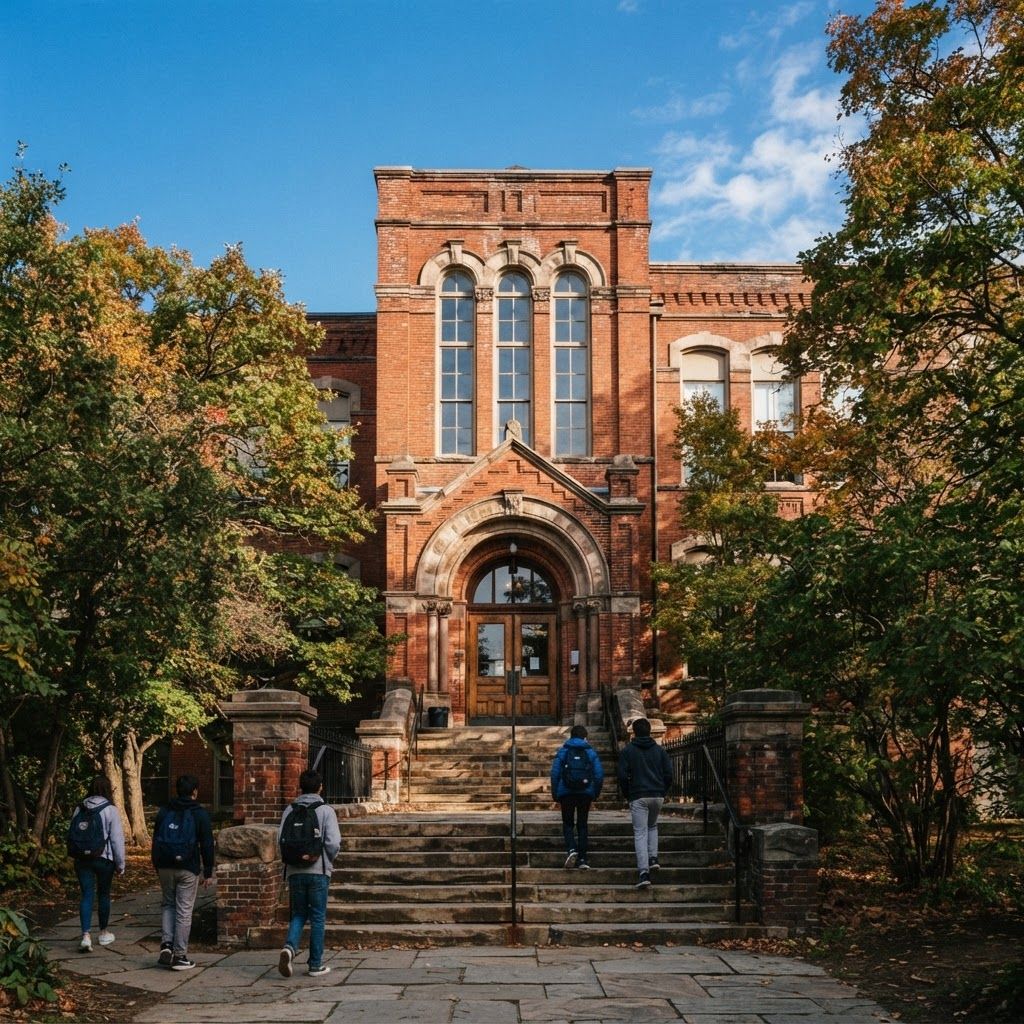
Understanding Buffalo's School Landscape
Choosing a school in Buffalo is less a matter of finding one best option than of understanding a genuinely layered system. Buffalo Public Schools operates a citywide model in which many of the strongest programs are criteria-based, meaning admission depends on academic records, testing, auditions, or a combination. Alongside the district sit charter schools, a substantial Catholic and independent sector with roots going back more than a century, and neighboring suburban districts that draw families across municipal lines. Each pathway carries different admissions timelines, costs, and cultures, and the right answer depends heavily on the individual child.
Criteria-Based Public Schools
City Honors School is the best known of the district's selective schools. It offers the International Baccalaureate Diploma Programme and consistently ranks among the strongest public high schools in New York State. Admission is competitive and begins at the middle school entry point.
Hutchinson Central Technical High School, universally called Hutch Tech, pairs rigorous academics with engineering, computer science, and health science pathways, making it a natural fit for students who want technical depth before college. Da Vinci High School has built a reputation for science and mathematics emphasis in a smaller setting. Olmsted School 156 and Olmsted 64 serve gifted and talented students from the elementary grades upward and are among the most requested placements in the city.
The Buffalo Academy for Visual and Performing Arts serves students pursuing dance, theater, music, and visual art alongside a full academic program, with admission by audition or portfolio. For families whose child has a clear artistic direction, it provides training that is difficult to replicate elsewhere in the region.
Private and Parochial Options
Buffalo's independent and Catholic schools are a significant part of the local picture. Nichols School, founded in 1892, is the region's best-known independent day school, serving grades five through twelve with a college preparatory curriculum, extensive athletics, and a strong record of selective college placement. The Park School of Buffalo, on a large Amherst campus, follows a progressive philosophy emphasizing experiential and project-based learning.
Canisius High School and Saint Joseph's Collegiate Institute anchor the boys' Catholic secondary tradition, both with long histories, deep alumni networks, and strong academic and athletic programs. Nardin Academy serves students from early childhood through high school and is among the oldest schools in the city. Buffalo Seminary, founded in 1851, is an independent school for girls in grades nine through twelve with a notable international boarding component. Elmwood Franklin School and Buffalo Academy of the Sacred Heart round out a sector known for small class sizes and long institutional memory.
Charter Schools
Buffalo has one of the more developed charter sectors in Upstate New York. Schools including Tapestry Charter School, Elmwood Village Charter School, Charter School for Applied Technologies, and Buffalo Collegiate Charter School offer tuition-free alternatives with distinct instructional models, from expeditionary learning to career and technical focus. Admission is by lottery rather than academic criteria, which makes them accessible but also means placement is uncertain in high-demand years.
Suburban Districts Worth Knowing
Many families ultimately weigh city options against surrounding districts. Williamsville, Amherst, Clarence, East Aurora, Orchard Park, and Hamburg all maintain strong reputations, with high graduation rates, broad Advanced Placement offerings, competitive athletics, and well-funded arts and music programs. The tradeoff is housing cost and commute, and for some families the loss of the diversity and walkability that city neighborhoods provide.
What Actually Distinguishes a Strong School
Rankings are a starting point, not a conclusion. Teacher retention is one of the most reliable indicators of institutional health, because schools where teachers stay tend to have functional leadership and manageable workloads. Class size affects how much individual attention a student receives, particularly in writing-intensive and laboratory subjects.
Breadth of course offerings determines whether a motivated student can go deep. A school with several languages, multiple advanced science courses, computer science, and a serious arts program gives a student room to discover what they care about. Support services matter equally: reliable counseling, special education staffing, English language learner support, and mental health resources often determine whether a child thrives or merely gets through.
Trends in Buffalo Education
Career and technical education has expanded well beyond its traditional scope, now covering health care, information technology, advanced manufacturing, and skilled trades, often with industry certifications attached. Dual enrollment partnerships with local colleges let high school students accumulate transferable credit before graduation.
Multilingual education has grown substantially as Buffalo has resettled significant refugee and immigrant populations. Schools across the city now support students speaking Karen, Burmese, Arabic, Somali, Spanish, and Ukrainian, and the strongest programs treat that linguistic diversity as an asset rather than a logistical problem. Meanwhile, technology integration has matured past device distribution into genuine questions about screen time, digital literacy, and the appropriate role of artificial intelligence tools in student work.
Practical Advice for Families
Start early. Criteria-based and private school applications generally open in the fall for the following September, and the strongest programs fill quickly. Visit in person during a regular school day rather than only at an open house, and pay attention to how students speak to each other and to adults. Ask about the specific supports your child needs, whether that is an individualized education program, acceleration in mathematics, or a serious music ensemble.
Talk to current parents rather than relying only on official materials, and keep the child in the conversation. A school that looks excellent on paper but leaves a student isolated or unchallenged is not the right school. Fit, not prestige, produces the outcomes families actually want.
Final Thoughts
Buffalo offers a wider range of quality schooling than its national reputation suggests, from an internationally recognized IB program to century-old independent academies to innovative charters. The system rewards families who research carefully and apply early. With clear priorities and an honest read on a child's needs, there is a strong option available in nearly every direction.