
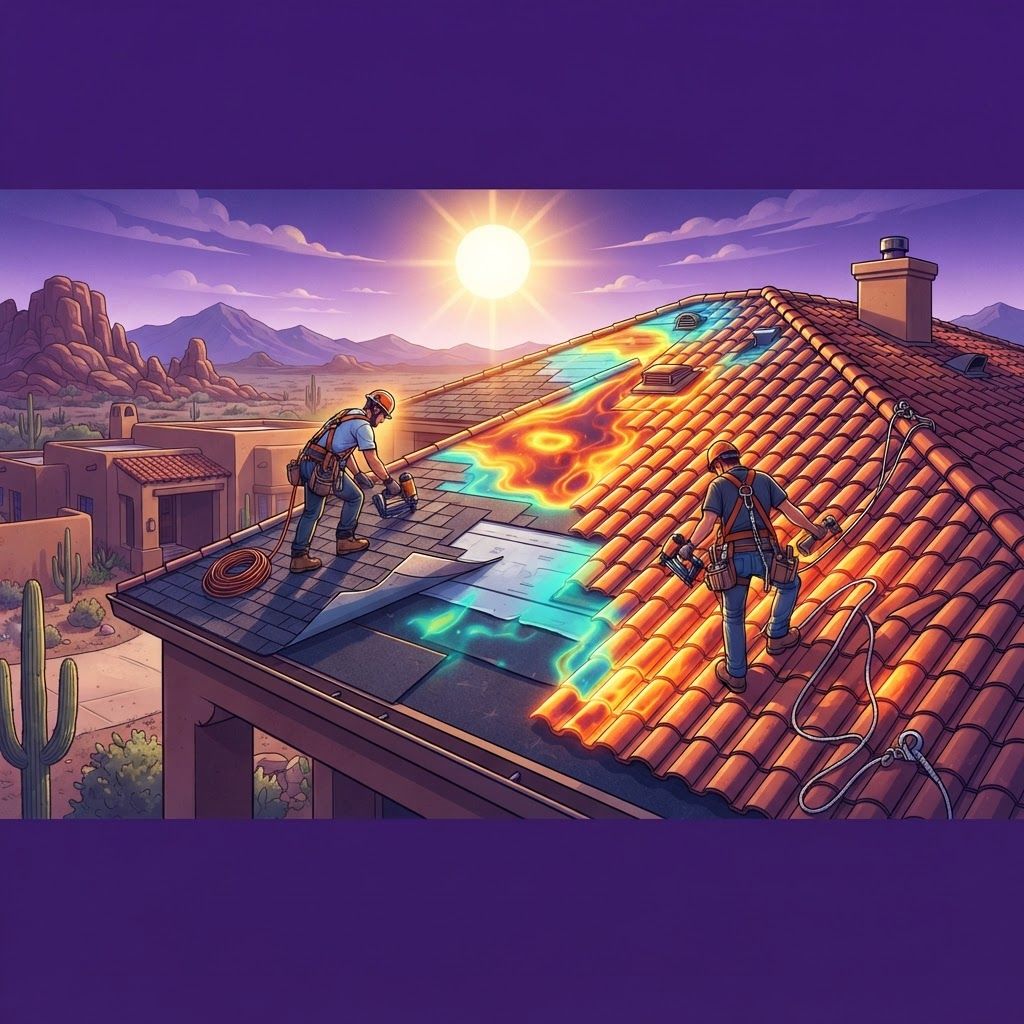
Why Roofing Is the Most Demanding Trade in the Desert
A roof in Surprise faces a punishing combination of conditions. Surface temperatures on dark roofing materials can exceed 160 degrees in summer, driving thermal expansion and contraction that fatigues fasteners, sealants and underlayment. Ultraviolet radiation degrades organic materials relentlessly. Then, for a few weeks each year, monsoon storms deliver intense rainfall accompanied by wind gusts that test every edge detail and flashing joint.
The consequence is that roofing materials in Arizona often fail from heat aging rather than from water exposure. Underlayment beneath tile roofs typically reaches the end of its service life long before the tiles themselves show wear, producing leaks in roofs that appear perfectly sound from the street. Understanding this pattern is the single most useful piece of knowledge a local homeowner can have.
Roofing Systems That Perform Well Locally
Concrete tile roofs dominate residential neighborhoods across Surprise. The tiles themselves last for decades and provide excellent thermal performance through the air space beneath them, but the waterproofing layer is the underlayment below. Tile underlayment replacement, sometimes called a tile lift and relay, removes and stacks the tiles, replaces the underlayment and reinstalls the original tiles. This is one of the most common and most valuable roofing projects in the area.
Asphalt shingle roofs appear on many homes as well, valued for lower installation cost. In this climate, higher-grade architectural shingles with strong ultraviolet resistance substantially outperform basic three-tab products, and adequate attic ventilation extends their life considerably.
Foam roofing, specifically sprayed polyurethane foam with an acrylic coating, is widely used on low-slope and flat roof sections common in southwestern architecture. Foam provides seamless coverage and meaningful insulation value, and it can be recoated periodically to extend service life almost indefinitely with proper maintenance.
Modified bitumen and built-up systems serve flat roofs on both homes and commercial buildings, offering proven durability when properly detailed at penetrations and parapets.
Metal roofing has grown in popularity for its longevity, fire resistance and reflectivity. Standing seam systems with cool roof coatings reflect a large portion of solar radiation, reducing attic temperatures and cooling loads.
Single-ply membranes including thermoplastic polyolefin dominate commercial low-slope applications, with highly reflective white surfaces that measurably reduce building energy consumption in this climate.
Leading Roofing Contractors Serving Surprise
Established Arizona roofing companies with decades of local operation form the backbone of the market. Their value is straightforward: they have seen how every material behaves over full service cycles in this specific climate, and they will still be in business when a warranty claim arises.
Tile roofing specialists focus on the underlayment replacement work that defines the region. Their crews are skilled at removing, stacking and reinstalling tile without breakage, and they typically stock matching replacement tiles for older profiles that are no longer manufactured.
Foam roofing contractors serve the substantial inventory of flat and low-slope roofs, providing application, recoating and maintenance programs. Recoating on a regular cycle is dramatically cheaper than replacement and is a hallmark of a contractor focused on long-term relationships.
Commercial roofing firms handle shopping centers, industrial buildings and institutional facilities with single-ply and built-up systems, along with roof asset management programs that track condition across multiple properties.
Storm damage and insurance restoration specialists respond after monsoon events, documenting damage, working with adjusters and completing repairs. Homeowners should choose carefully in this category, as major storms attract out-of-area operators with no local track record.
Solar-integrated roofing contractors coordinate photovoltaic installation with roof replacement, which is the sensible sequence since removing and reinstalling an array on an aging roof is expensive and avoidable with proper planning.
Roof repair and maintenance specialists handle targeted work, including leak diagnosis, flashing repair, tile replacement and preventive inspections. Annual inspections before monsoon season are inexpensive insurance.
Gutter and drainage contractors, while adjacent to roofing, address water management that protects foundations and stucco during heavy rain events.
Skylight and roof penetration specialists handle the details where most leaks actually originate, since penetrations rather than open field areas account for the majority of roof failures.
Finally, roofing manufacturers' certified installer networks provide access to extended system warranties that require certified installation, offering an additional layer of protection beyond the contractor's own workmanship guarantee.
How to Evaluate a Roofing Contractor
Verify the license classification with the Arizona Registrar of Contractors, and confirm general liability and workers compensation coverage directly. Roofing is among the highest risk trades, and an uninsured crew on your roof is an unacceptable liability exposure.
Insist on a written scope that specifies materials by manufacturer and product line, underlayment type and weight, fastener specifications, flashing details, ventilation work and cleanup. Vague proposals allow substitution of cheaper materials after the contract is signed.
Understand the two distinct warranties. The manufacturer warranty covers material defects and varies by product. The workmanship warranty covers installation, and its length and transferability say a great deal about a contractor's confidence. In Arizona, a workmanship warranty of five to ten years on a full replacement is a reasonable expectation.
Be cautious about pressure tactics and door-to-door solicitation following storms. Legitimate contractors provide time to consider proposals, do not demand large upfront payments, and never encourage insurance fraud through inflated claims or deductible waiving.
Maintenance That Extends Roof Life
Inspect twice a year, ideally in spring before summer heat and again in autumn after monsoon season. Look for cracked or slipped tiles, exposed or deteriorated underlayment at eaves, damaged flashing around vents and chimneys, blistering on foam surfaces and debris accumulation in valleys and drains.
Keep drainage paths clear. Blocked scuppers and drains on flat roofs cause ponding, which accelerates membrane failure and adds structural load. Trim vegetation away from roof edges to prevent abrasion and reduce debris.
Address small issues immediately. A single displaced tile exposes underlayment to direct sun, and in Arizona that exposed area can deteriorate within a season. Roofs here reward attention and punish neglect faster than in almost any other climate in the country.