
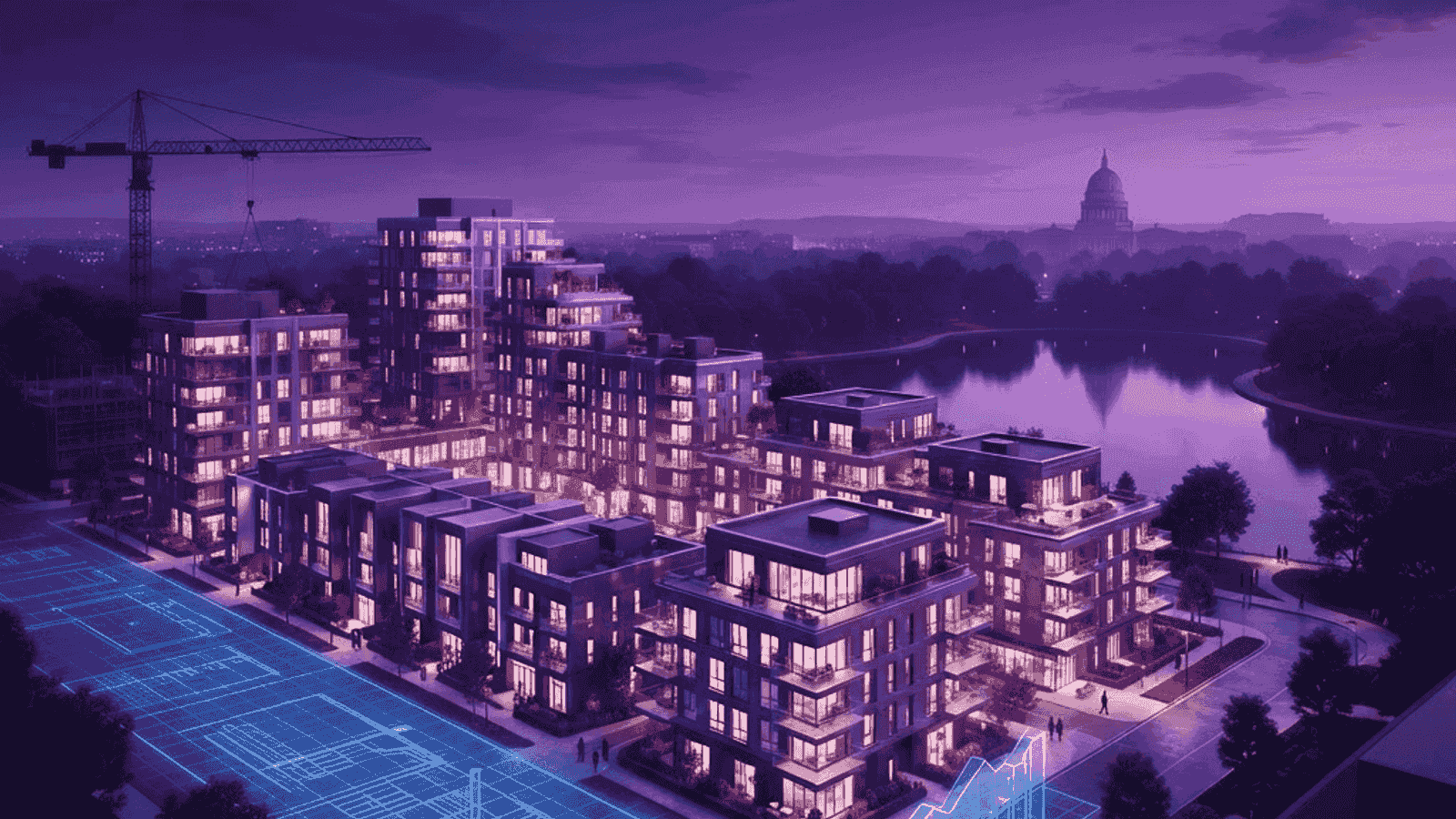
A Constrained Market Driving Ambitious Development
Madison is geographically unusual. The city core sits on an isthmus between Lake Mendota and Lake Monona, which physically caps how much land is available downtown. Combine that with steady employment growth from the university, state government, healthcare systems, and a maturing technology sector, and the result is persistent housing pressure that has defined local development for more than a decade.
Developers have responded on two fronts. Within the city, the emphasis is vertical infill: mixed-use buildings replacing surface parking and aging low-density commercial along corridors like East Washington Avenue and the near west side. Beyond the beltline, growth has moved into Sun Prairie, Verona, Waunakee, Middleton, and Fitchburg, where master-planned neighborhoods deliver the single-family inventory the core cannot physically supply.
Development Trends Shaping New Madison Housing
Several patterns distinguish current projects from those built fifteen years ago. Energy performance has become a competitive feature rather than an afterthought, with high-efficiency envelopes, heat pump systems, and solar readiness appearing in mid-market product, not just luxury builds. Missing middle housing, meaning duplexes, triplexes, and small courtyard buildings, has gained traction as zoning reform made these formats viable again.
Walkability is also monetized more explicitly here than in comparable markets. Proximity to bike infrastructure, especially the Capital City and Southwest Commuter paths, measurably affects pricing. Developers who orient projects toward trail access and transit rather than parking ratios have consistently outperformed on absorption.
Ten Notable Residential Developers in the Madison Area
1. Veridian Homes
One of the region's largest and most recognizable homebuilders, known for energy-efficient construction and large master-planned communities across the metro. Its scale allows standardized quality control and a broad floor plan library, and its sustainability commitments have been a differentiator in the local market for years.
2. T. Wall Enterprises
A prolific multifamily developer with substantial apartment inventory throughout Madison and surrounding communities. Its projects typically emphasize amenity packages and professional on-site management, and the firm has been active in both suburban garden-style and urban infill formats.
3. Gorman and Company
Nationally recognized for adaptive reuse and affordable and workforce housing, with several Wisconsin projects converting historic structures into residential use. Gorman's expertise in layered public financing makes it a key player in housing that the pure market would not otherwise deliver.
4. Stone House Development
A Madison-based developer focused on downtown and near-downtown infill, with a portfolio that includes mixed-income apartment buildings integrated into existing urban fabric. Frequently cited for design sensitivity in dense contexts.
5. JT Klein Company
Known for boutique multifamily and mixed-use buildings in established neighborhoods, generally at a scale that fits its surroundings. Attention to material quality and streetscape detail sets its work apart from commodity apartment construction.
6. Tim O'Brien Homes
A builder with a strong reputation for high-performance, third-party certified homes. Buyers focused on measurable energy performance and long-term operating costs, rather than square footage alone, tend to gravitate here.
7. Encore Real Estate Development
Active in mixed-use and workforce housing projects with a focus on transit-oriented sites. Its developments often combine ground-floor commercial with residential above, contributing to genuinely walkable corridors.
8. Ruedebusch Development and Construction
A local firm with a broad portfolio spanning residential subdivisions and commercial work. Its dual capability as both developer and builder streamlines project delivery and simplifies accountability for buyers.
9. Halverson Development
Focused on infill apartment projects and neighborhood-scale mixed-use, often in locations that require careful navigation of city approvals. Recognized for persistence on complex urban sites.
10. Hovde Properties
A long-established Madison company with significant downtown holdings and residential components within mixed-use developments. Its multi-generational presence gives it unusually deep familiarity with the local entitlement environment.
How to Evaluate a Developer Before You Buy
Start with completed projects rather than renderings. Visit a development the builder finished five to seven years ago and observe how it has aged: settling cracks, drainage performance, common area maintenance, and whether the landscaping matured as promised. Then speak to residents, who will tell you more in ten minutes than any sales center presentation.
Examine warranty terms carefully, distinguishing the structural warranty period from workmanship coverage, and ask specifically how service requests are handled after closing. Review the homeowners association budget and reserve study if applicable, because underfunded reserves eventually become special assessments. For pre-construction purchases, understand exactly what specifications are guaranteed versus subject to substitution, and get allowances documented in writing.
What to Expect Going Forward
Madison's fundamentals point toward continued development pressure. Employment growth remains steady, the physical land constraint is permanent, and zoning reform is gradually enabling denser housing types in areas previously restricted to single-family use. For buyers, this means new construction will keep concentrating in vertical infill within the city and planned communities at the edges, with the middle ground of modest new single-family homes near the core remaining the scarcest and most competitive segment in the market.