
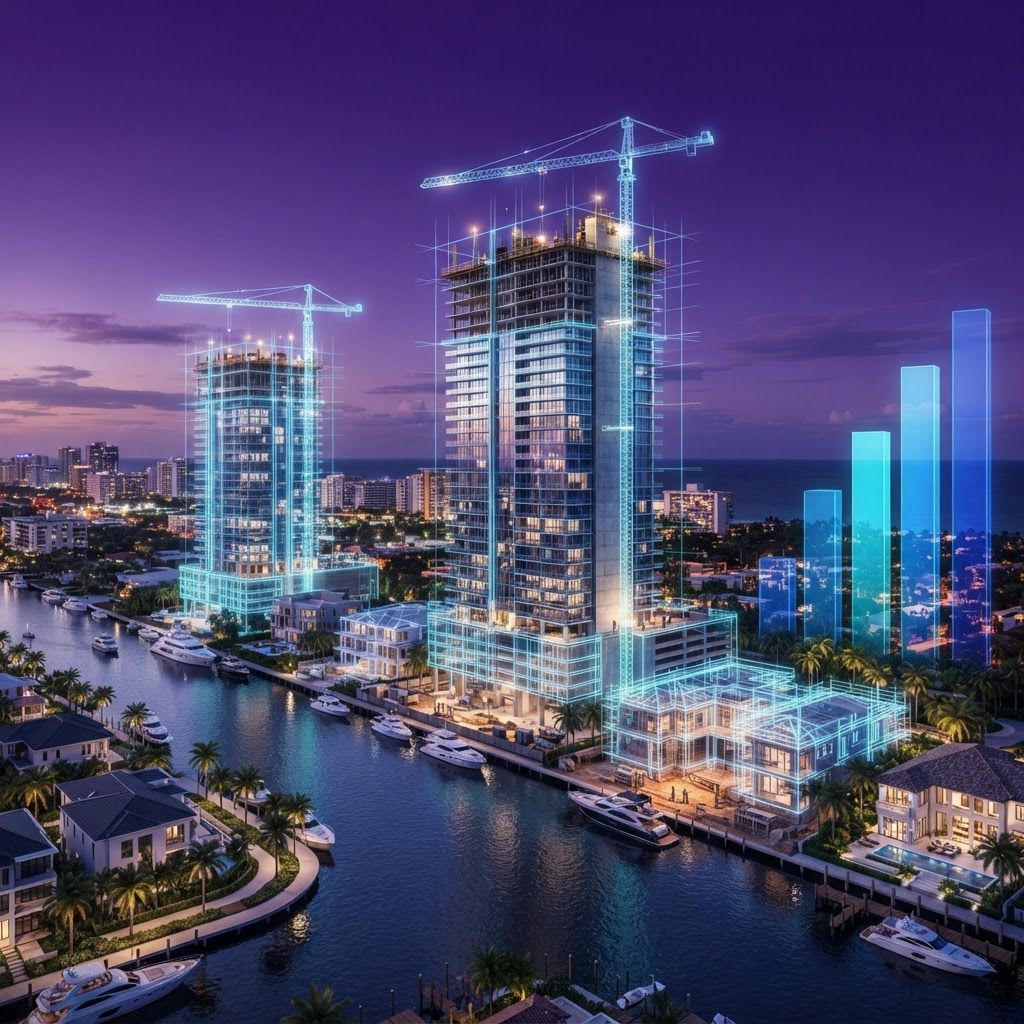
A Skyline in Transformation
Few American cities have changed as visibly as Fort Lauderdale over the past ten years. What was once a low-rise beach town defined by mid-century motels and single-family canal homes has become a genuine vertical city, with luxury condominium towers rising along Las Olas Boulevard, the New River, and the barrier island. Downtown Fort Lauderdale in particular has absorbed thousands of new residential units, transforming Flagler Village and the Central Business District into dense, walkable neighborhoods.
This transformation is driven by a specific set of forces: sustained migration from higher-tax states, the maturation of Fort Lauderdale as a business center rather than a Miami suburb, the expansion of Brightline rail service, and a limited supply of developable waterfront land. Residential developers have responded with product across the spectrum, from ultra-luxury waterfront residences to purpose-built rental communities.
The Major Development Categories
Luxury waterfront condominiums represent the highest-profile segment. These projects, typically located on the Intracoastal, along the beach, or on the New River, feature large floor plans, private elevators, marina access, and resort-level amenity decks. Branded residences, where a hotel or luxury brand lends its name and service standards, have become a defining feature of this tier.
Urban mid-rise and high-rise condominiums serve the downtown professional market with smaller units, co-working lounges, rooftop pools, and walkable access to restaurants and transit. Build-to-rent and multifamily rental communities have expanded aggressively, reflecting both affordability pressure and demand from newcomers who want to rent before committing to a purchase.
Single-family and townhome development continues in the western suburbs of Broward County and through infill redevelopment closer to the coast, where older homes on generous lots are replaced by modern construction. Finally, adaptive reuse and historic redevelopment projects convert older commercial structures into residential space, particularly around Flagler Village and Progresso.
Developers Shaping the Market
Several names recur consistently in Fort Lauderdale's residential landscape. Related Group, one of Florida's most prolific condominium developers, has delivered multiple high-profile towers across South Florida and has been active in the Fort Lauderdale luxury and rental segments. Kolter Group, a Florida-based developer, is known for well-executed coastal condominium projects and master-planned communities throughout the state.
Dev Corp and The Related Companies have brought national and international capital into the downtown core, while Property Markets Group has pursued dense urban residential projects in the region. Tavistock Development Company and BTI Partners have been significant players in larger-scale land development and mixed-use planning across Broward County.
On the production homebuilding side, Lennar, GL Homes, and Pulte Homes dominate suburban single-family and townhome delivery in western Broward, offering standardized floor plans, warranty programs, and financing arms. Their scale provides predictability and consumer protections that smaller boutique developers cannot always match.
Boutique developers also play an important role, delivering small-footprint luxury projects with distinctive architecture, often on infill sites near the beach or along quieter stretches of the Intracoastal. These projects trade amenity scale for design quality and exclusivity.
What Distinguishes a Strong Developer
Track record is the most reliable predictor. A developer with multiple completed and occupied South Florida projects has demonstrated the ability to secure financing, navigate permitting, manage construction through hurricane seasons and labor shortages, and hand over a functioning building. Buyers should visit earlier projects and speak to residents about construction quality and how warranty issues were handled.
Financial structure matters enormously in preconstruction purchases. Reputable developers hold buyer deposits in escrow per Florida statute, disclose lender relationships, and provide clear timelines with contractual remedies for delay. Buyers should read the condominium documents carefully, paying attention to developer control periods, budget assumptions, and reserve funding.
Construction resilience is a South Florida imperative. Strong developers build well beyond minimum code, using impact-rated glazing, elevated mechanical systems, robust drainage, corrosion-resistant materials for coastal exposure, and backup power for essential building systems. In a market where insurance costs have climbed sharply, resilient construction directly affects long-term ownership costs.
Trends Defining the Next Cycle
Insurance and assessment awareness now shapes buyer behavior more than at any point in recent memory. Following statewide reforms requiring structural integrity inspections and fully funded reserves for older buildings, newly constructed towers with modern engineering have gained a real competitive advantage.
Amenity programming has shifted from purely recreational to lifestyle-functional. Co-working suites, wellness floors with cold plunge and recovery rooms, pet spas, private dining rooms, and marina slips now appear more frequently than traditional card rooms and formal lobbies.
Sustainability has moved from marketing language to measurable specification, with developers pursuing green certification, high-efficiency systems, electric vehicle charging infrastructure, and water conservation measures that reduce operating costs for residents.
Finally, mixed-use integration continues. The strongest new projects place residential floors above ground-level retail and restaurant space, contributing to the walkability that downtown Fort Lauderdale has been deliberately cultivating.
How to Evaluate Before You Buy
Request the developer's completed project list and visit at least two in person. Examine common area maintenance, elevator condition, and whether the amenities promised in marketing materials actually exist and function. Ask the property manager about construction defect claims.
Review the offering documents with a Florida real estate attorney. Pay particular attention to the estimated operating budget, because developers occasionally understate initial assessments, leading to sharp increases after turnover. Confirm reserve funding assumptions and any developer guarantee period.
Investigate the site itself. Check flood zone designation, elevation, and drainage infrastructure. Ask about planned development on adjacent parcels, since a protected water view can disappear when a neighboring site is entitled.
Final Thoughts
Fort Lauderdale's residential development market offers exceptional product across price points, backed by developers with genuine regional expertise. The buyers who do best are those who evaluate the developer as carefully as the floor plan, scrutinize construction resilience and association finances, and think in terms of total long-term ownership cost rather than purchase price alone.