
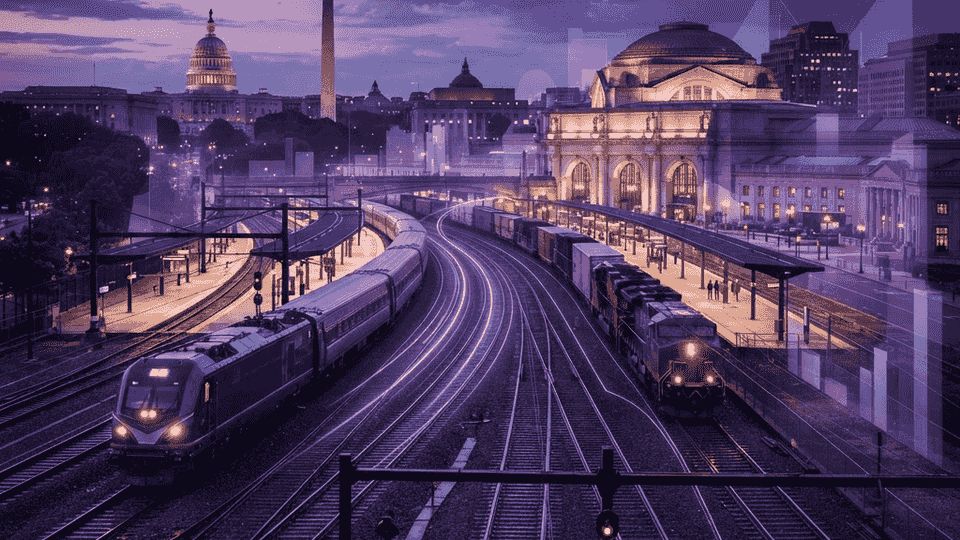
Rail Connections in Washington
Union Station places Washington at the center of the Northeast passenger-rail corridor, while regional commuter lines extend into Maryland, Virginia, and West Virginia. Freight railroads operate through the wider metropolitan area and connect local commerce with ports and national networks. Since passenger and freight operators serve different needs, this list evaluates relevance to Washington rather than treating every company as a direct substitute.
1. Amtrak
Amtrak is Washington’s principal intercity passenger operator. Union Station supports Northeast Regional, Acela, long-distance, and state-supported routes. Frequent service to Baltimore, Philadelphia, New York, and Boston makes rail competitive with air travel on the corridor, especially when travelers value city-center arrivals and productive journey time.
2. Amtrak Acela
Acela is Amtrak’s premium high-speed corridor service and deserves separate consideration for business travelers. Reserved seating, fewer stops, and upgraded onboard amenities distinguish it from conventional trains. The value is strongest when schedule, comfort, and downtown-to-downtown convenience matter more than finding the lowest fare.
3. Maryland Area Rail Commuter
Maryland Area Rail Commuter, known as MARC, operates commuter service into Union Station on the Penn, Camden, and Brunswick lines. It connects Washington with Baltimore, Maryland suburbs, and parts of West Virginia. Riders should compare line-specific frequency because weekend and off-peak service differs considerably.
4. Virginia Railway Express
Virginia Railway Express, or VRE, links Washington with Northern Virginia communities on the Fredericksburg and Manassas lines. It is designed primarily around weekday commuting. Spacious trains and predictable rail travel can be attractive alternatives to Interstate 95 and Interstate 66, though schedules are less flexible than Metrorail.
5. Washington Metropolitan Area Transit Authority
WMATA operates Metrorail, the region’s rapid-transit railway. Six lines connect the District with Maryland and Virginia, including service near Reagan National and Dulles airports. Metrorail is the most useful rail option for many local trips, with frequent urban service and connections to commuter and intercity trains.
6. CSX Transportation
CSX is a major eastern freight railroad serving the Washington region. It moves intermodal containers, construction materials, automotive products, chemicals, food, and other commodities through a vast network. Businesses value rail for high-volume, long-distance efficiency, although most access it through terminals, transload providers, or logistics intermediaries.
7. Norfolk Southern
Norfolk Southern is another major freight operator with Mid-Atlantic reach. Its network connects industrial regions, ports, and intermodal facilities. Washington-area shippers may use Norfolk Southern through regional terminals and partner facilities, particularly when cargo flows originate or terminate beyond the immediate District.
8. Buckingham Branch Railroad
Buckingham Branch Railroad is a Virginia short-line operator connecting with larger railroads. It supports regional industries and preserves freight access on routes that would not be the primary focus of a national carrier. Short lines are important because they provide the first or last rail segment for many customers.
9. Winchester & Western Railroad
Winchester & Western Railroad serves parts of Virginia, West Virginia, Maryland, and New Jersey. Its regional operations connect customers with the broader freight system and support commodities such as aggregates and industrial materials. It is most relevant to shippers in the outer Washington trade area rather than urban passengers.
10. Potomac Eagle Scenic Railroad
Potomac Eagle Scenic Railroad provides leisure rail excursions in nearby West Virginia. Although it is not a daily Washington transport operator, it offers regional visitors a distinctive heritage and nature-focused rail experience. It suits day trips and tourism itineraries where the journey itself is the attraction.
Choosing the Right Rail Service
Passengers should compare station access, frequency, fare flexibility, baggage, accessibility, and disruption policies. Intercity travelers can save by booking early, while commuters should examine passes and parking. Always confirm the final departure because maintenance, weather, and infrastructure work can alter schedules.
Freight buyers need a different analysis: siding or terminal access, minimum volume, equipment, transit variability, transloading, and drayage. Rail can reduce cost and emissions for suitable long-distance cargo, but it requires planning. Washington’s greatest rail advantage is connectivity—the ability to combine local transit, commuter lines, intercity trains, and national freight networks within one strategic region.