
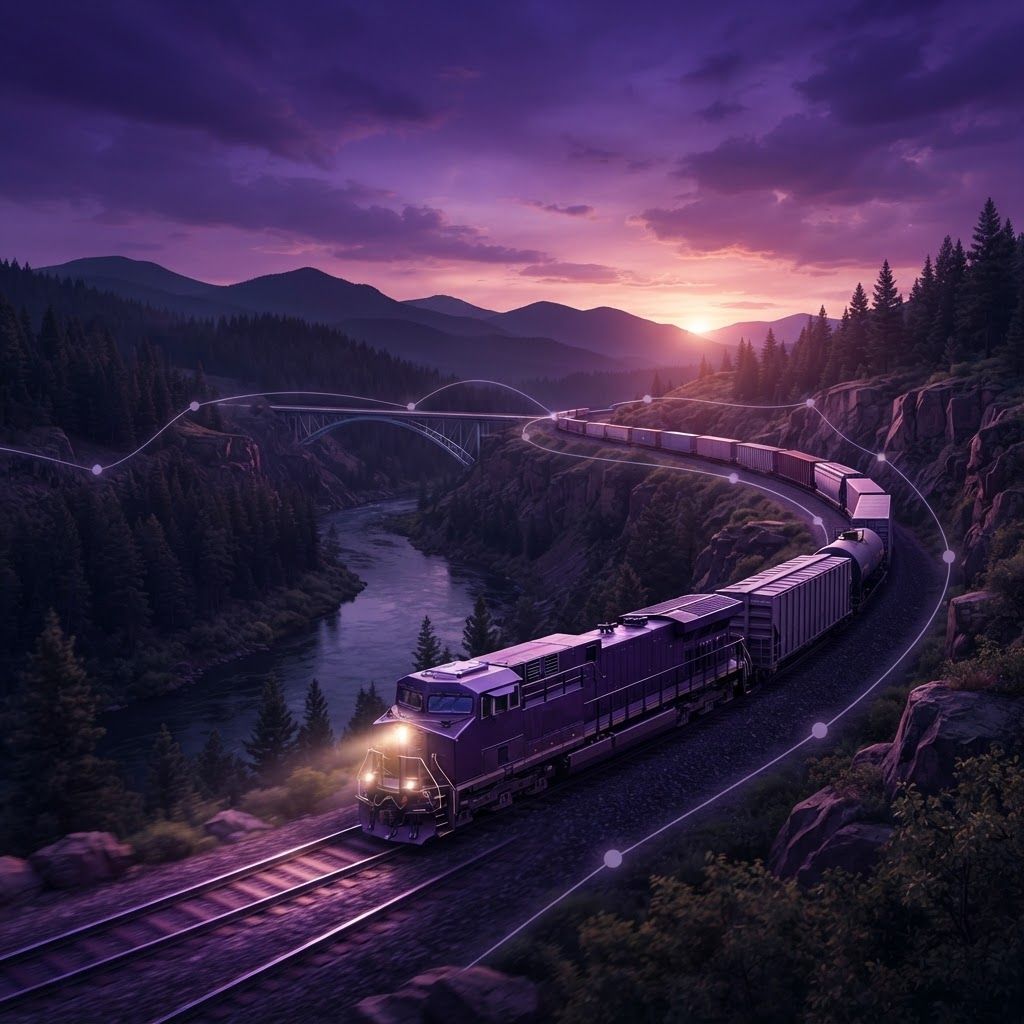
Rail in Boise City: A Different Kind of Network
Rail occupies an unusual position in Boise City. Unlike many western cities where rail is highly visible in daily life, Idaho's capital has a rail story shaped by geography, history, and a long-running gap in passenger service. The Union Pacific mainline crosses southern Idaho, but it bypasses downtown Boise City to the south through Nampa, a routing decision made in the nineteenth century that shaped the region's development pattern for generations. The Boise Depot, a beautiful Spanish-style landmark on the Boise Bench, still stands as a monument to a passenger era that ended decades ago.
What remains is a rail network that matters enormously for freight while barely registering for passengers. Southwestern Idaho's agriculture, food processing, chemicals, lumber, and industrial sectors ship substantial volume by rail because the economics of moving heavy, dense, non-urgent commodities over long distances strongly favor it. A single train can replace hundreds of truckloads at a fraction of the fuel consumption per ton-mile. Understanding which operators serve which segments is essential for any Treasure Valley business evaluating rail.
How Rail Freight Works Locally
Rail service divides into distinct tiers. Class I railroads are the large national carriers that operate mainlines and handle long-haul movements. Short line and regional railroads operate branch lines, typically providing first-mile and last-mile service that connects local shippers to Class I networks. Transload facilities bridge rail and truck, allowing shippers without their own rail siding to still access rail economics. Intermodal service moves containers and trailers on flatcars, combining rail line-haul with truck pickup and delivery.
For most Boise City businesses, the practical question is whether they have direct rail access. Shippers with a private siding can load railcars on their own property. Those without one use transload facilities, accepting an extra handling step in exchange for rail line-haul savings. The break-even generally depends on distance, volume, and commodity density, with rail becoming compelling on longer hauls with consistent volume.
The Top 10 Best Railway Operators in Boise City
1. Union Pacific Railroad
Union Pacific is the dominant rail carrier in southern Idaho and the single most important railway operator for Boise City area shippers. Its mainline across southern Idaho connects the region eastward toward Utah and the central United States and westward toward Oregon and Pacific Northwest gateways.
Union Pacific's value for Treasure Valley shippers lies in network reach and commodity breadth. The railroad handles agricultural products, food and beverage, chemicals, fertilizer, lumber and forest products, industrial materials, and intermodal containers. Its extensive network across the western two-thirds of the country means a Boise-area shipper can reach most major domestic markets and West Coast ports through a single carrier relationship. The company provides shipment visibility tools, rail-served site location assistance for businesses evaluating industrial property, and transload options for shippers without direct track access. For high-volume bulk commodities out of southwestern Idaho, Union Pacific is typically the foundation of the transportation plan.
2. BNSF Railway
BNSF is the other major Class I railroad in the western United States, and while its Idaho presence is concentrated in the northern part of the state rather than the Treasure Valley, it remains highly relevant to Boise City shippers. Freight moving to or from the Pacific Northwest, the northern tier states, or the upper Midwest frequently touches the BNSF network through interchange arrangements.
BNSF is particularly strong in intermodal service and in agricultural products, both of which matter for Idaho commodities. For shippers whose destinations align with BNSF's network strengths, routing through interchange can produce better transit times or rates than a single-carrier path. Its intermodal terminals in the broader Northwest provide container access for Boise City shippers willing to drayage containers to and from those facilities.
3. Boise Valley Railroad
Boise Valley Railroad is the short line operator serving the Treasure Valley directly, and for many local shippers it is the most operationally important rail partner. Operating branch line trackage in the Nampa, Caldwell, and Wilder areas, it provides the local switching and first-mile service that connects Idaho shippers to the Union Pacific mainline.
Short lines like this fill a role that Class I railroads generally cannot serve economically. They handle single-car and small-block shipments, provide flexible switching schedules, and work closely with local industries on siding design and car placement. Boise Valley Railroad serves agricultural shippers, food processors, and industrial customers throughout its territory, moving grain, fertilizer, food products, and general freight. Its responsiveness and local relationships are typically far more personal than what a national carrier provides, which matters when a shipper needs a car spotted on short notice or has an unusual loading requirement.
4. Eastern Idaho Railroad
Eastern Idaho Railroad operates short line trackage across southern and eastern Idaho, and while its territory extends beyond the immediate Boise City area, it is an important part of the state's rail network and relevant to shippers with multi-location Idaho operations.
The railroad serves agricultural and industrial customers throughout its territory, handling potatoes, grain, fertilizer, chemicals, and food products. Like other short lines, its strength is local service quality and willingness to work with smaller-volume shippers. For businesses with facilities across southern Idaho, coordinating with both Boise Valley Railroad and Eastern Idaho Railroad can provide rail access at multiple points.
5. Thunder Mountain Line
The Thunder Mountain Line is Idaho's premier heritage and excursion railway, operating scenic passenger trains from Horseshoe Bend north of Boise City along the Payette River canyon. While not a freight operator, it is arguably the most publicly beloved railway operation in the region and a significant tourism asset.
The excursion experience is genuinely spectacular, following the Payette River through a canyon inaccessible by road for much of its length. Seasonal programming includes spring and summer canyon runs, autumn color trains, and holiday-themed excursions that sell out well in advance. Vintage equipment, open-air cars, and knowledgeable narration make it popular with families, photographers, and rail enthusiasts. For visitors to Boise City looking for a distinctive half-day experience, it consistently ranks among the most memorable options in the area.
6. Transload and Rail-to-Truck Facilities
Transload operators are the practical gateway to rail for the majority of Boise City businesses, because most do not have private rail sidings. These facilities receive rail cars, transfer commodities to trucks or storage, and handle the reverse process for outbound freight.
Treasure Valley transload capabilities cover bulk commodities, lumber and building materials, agricultural products, liquids, and general merchandise. The economics work when rail line-haul savings exceed the cost of the additional handling plus local drayage, which is typically the case on hauls beyond several hundred miles with reasonable volume. Good transload operators provide inventory management, quality handling that minimizes product damage, and flexible scheduling that keeps rail car demurrage charges under control. For a growing shipper, transloading is also a low-commitment way to test rail before investing in private track.
7. Rail-Served Industrial Site Developers
An important category adjacent to rail operations is the developers and industrial property specialists focused on rail-served sites throughout the Treasure Valley. As the region's industrial base has expanded, demand for property with existing or feasible rail access has grown substantially.
These organizations help businesses evaluate whether a site can be economically served by rail, what track construction would cost, and how switching arrangements would work. For manufacturers, food processors, and distributors making long-term facility decisions, rail access can materially change operating economics over the life of the building. Both Union Pacific and the regional short lines maintain site-selection resources that support this analysis.
8. Amtrak
Amtrak deserves inclusion despite the fact that it does not currently serve Boise City, because the story of passenger rail in Idaho is very much an active conversation. Amtrak's Pioneer route, which ran through southern Idaho connecting Seattle and Portland with Salt Lake City, Denver, and Chicago, was discontinued in 1997. Since then, restoring passenger service along the corridor has been a recurring subject of regional advocacy and federal planning studies.
Today, Boise City residents wanting to travel by Amtrak typically connect through stations in other states or use Amtrak Thruway bus connections to reach the nearest served points. Recent federal infrastructure funding has renewed corridor identification work that includes potential Pioneer route restoration, though any actual service return would require years of planning, funding, and negotiation. For anyone tracking the region's transportation future, this remains one of the more consequential open questions.
9. Rail Car Leasing and Fleet Management Providers
Shippers with sustained rail volume often find that leasing rail cars produces better economics and reliability than depending entirely on railroad-supplied equipment. Rail car lessors and fleet managers serve Idaho shippers with covered hoppers for grain and agricultural products, tank cars for liquids and chemicals, boxcars, and specialized equipment.
The advantages are equipment availability during peak seasons, car specifications matched precisely to the commodity, and better control over loading schedules. Fleet management services handle maintenance compliance, repair coordination, and utilization tracking. For Idaho agricultural shippers facing intense seasonal demand peaks around harvest, dedicated leased equipment can be the difference between shipping on schedule and watching product sit.
10. Idaho Rail Advocacy and Industry Organizations
Rounding out the list are the industry associations and advocacy organizations that shape rail policy and coordination across Idaho. These groups work on infrastructure funding, at-grade crossing safety, short line preservation, passenger rail restoration, and coordination between railroads and state transportation planning.
Their practical value to businesses is information and influence. They track regulatory developments, provide forums where shippers and railroads discuss service issues, and represent rail interests in state and federal transportation planning. For companies with significant rail dependence, participation in these organizations provides both early awareness of changes and a channel for raising systemic concerns.
Is Rail Right for Your Freight?
Rail excels with heavy, dense commodities moving long distances in consistent volumes where transit speed is not the primary concern. Grain, fertilizer, chemicals, lumber, aggregates, processed food, and containerized consumer goods all move well by rail. The cost advantage over trucking grows with distance and weight.
Rail is a poor fit for small shipments, highly time-sensitive freight, short hauls, and products requiring frequent small deliveries. Transit times are longer and less precise than truckload, and the network is inherently less flexible. Businesses evaluating rail should model total landed cost including drayage, transload handling, demurrage risk, and the working capital effect of longer transit and larger shipment sizes.
Trends Shaping Idaho Rail
Three developments are worth watching. First, federal infrastructure investment has increased funding available for short line rehabilitation and crossing improvements, which improves service quality on branch lines serving Idaho industry. Second, sustainability pressure is pushing more shippers to evaluate rail seriously, since rail emits substantially less carbon per ton-mile than trucking. Third, the passenger rail conversation has more momentum than at any point since the Pioneer's discontinuation, though realistic timelines remain long.
Technology is also changing rail service quality. Improved shipment visibility, electronic documentation, and better car-tracking tools have reduced one of rail's historical disadvantages relative to trucking, where shippers often felt they lost sight of freight once it entered the rail network.
Final Thoughts
Rail in Boise City is a specialist tool rather than a general-purpose one, but for the right freight it is unmatched on cost and environmental performance. Union Pacific provides the mainline reach, Boise Valley Railroad and Eastern Idaho Railroad provide the local connectivity, transload operators open access to shippers without private track, and the Thunder Mountain Line preserves a genuinely wonderful piece of Idaho rail heritage. Businesses that model rail economics honestly and build relationships with both the Class I carrier and the relevant short line often find meaningful savings hiding in their transportation spend.