
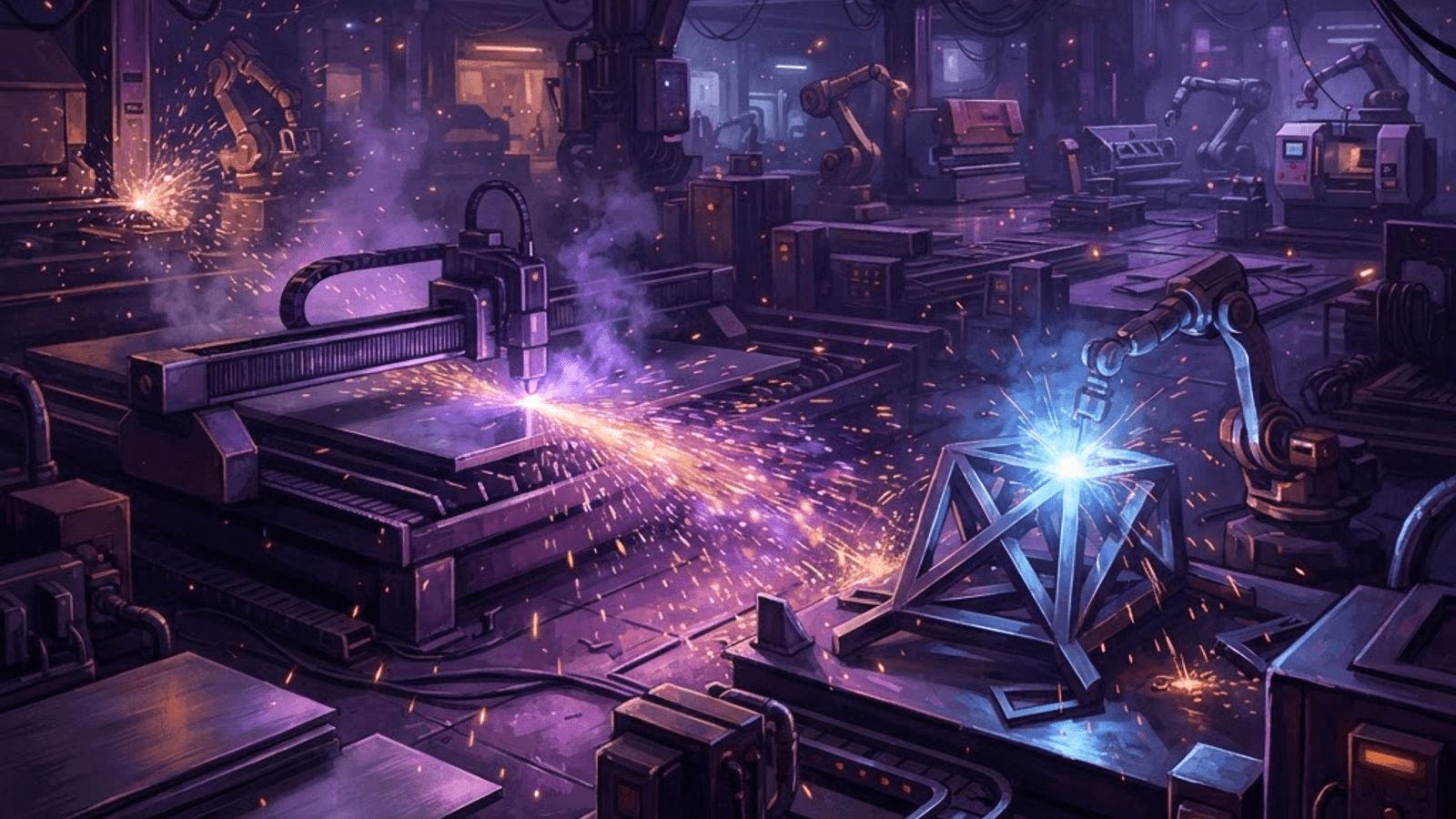
Metalworking in an Engineering Region
Metal fabrication and machining form the backbone of any industrial economy, and the Huntington Beach area has an especially deep base. Aerospace and defense work established exacting standards decades ago, and those standards persist in shops that now serve a much broader customer mix: marine and boating, medical devices, automotive and motorsport, architectural and ornamental work, and general industrial maintenance.
The sector includes several distinct disciplines. Precision machining removes material from solid stock to produce parts with tight tolerances. Sheet metal fabrication cuts, bends, and joins flat material into enclosures, brackets, and panels. Welding and structural fabrication join heavier sections for frames and assemblies. Finishing operations apply plating, anodizing, powder coating, and passivation. Many shops combine several of these, while others specialize narrowly.
Understanding Shop Capabilities
Capability differences are substantial and consequential. A shop with three-axis milling equipment cannot efficiently produce a part requiring simultaneous five-axis motion. A shop set up for aluminum may struggle with hardened steel or titanium. A production shop optimized for repeat runs may quote poorly on a single prototype. Matching the job to the shop is the single most important factor in getting good pricing and delivery.
Quality systems matter as much as equipment. Shops serving aerospace and medical customers maintain calibration programs, inspection documentation, material certification traceability, and first article inspection procedures. These systems cost money to maintain and are reflected in pricing, which is appropriate when they are needed and wasteful when they are not.
Ten Metalworks Companies Serving Huntington Beach
Surf City Precision Machining provides multi-axis milling and turning for aerospace, medical, and industrial customers, maintaining inspection equipment and documentation practices suited to demanding tolerance requirements.
Pacific Coast Sheet Metal Works fabricates enclosures, panels, brackets, and ducting using laser cutting, press brake forming, and welding, offering both prototype quantities and production runs.
Goldenwest Welding and Structural Fabrication builds frames, platforms, tanks, and structural assemblies in steel, stainless, and aluminum, with certified welders qualified across multiple processes and positions.
Harbour Marine Metal Fabrication specializes in stainless and aluminum work for boats and waterfront structures, including railings, hardware, T-tops, and custom components engineered for salt water service.
Bolsa Metal Finishing Services provides anodizing, powder coating, plating, passivation, and polishing, with process control appropriate for both cosmetic and functional coating requirements.
Edinger Architectural Metalworks produces decorative and structural architectural elements including stairs, railings, gates, screens, and facade components, collaborating with architects from design development through installation.
Oceanview Waterjet and Laser Cutting offers precision cutting services across a wide range of materials and thicknesses, serving other fabricators as well as end customers needing profiles cut to drawing.
Seacliff Tube and Pipe Fabrication performs bending, forming, and welding of tubular structures for roll cages, handrails, exhaust systems, and process piping.
Coastline Prototype Metalworks focuses on rapid turnaround for engineering teams, producing one-off parts and small batches with direct communication between machinists and designers.
Beachfront Industrial Repair and Machining provides field service, equipment repair, shaft and bearing work, and emergency machining for facilities needing production equipment returned to service quickly.
Trends in Metalworking
Automation continues to spread to smaller shops. Automatic bar feeders, pallet changers, and robotic loading allow lights-out operation that improves capacity without proportional labor increase. Offline programming and simulation reduce setup time and scrap on complex parts.
Additive manufacturing in metal has moved beyond novelty for certain applications, particularly complex geometries that would be difficult or impossible to machine. Most shops treat it as complementary rather than competitive, using printed near-net shapes that are then finish machined.
Workforce development remains a persistent industry concern. Experienced machinists and welders are retiring faster than replacements enter the trade, and shops that invest in apprenticeship and training have gained a real competitive advantage in capacity and quality consistency.
Selecting and Working with a Shop
Provide complete information when requesting a quote: dimensioned drawings or solid models, material specification, quantity, tolerance requirements, finish, and any applicable standards. Incomplete packages produce padded quotes because shops price uncertainty conservatively.
Discuss design for manufacturability. Small changes such as relaxing non-critical tolerances, adopting standard corner radii, or adjusting hole sizes to standard tooling can reduce cost substantially without affecting function. A good shop will suggest these proactively.
Be realistic about lead times and communicate priorities clearly. Rush work costs more because it displaces scheduled jobs, and shops appreciate customers who distinguish genuine urgency from habitual expediting.
For ongoing work, invest in the relationship. A shop that understands your products, keeps your fixtures, and knows your quality expectations will consistently deliver better results than one chosen fresh on price for each order.
Final Thoughts
The metalworking community around Huntington Beach combines aerospace-grade discipline with the flexibility of small independent shops. That combination serves an unusually wide range of customers, from engineers developing medical devices to homeowners commissioning custom railings. Choose a shop whose capability genuinely matches your requirements, communicate thoroughly, and treat good shops as long-term partners rather than interchangeable vendors.