
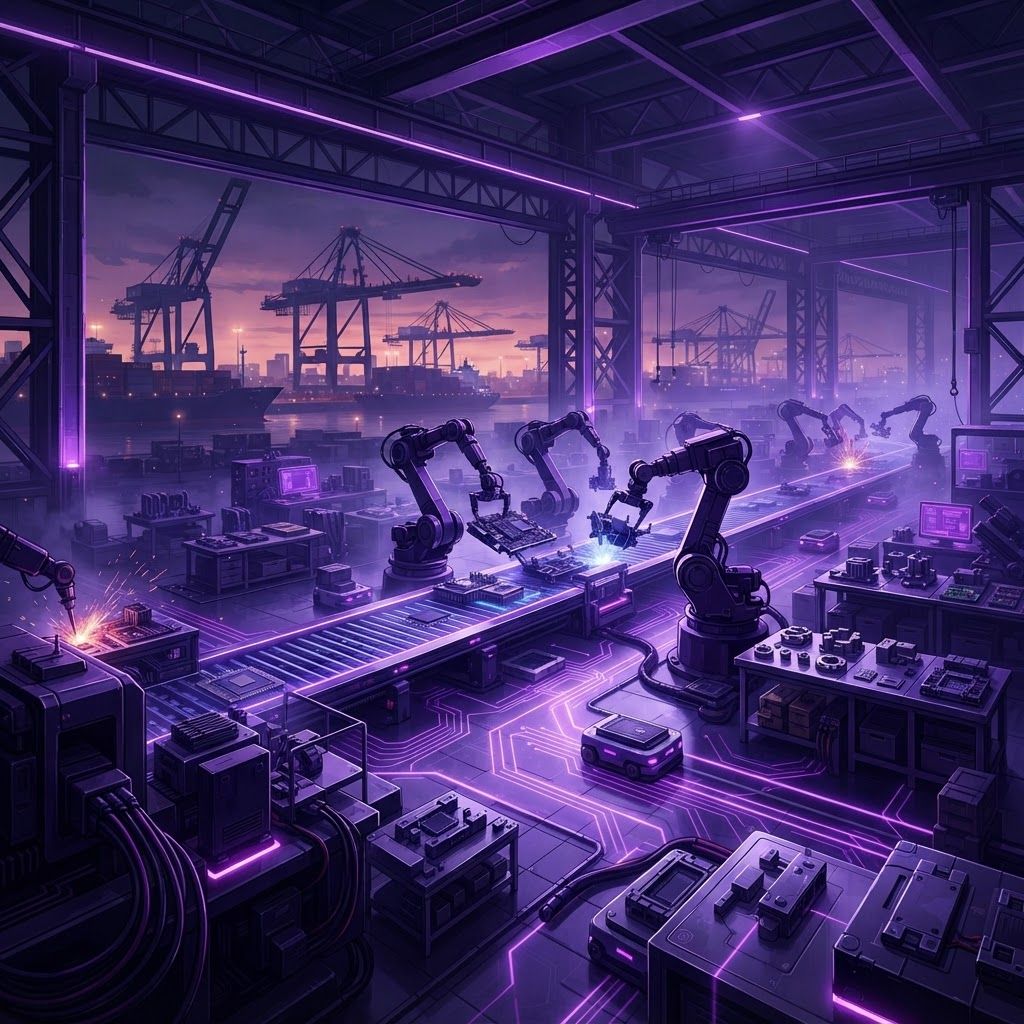
An Industrial City That Never Stopped Building
Long before software became the region's most publicized industry, Tacoma built things. Lumber, rail equipment, ships and heavy machinery shaped the city's economy and left behind something more durable than any single product: a workforce that understands tolerances, materials and delivery schedules. That inheritance is why hardware manufacturing remains one of Tacoma's most competitive sectors, and why companies from across the country source components here.
What has changed is the nature of the work. Volume commodity production has largely moved offshore, and the manufacturers that thrived did so by climbing the complexity ladder. Today's Tacoma shops specialize in tight-tolerance machining, welded assemblies, marine-grade fabrication, electronics assembly and low-to-mid volume production where engineering support matters more than unit price. Proximity to aerospace supply chains, military installations and a working deep-water port reinforces that positioning.
The Capabilities That Define the Market
Buyers evaluating Tacoma manufacturers generally encounter five capability clusters. Precision machining covers multi-axis milling and turning for aerospace, medical and instrumentation parts. Sheet metal and structural fabrication serves industrial equipment and infrastructure. Marine and heavy fabrication addresses vessels, barges and port equipment. Electronics manufacturing services handle circuit assembly, cabling and box build. Finally, contract assembly and integration brings those pieces together into finished products.
Industry trends are pushing all five toward automation and traceability. Robotic welding cells and automated inspection have become common even in mid-sized shops, driven by labor availability rather than volume. Digital quality systems now track material certifications and inspection data at the serial number level, which large customers increasingly require. Additive manufacturing has found a genuine niche in tooling, fixtures and prototype iteration rather than replacing conventional production. And reshoring interest has increased quoting activity across the region as buyers reassess long, fragile overseas supply chains.
The Top 10 Hardware Manufacturers Serving Tacoma
1. Commencement Precision Works is a benchmark machining operation with multi-axis capability and an established aerospace quality system. Engineers value its design-for-manufacturability feedback, which routinely removes cost from parts before the first chip is cut.
2. Port Industrial Fabrication handles large structural and heavy plate work for port equipment, material handling systems and industrial infrastructure. Its certified welding program and in-house crane capacity let it take on assemblies most shops cannot move, let alone build.
3. Rainier Sheet Metal Company specializes in enclosures, chassis and brackets, combining laser cutting, forming and powder coating under one roof. Quick-turn prototype service is its main differentiator for hardware startups.
4. Sound Electronics Assembly provides surface mount and through-hole circuit assembly, cable harnesses and full box build. The company maintains strong traceability practices and supports low-volume, high-mix production that larger contract manufacturers decline.
5. Foss Marine Manufacturing builds and repairs marine components and vessel systems, drawing on the region's shipbuilding tradition. Corrosion-resistant fabrication and on-water service capability define its practice.
6. Evergreen Tool and Die produces tooling, dies, jigs and fixtures for other manufacturers. It functions as infrastructure for the local industrial ecosystem and is often the reason a neighboring shop can hit a schedule.
7. Pierce Composite Systems works in advanced composites and bonded structures, serving aerospace, transportation and recreational equipment customers who need strength at reduced weight.
8. Tideline Machine and Repair focuses on industrial maintenance, reverse engineering and replacement parts for aging equipment. When an obsolete component fails and no supplier remains, this is the kind of shop that recreates it from measurements.
9. Northwest Instrument Manufacturing builds sensors, gauges and measurement devices, combining precision machining with calibration and testing services under a documented quality regime.
10. Harborline Contract Assembly rounds out the list by integrating machined parts, electronics and enclosures into finished, tested products, offering kitting, packaging and fulfillment for companies without their own assembly floor.
How to Evaluate a Manufacturing Partner
Certifications are the fastest filter. Quality management registration signals documented process control, while aerospace and medical work require sector-specific accreditation. Welded structures should come from shops with recognized welding procedure qualifications. Ask to see current certificates rather than accepting a claim on a website.
Then visit the floor. A walkthrough reveals more than any capability statement. Look at housekeeping, machine condition, work-in-process organization and whether inspection happens in a controlled area or at the operator's convenience. Ask how nonconforming material is segregated and how corrective actions are documented.
Capacity deserves direct questioning. Request current lead times, machine utilization and the number of qualified operators for the processes your part requires. A shop with excellent equipment and one person who can run it is a schedule risk. Finally, discuss engineering support explicitly, because the difference between a vendor and a partner is usually whether they will tell you your drawing is expensive to build.
The Outlook for Tacoma Hardware
The medium-term picture is encouraging. Reshoring pressure, defense and aerospace demand, and infrastructure investment all favor regions with existing industrial capability and port access. Tacoma has both. The binding constraint is skilled labor, which is why local manufacturers have invested heavily in apprenticeships and partnerships with regional technical programs.
For buyers, the practical takeaway is that Tacoma is best approached as a source of engineered hardware rather than cheap parts. Companies that engage early, share design intent and treat manufacturers as collaborators consistently get better outcomes than those who simply distribute drawings and wait for the lowest quote.