
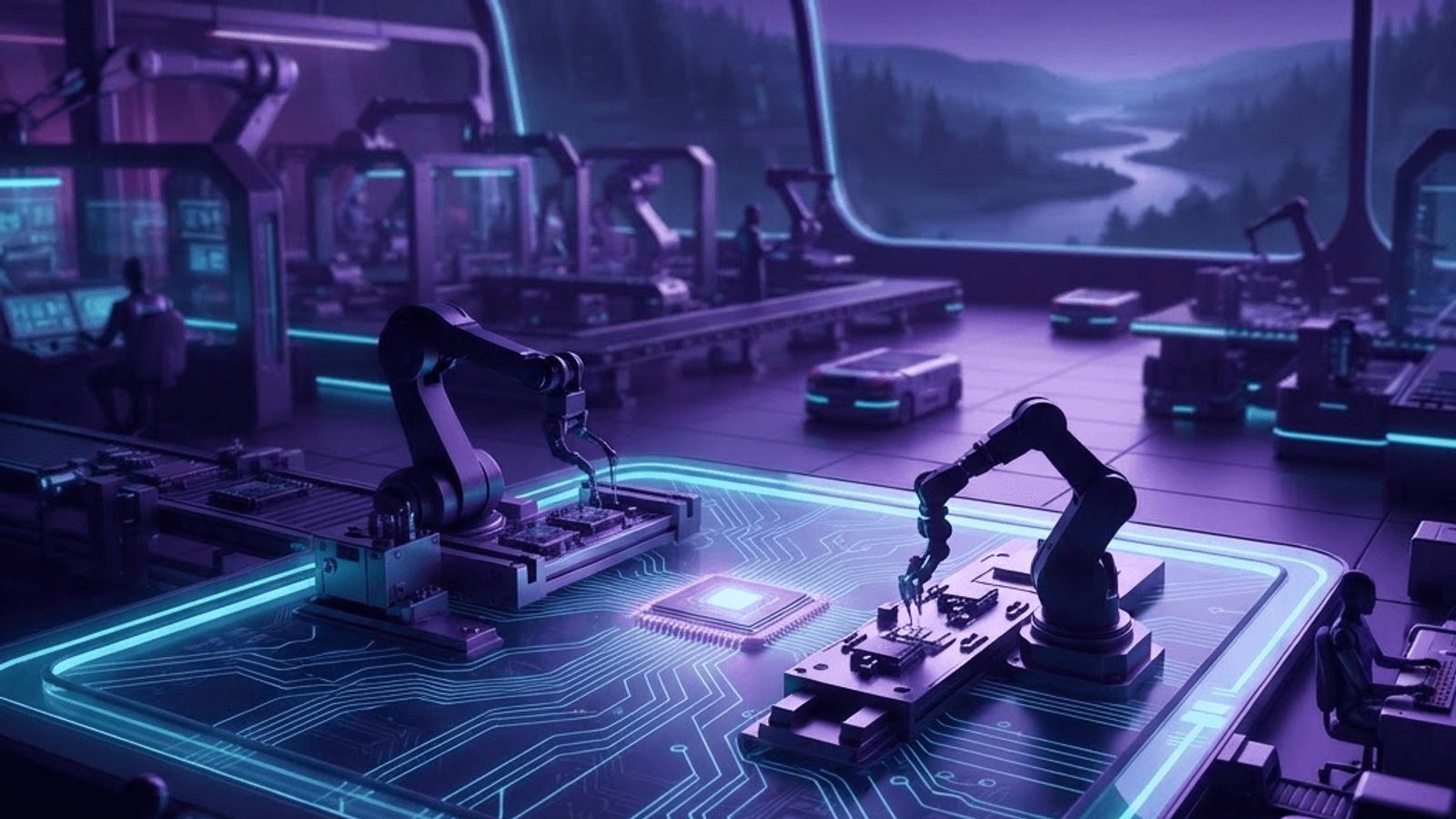
Manufacturing Is Still the Backbone of the Regional Economy
It is easy to describe Eugene through its university and its software companies, but the machinery of the local economy has always included metal, wood, sensors, and assembly lines. The southern Willamette Valley supports an unusually broad manufacturing base for a city of its size, spanning recycling and materials recovery equipment, wood products machinery, electric vehicles, scientific instruments, food processing equipment, and contract electronics.
Several structural advantages explain this. Access to rail and Interstate 5 places producers within a day of Portland, Seattle, and Northern California markets. Relatively affordable industrial land compared with metro Portland keeps facility costs manageable. Regional utilities supply comparatively clean and stable power, which matters for energy-intensive processes. And a skilled trades pipeline supported by Lane Community College and regional apprenticeship programs keeps the workforce replenished.
What Buyers Should Evaluate in a Manufacturing Partner
Sophisticated buyers look past the quoted unit price. Quality system certification, traceability of materials, first-article inspection discipline, and documented corrective action processes determine whether a supplier can hold tolerance across thousands of units rather than dozens. Capacity headroom matters as well, because a partner running at full utilization has no room to absorb your growth or a rush order.
Engineering support is the other differentiator. The strongest Eugene manufacturers participate in design for manufacturability review, suggesting material substitutions, tolerance relaxations, and assembly simplifications that reduce cost without compromising function. That collaborative capability is typically worth more than a modest per-unit discount.
The Leading Hardware Manufacturers in Eugene
Bulk Handling Systems is the standout name in advanced materials recovery equipment, designing and building sorting systems that combine conveyors, optical sorters, robotics, and machine vision. Its systems operate in recycling facilities worldwide, and the company has become a regional center of gravity for automation and controls engineering talent.
Arcimoto brought electric vehicle assembly to Eugene, building lightweight three-wheeled electric vehicles and developing in-house expertise in battery systems, composite bodywork, and low-volume vehicle assembly. Regardless of market cycles, the engineering knowledge it concentrated in the region has been significant.
Ninkasi Brewing and similar beverage producers may not be classic hardware firms, but their in-house fabrication and process engineering teams have driven demand for local stainless fabrication, tanks, and automation, strengthening the supplier network that other manufacturers rely on.
Sierra Pine and regional wood products manufacturers continue to produce composite panels and engineered wood components, supported by heavy machinery, kiln control systems, and dust management engineering that require constant mechanical innovation.
Contract electronics manufacturers in the area handle circuit board assembly, cable harnesses, and box builds for instrument and device companies. Their value is in flexibility, supporting prototype runs and modest production volumes that large national houses decline.
Precision machine shops across Eugene and Springfield offer computer controlled milling and turning, often with in-house inspection and finishing. These shops serve aerospace, medical device, and semiconductor equipment supply chains, where documentation and repeatability are as important as chip removal.
Scientific instrument builders serve research laboratories with optical, environmental monitoring, and laboratory automation hardware. Proximity to university research groups gives them an unusually direct feedback loop with end users.
Food processing equipment fabricators supply the valley agricultural sector with sorting, washing, packing, and cold chain hardware, designed around sanitary standards and seasonal throughput spikes.
Sheet metal and structural fabricators provide enclosures, frames, and weldments, increasingly with integrated powder coating and assembly so that customers receive a finished subassembly rather than parts.
Emerging robotics and automation integrators round out the list, retrofitting existing production lines with vision systems, collaborative robots, and modern controls. For many established manufacturers, this retrofit work delivers a faster return than new capital equipment.
Trends Reshaping Willamette Valley Manufacturing
Reshoring has been the most consequential shift. Supply chain disruption taught product companies that a supplier a few hours away can be worth a premium, and Eugene manufacturers have absorbed meaningful new demand as a result. Automation is the second trend, driven less by cost cutting than by persistent difficulty hiring for repetitive roles. Third, sustainability requirements from customers have pushed producers to document energy use, material sourcing, and waste diversion, which regional firms are generally well positioned to do given local environmental culture.
Practical Sourcing Advice
Visit the floor before you commit. A short walkthrough reveals more about organization, maintenance discipline, and quality culture than any capability deck. Request a sample inspection report from a recent job. Understand where the supplier sources raw material and what the lead time exposure looks like. Negotiate tooling ownership explicitly so you are not locked in. And start with a pilot order sized to test the relationship rather than the price.
Final Thoughts
Eugene manufacturers combine genuine technical depth with the responsiveness of mid-sized operations, which is an increasingly attractive combination for product companies tired of long overseas lead times. Whether you need high-volume automated systems, precision machined components, or a partner to help take a prototype into production, the regional supplier base can very likely support it.