
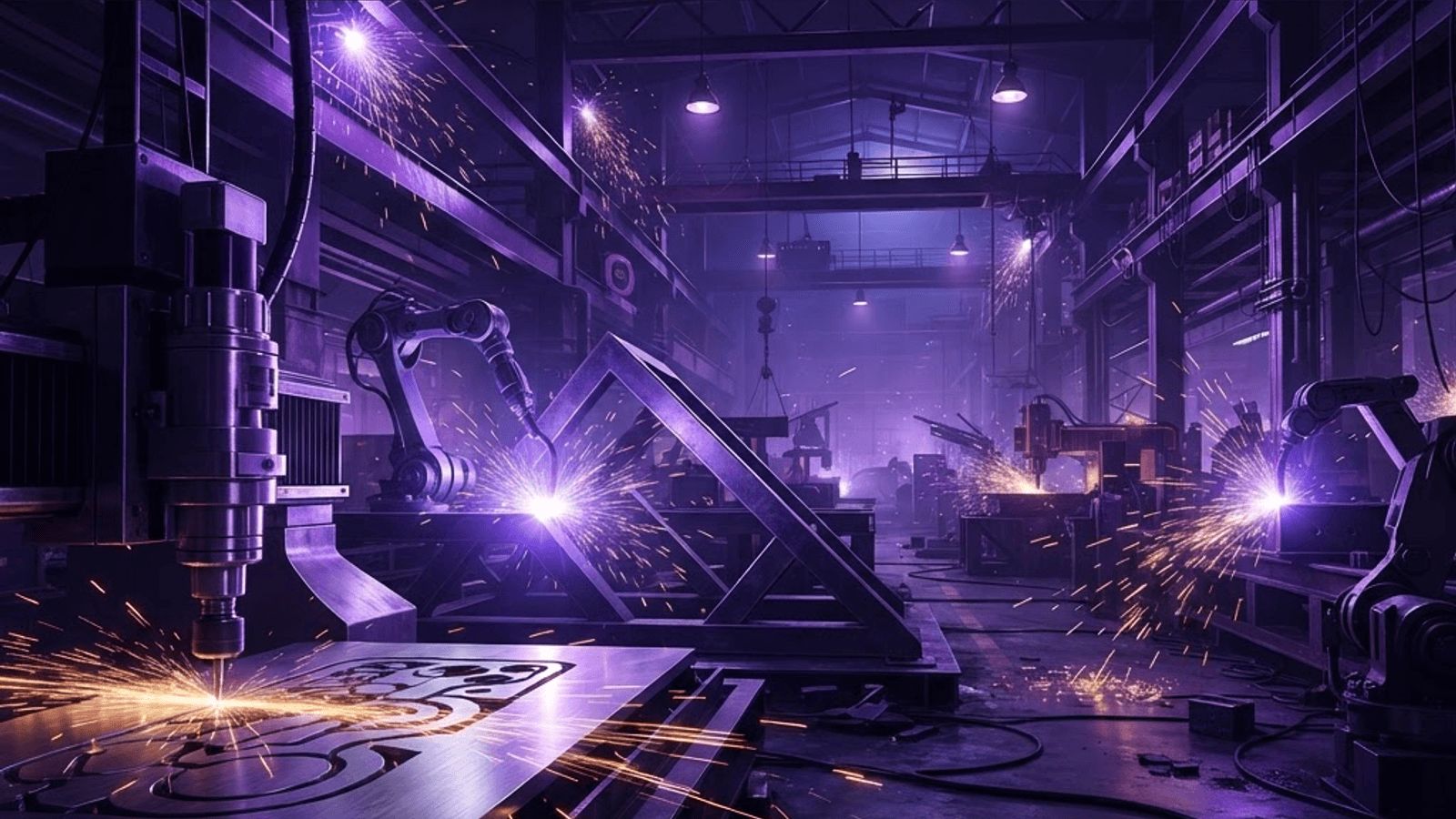
Metalwork Is Where Design Meets Reality
Every structure, machine, and piece of equipment eventually depends on someone who can cut, form, join, and finish metal accurately. Elk Grove's metalworking sector serves an unusually broad customer base: agricultural equipment operators needing repairs that cannot wait, general contractors requiring structural steel and miscellaneous metals, manufacturers sourcing machined components, and homeowners commissioning railings and gates.
The category is broad enough that the word fabricator alone tells you very little. A shop running five-axis CNC machining to a few thousandths of an inch and a shop welding heavy plate for equipment frames are both metalworks companies, and they rarely compete for the same job.
The Main Disciplines
Sheet metal fabrication involves laser or plasma cutting, press brake forming, and welding of relatively thin material into enclosures, ducts, brackets, and panels. Structural steel fabrication handles beams, columns, and connections to engineered drawings, and typically requires certified welding procedures and inspection. Precision machining removes material from solid stock on lathes and mills to produce components with tight tolerances. Ornamental and architectural metalwork prioritizes appearance alongside strength. Industrial welding and mobile repair keep existing equipment running.
Ten Metalworks Companies in Elk Grove
Elk Grove Precision Machining operates CNC mills and turning centers for aerospace-adjacent, medical, and industrial customers. Its inspection capability, including a coordinate measuring machine and documented first-article reporting, is what qualifies it for tightly toleranced work.
Valley Steel Fabricators handles structural packages for commercial construction: moment frames, stairs, canopies, and embeds. Certified welders and detailing capability allow it to take a structural engineer's drawings straight into shop production.
Laguna Sheet Metal Works focuses on enclosures, control panels, ductwork, and custom brackets. Laser cutting with in-house forming means prototype to production happens without external handoffs, which compresses development timelines.
Franklin Ornamental Iron produces gates, railings, fencing, and decorative architectural elements. Its finishing process, including proper surface preparation before powder coating, is why its exterior work holds up in Central Valley heat and winter moisture.
Sierra Welding and Industrial Services provides mobile welding and on-site repair for agricultural and industrial clients. When a harvester frame cracks during season, its ability to arrive with a truck-mounted rig is worth more than any price advantage.
Stonelake Metal Finishing supplies powder coating, sandblasting, passivation, and anodizing to other fabricators and manufacturers. Consistent finish quality and reliable turnaround make it an essential link in the local supply chain.
Bond Road Machine and Tool builds fixtures, jigs, tooling, and replacement parts for manufacturers. Reverse engineering an obsolete component from a worn sample is routine work here, and it keeps older production equipment in service.
Harvest Agricultural Metalworks specializes in equipment for the surrounding farming economy, including custom implements, trailers, bins, and modifications. Its designs reflect real field conditions rather than catalog assumptions.
Emerald Architectural Metals produces facade panels, sunshades, handrails, and feature stairs for commercial interiors and exteriors. Coordinating with architects on finish samples and mockups is a core part of its service.
Grove Laser and Waterjet Cutting offers cutting services to other shops and end customers, handling materials from thin aluminum to thick stainless plate. Waterjet capability matters when heat-affected zones would compromise a material.
Trends in Regional Metal Fabrication
Automation is arriving unevenly but decisively. Fiber lasers cut faster and cheaper than older CO2 machines, robotic welding cells handle repetitive seams consistently, and offline programming reduces machine idle time. Shops that invested have widened their cost advantage on volume work.
Skilled labor remains the constraint. Experienced welders, machinists, and press brake operators are in short supply nationally, and Elk Grove is no exception. The companies handling it best run apprenticeship programs and partner with regional trade education rather than competing solely on wages.
Material traceability is increasingly required. Structural and regulated work demands mill test reports and documented welding procedures, and shops with mature quality systems win that business by default.
Selecting the Right Shop
Start with tolerance. If your drawing calls for tight tolerances, verify the shop's inspection equipment rather than its machine list, because measurement capability is the real constraint. If your job is structural, confirm welder certifications and whether the shop works under a recognized fabrication quality program.
Discuss material sourcing and lead times, especially for stainless and aluminum grades that are not stocked locally. Ask how the shop handles design-for-manufacture feedback; a fabricator who suggests a bend relief or a different weld joint before cutting will save you money.
Request a shop visit and look at fit-up quality on parts in progress rather than polished finished pieces. Clean weld preparation and organized material staging correlate strongly with dimensional accuracy in the finished assembly.
Final Thoughts
Metalworks companies in Elk Grove cover everything from thousandths-of-an-inch machining to heavy structural steel and emergency field repair. The right partner depends far more on matching capability to requirement than on finding the single best shop overall. Define your tolerances, volumes, finish expectations, and schedule clearly, then choose the fabricator whose equipment and quality systems were built for exactly that kind of work.