
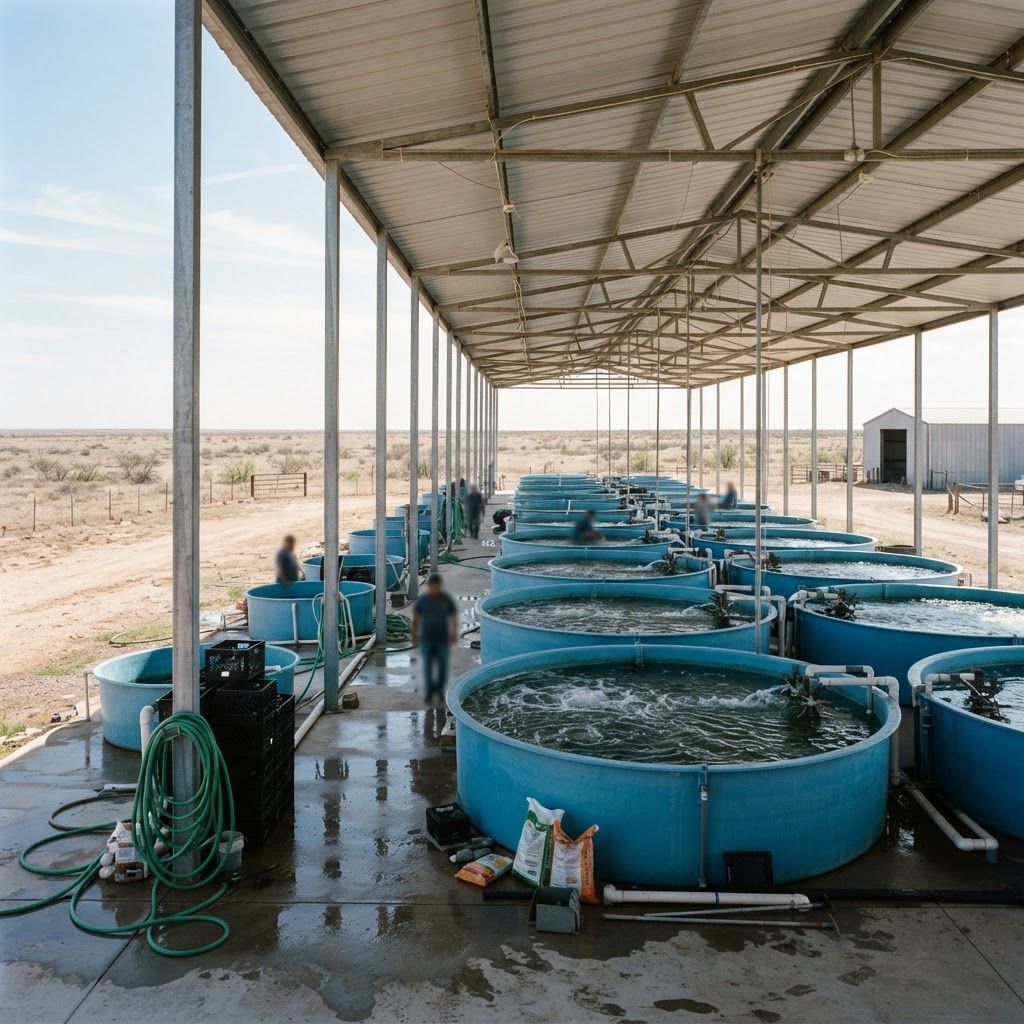
A Fishery Sector in the Middle of the High Plains
The idea of a fishery industry in a semi-arid West Texas city sounds improbable until you look at how the sector actually works inland. Lubbock's fishery businesses fall into three distinct groups: recirculating aquaculture and pond-based fish farming, wholesale seafood distribution serving restaurants and grocers across a very wide region, and specialist services such as pond stocking, fish health management and aquaculture equipment supply.
Distance from the coast is precisely what creates the opportunity. Restaurants, grocery chains and institutional kitchens across the South Plains need reliable cold-chain seafood, and a city with strong highway and air connections plus substantial cold storage capacity is a natural distribution point. Meanwhile, controlled-environment aquaculture is genuinely well suited to the region because it recirculates water rather than consuming it at agricultural rates.
How the Sector Is Evaluated
Buyers judge these companies on cold-chain integrity, traceability from farm or vessel to plate, species availability and consistency, food safety certification, and honesty about substitution. In aquaculture, the criteria shift toward water-use efficiency, fish health protocols, feed conversion performance and biosecurity.
The Top 10 Fishery Companies Serving Lubbock
1. Caprock Aquaculture
The most established recirculating aquaculture operation in the area, Caprock Aquaculture raises tilapia and catfish in indoor tank systems with filtration that reuses the great majority of its water. Its appeal to local chefs is freshness measured in hours rather than days, and its controlled environment means year-round supply without seasonal gaps. Water efficiency also makes it a defensible model in a region watching every acre-foot.
2. South Plains Seafood Distributors
A full-line wholesale distributor supplying restaurants, hotels and independent grocers across West Texas, South Plains Seafood Distributors brings in fresh and frozen product from Gulf, Pacific and international sources. Its reputation rests on cold-chain discipline and consistent delivery schedules to towns that larger national distributors serve infrequently, which makes it essential infrastructure for regional restaurant menus.
3. Llano Fish Farms
Operating pond-based production alongside a hatchery, Llano Fish Farms supplies both food fish and stocker fish for private lakes and ranch ponds. The stocking side is a significant regional business, serving landowners managing recreational fisheries. Its hatchery expertise in largemouth bass, bluegill and channel catfish makes it a first call for pond owners planning a multi-year management programme.
4. Hub City Fresh Fish Market
Operating as both a retail counter and a small-scale wholesaler, Hub City Fresh Fish Market has built a following among home cooks and chefs who want species selection beyond standard supermarket offerings. Frequent air-freighted deliveries and clear labelling of origin and harvest method have earned it credibility in a market where seafood provenance is often vague.
5. West Texas Aquaculture Systems
Rather than producing fish, this company designs, installs and services recirculating aquaculture systems, supplying tanks, biofilters, aeration equipment, pumps and monitoring instrumentation. As indoor aquaculture expands across the interior United States, technical suppliers like this are the enabling layer, and its regional service coverage means downtime is measured in hours rather than weeks.
6. Panhandle Shrimp Company
Inland shrimp farming has grown steadily in Texas, and Panhandle Shrimp Company produces marine shrimp in biofloc and recirculating systems using engineered saltwater. The product commands a premium because it reaches customers live or same-day fresh, something coastal supply chains struggle to match this far inland. Its biosecurity protocols are a genuine competitive asset.
7. Redbud Cold Chain & Seafood Logistics
Specialising in temperature-controlled storage and transport for seafood and other perishables, this company provides the warehousing, blast freezing and refrigerated distribution that the rest of the sector depends on. For distributors and restaurant groups it removes the need to own cold assets, and its documented temperature monitoring supports food safety audits.
8. Texas Plains Fish Health Services
A specialist consultancy and diagnostic service, Texas Plains Fish Health Services supports aquaculture operators and pond managers with water quality testing, disease diagnosis, treatment planning and biosecurity auditing. Fish health problems escalate quickly, so rapid local diagnostics prevent losses that would otherwise be catastrophic for a single-site producer.
9. Lubbock Institutional Seafood Supply
Focused on schools, hospitals, university dining and correctional facilities, this supplier deals in portion-controlled and value-added seafood products where consistency, nutrition specification and documented sourcing matter more than variety. Its comfort with public procurement processes and reliable pricing schedules make it a fixture in institutional contracts across the region.
10. Caprock Bait & Sportfish Supply
Serving the recreational side of the fishery economy, Caprock Bait & Sportfish Supply provides live bait, forage fish and pond management inputs to anglers, lake associations and landowners. It is a modest business in revenue terms but a culturally important one, supporting the reservoir and playa lake fishing that many South Plains residents enjoy.
Trends Shaping Inland Fisheries
Land-based recirculating aquaculture is the defining trend, driven by consumer demand for fresh fish, pressure on wild stocks and technology that has become considerably more affordable. Traceability is the second force: restaurant customers increasingly ask where fish came from, and suppliers who can answer precisely win menu placement. Water stewardship is the third, and it favours recirculating systems that reuse water many times over.
Feed innovation, including alternative proteins that reduce reliance on wild-caught fishmeal, is also improving the sustainability profile of inland aquaculture and gradually lowering input costs.
Choosing a Fishery Partner
Restaurants should prioritise delivery reliability and species consistency, and should ask directly about substitution policy. Landowners stocking ponds should look for hatcheries offering multi-year management plans rather than one-off fish sales. Aquaculture entrants should evaluate equipment suppliers on local service capability above all else, because a failed biofilter is an emergency.
Final Thoughts
Lubbock's fishery sector is a good example of an industry adapting to geography rather than being limited by it. Between recirculating aquaculture, disciplined cold-chain distribution and specialist technical services, the city supports a surprisingly complete fishery ecosystem. For chefs, retailers and landowners across the South Plains, that means fresh, traceable fish is far more accessible than the map suggests.