
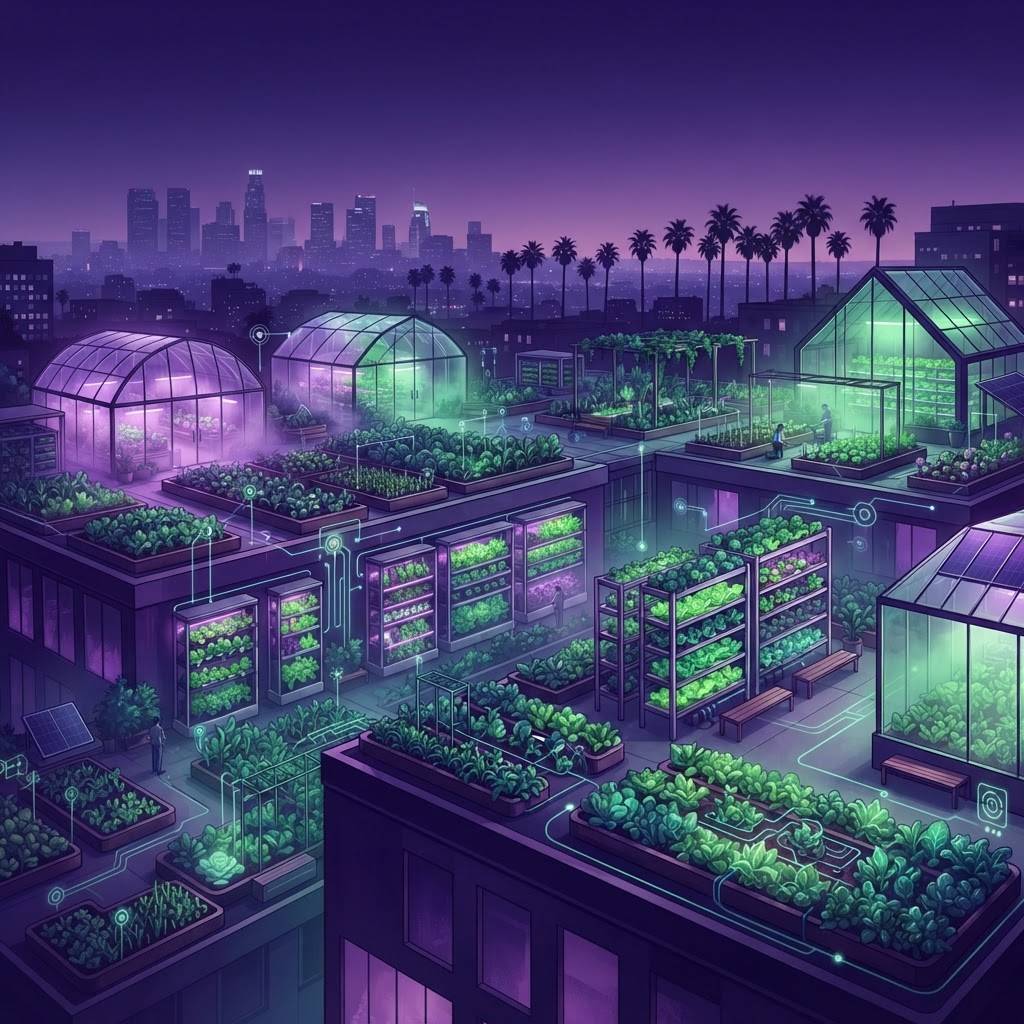
Agriculture in an Urban Setting
Farming and Hollywood are not an obvious pairing, yet agriculture operates here in forms adapted to dense urban conditions. Rooftop farms supply restaurants within walking distance. Controlled environment facilities grow leafy greens year-round in converted industrial space. Community farms produce food while serving educational and social functions. And regional farming operations maintain a strong presence through direct supply relationships with city buyers.
The economics work because proximity has value. Produce harvested hours before service retains flavor and shelf life that shipped product cannot match, and chefs will pay for that difference. Urban farming also shortens the feedback loop between grower and buyer, allowing varieties to be selected for specific menus.
What Distinguishes a Strong Farming Operation
Consistency of supply is the first test. A restaurant cannot build a menu item around an ingredient that appears unpredictably. Growers who plan succession plantings and communicate availability weeks ahead become genuine partners rather than occasional sources.
Food safety practice is equally important. Documented handling procedures, water quality management, and traceability from bed to delivery protect both the grower and the buyer. Buyers increasingly ask for this documentation as a condition of purchase.
Resource efficiency matters too, both environmentally and economically. Water use per unit of yield, energy intensity in controlled environments, and soil health management determine whether an operation is viable over years rather than seasons.
Ten Farming Companies Serving Hollywood
Sunset Rooftop Farms operates elevated growing spaces producing greens and herbs delivered same-day to nearby kitchens, with minimal transport footprint.
Hollywood Hydroponic Growers runs controlled environment production focused on consistent year-round leafy green supply insulated from weather variability.
Vine Street Urban Agriculture converts underused lots into productive growing space while supplying local markets and restaurants.
Highland Organic Farms maintains certified organic regional acreage with direct delivery relationships into the city.
Cahuenga Vertical Farming Co. uses stacked growing systems to maximize yield per square foot, emphasizing energy efficiency and water recirculation.
Franklin Community Farm Collective combines food production with education and workforce training, supplying local markets and food programs.
Argyle Microgreens & Specialty Produce serves chefs with high-value specialty crops grown to order on short cycles.
Studio Row Mushroom Cultivators produces specialty fungi in controlled conditions, supplying restaurants seeking distinctive ingredients.
Cherokee Lane Herb Gardens focuses on culinary herbs harvested to order, prized for aroma retention that shipped product loses.
Beachwood Regenerative Farms rounds out the list with soil-focused practices including cover cropping and rotational planting aimed at long-term land health.
Trends in Urban and Regional Agriculture
Controlled environment agriculture continues to mature, with operators focusing less on expansion and more on unit economics. Energy cost is the defining variable, and growers who optimize lighting schedules and climate control are the ones remaining profitable.
Direct-to-chef relationships are strengthening. Restaurants increasingly contract with growers for specific varieties planted to their specification, which gives farmers revenue certainty and gives kitchens genuinely exclusive ingredients.
Water stewardship dominates regional conversations. Drip irrigation, soil moisture monitoring, and drought-adapted variety selection are now standard among well-run operations rather than experimental practices.
Working With Local Growers
Buyers should start with a seasonal conversation rather than an order. Understanding what grows well and when allows menu planning that aligns with abundance, improving both cost and quality. Committing to volume in advance helps growers plan plantings and reduces waste on both sides.
Flexibility is essential. Weather and biology do not respect purchase orders, so kitchens that can substitute within a category maintain better relationships and better pricing than those demanding rigid specifications.
The Broader Value
Local farming operations deliver more than produce. They reduce transport emissions, keep food spending within the regional economy, create employment, and in many cases provide education and green space in dense neighborhoods.
For Hollywood businesses, working with these growers is both a quality decision and a community one. The operations profiled here have demonstrated that agriculture can function in an urban context when it is designed around proximity, precision, and genuine partnership with the buyers it serves.
The Economics of Small-Scale Growing
Urban farming succeeds or fails on crop selection. High-value, fast-cycling crops such as salad greens, herbs, microgreens, and specialty vegetables generate revenue per square foot that staple crops cannot approach. Operations that attempt commodity production in expensive urban space rarely survive.
Labor is typically the largest cost, which makes efficiency in harvest, washing, and packing decisive. Small investments in appropriate tools and workflow layout often produce larger margin improvements than yield increases do.
Community and Educational Value
Many Hollywood growing operations serve purposes beyond production. They provide green space in dense neighborhoods, host school programs, employ people entering the workforce, and demonstrate food systems to residents who have never seen produce growing.
These functions attract grant funding, volunteer labor, and community goodwill that commercial farms operating purely on margin cannot access. For operators, integrating education and community engagement into the business model is frequently what makes urban agriculture financially sustainable rather than a passion project subsidized from elsewhere.