
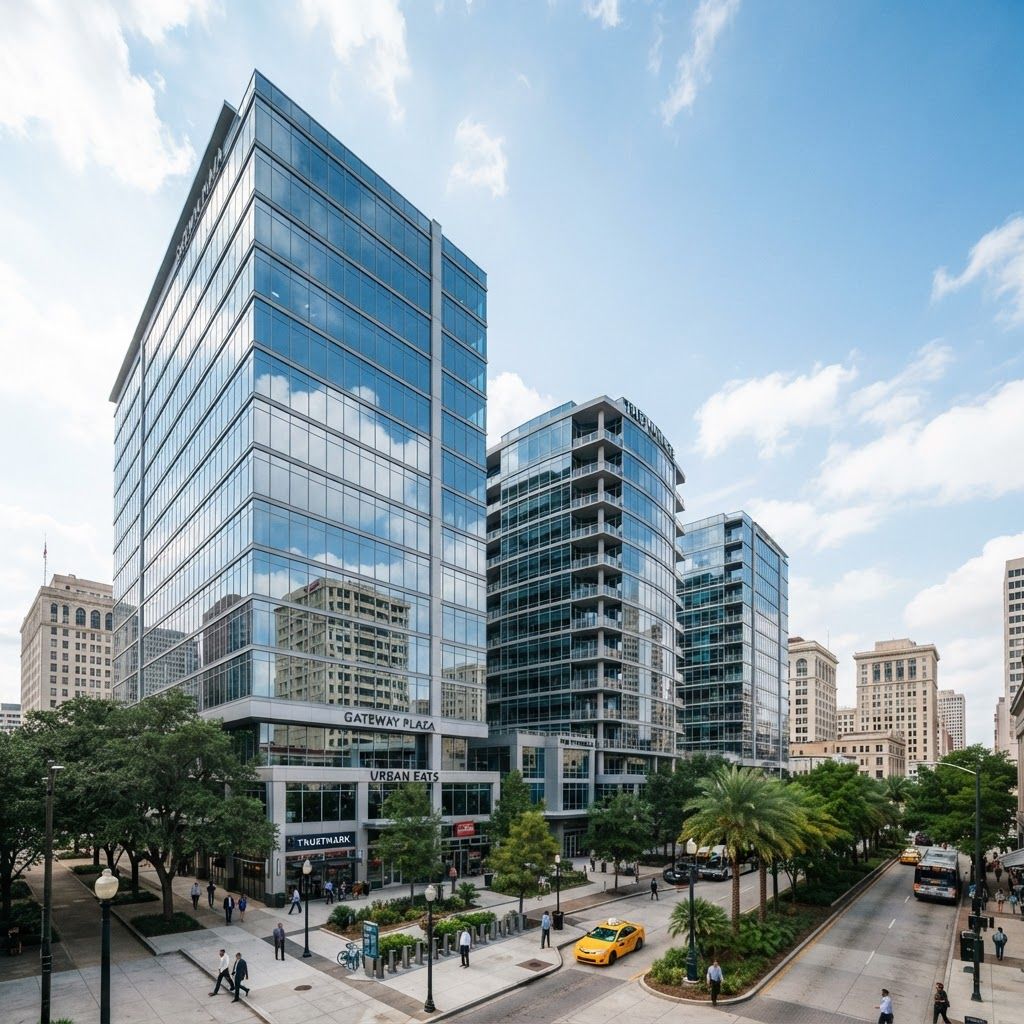
Understanding the Baton Rouge Commercial Market
Baton Rouge is not a typical mid-sized commercial market. Its economy rests on an unusual combination of pillars: petrochemical and industrial operations along the Mississippi River corridor, state government employment, LSU and its research ecosystem, and a substantial healthcare sector. Each pillar generates distinct real estate demand, and firms that succeed here tend to specialize rather than generalize.
Industrial and logistics space has been the strongest performer, driven by port activity, plant expansions, and distribution demand along the Interstate 10 and Interstate 12 corridors. Medical office has been similarly resilient, anchored by major hospital systems expanding outpatient footprints into the suburbs. Office, by contrast, has undergone the same repricing seen nationally, with older downtown product facing conversion pressure while newer suburban space with parking and flexible floor plates holds value.
1. Beau Box Commercial Real Estate
One of the most established commercial firms in Louisiana, Beau Box operates across brokerage, property management, and development advisory. Its bench covers office, industrial, retail, and land, and the firm's long tenure in the market gives it unusually deep comparable-sales data — a genuine advantage in a market where transaction volume is thin enough that pricing precedent matters.
2. Maestri-Murrell Real Estate
Maestri-Murrell has built a strong reputation in retail leasing and investment sales, representing both landlords and national tenants entering the market. The firm's property management arm handles a significant portfolio of shopping centers and mixed-use assets, and that operational visibility informs its leasing recommendations in ways pure brokerages cannot match.
3. Sealy Real Estate Services
Sealy is known for industrial and warehouse expertise, a segment central to the Baton Rouge economy. The firm handles site selection for manufacturing and distribution users, land assemblage near the river and interstate corridors, and build-to-suit advisory. For clients whose requirements involve rail access, heavy power, or truck court geometry, this technical depth is essential.
4. NAI Latter and Blum
Part of a national commercial network, this firm pairs local market knowledge with access to institutional capital and out-of-state tenants. That combination matters for owners marketing larger assets, since the buyer pool for a substantial Baton Rouge property often sits in Houston, Dallas, or Atlanta rather than locally.
5. Stirling Properties
Stirling is a full-service commercial firm with a substantial development and retail leasing practice across the Gulf South. Its involvement in shopping center development and redevelopment has shaped retail patterns throughout the metro, and its asset management capability appeals to owners seeking a single accountable partner across leasing, operations, and capital planning.
6. Mike Falgoust and Associates
This firm focuses on the middle market — the small and mid-sized office, retail, and industrial transactions that constitute the bulk of Baton Rouge deal volume. Local business owners buying their first building or negotiating a first commercial lease often find better service here than at firms oriented toward institutional assets.
7. Cook Moore Davenport and Associates
Valuation and advisory work is a distinct discipline, and this firm is among the region's most respected appraisal and consulting practices. Lenders, litigators, developers, and investors rely on independent valuation for financing, tax appeals, partnership disputes, and feasibility analysis. In a market with limited comparable transactions, credible appraisal expertise carries real weight.
8. Wampold Companies
Wampold is known for high-quality development and long-term ownership rather than transactional churn. Projects reflect a patient-capital philosophy: build well, lease to durable tenants, hold for decades. Tenants in these buildings frequently cite maintenance responsiveness and capital reinvestment as reasons for renewal.
9. Kean Miller Real Estate Advisory
Complex commercial transactions in Louisiana require legal fluency in a civil law system that differs meaningfully from common law states used elsewhere in the country. Firms with dedicated real estate advisory practices guide clients through servitudes, mineral rights, environmental liability, and title issues that surprise out-of-state investors. This expertise is often the difference between a closed deal and a collapsed one.
10. Elifin Realty
A newer entrant that has grown quickly by pairing modern marketing with owner-side representation, Elifin focuses on investment sales and landlord leasing across the metro. Its data-forward approach — detailed market reports, transparent listing presentation, digital marketing reach — has resonated with a generation of owners accustomed to more information than traditional brokerage provided.
Sector Trends to Watch
Industrial demand remains the market's engine. Plant maintenance cycles, capital projects along the river, and distribution requirements keep absorption steady, and constrained supply of modern warehouse space with adequate clear height has kept rents firm. Land near interstate interchanges continues to appreciate on that basis.
Medical office is the second growth story. Hospital systems have shifted care delivery outward, and ambulatory surgery centers, imaging facilities, and specialty clinics now anchor suburban retail-adjacent locations. These tenants sign long leases and invest heavily in build-out, making them attractive to investors seeking stability.
Office continues to bifurcate. Newer buildings with parking, natural light, and flexible layouts lease; older stock without those attributes struggles, and adaptive reuse conversations are increasingly serious. Retail, meanwhile, has stabilized around grocery-anchored and service-oriented centers, where tenants provide services that cannot be delivered online.
How to Select a Commercial Real Estate Partner
Specialization should drive the decision. A firm excellent at retail leasing may be the wrong choice for an industrial site search requiring heavy utilities. Ask directly what percentage of the firm's recent transactions occurred in your asset class and submarket, and request specific closed examples.
Clarify representation and compensation. Understand whether the broker represents you or the counterparty, how fees are structured, and whether the firm also manages competing properties. For investors, ask what proprietary data the firm maintains — in a market this size, private transaction knowledge often exceeds what public sources reveal. Finally, confirm familiarity with Louisiana-specific legal structures, flood zone implications, and current insurance realities, all of which materially affect underwriting.
Final Thoughts
Baton Rouge rewards commercial real estate partners with genuine local depth. Industrial strength, healthcare expansion, and a repricing office sector create both risk and opportunity, and the firms best positioned to navigate that are the ones with transaction history, operational visibility, and honest counsel about what a property is actually worth.