
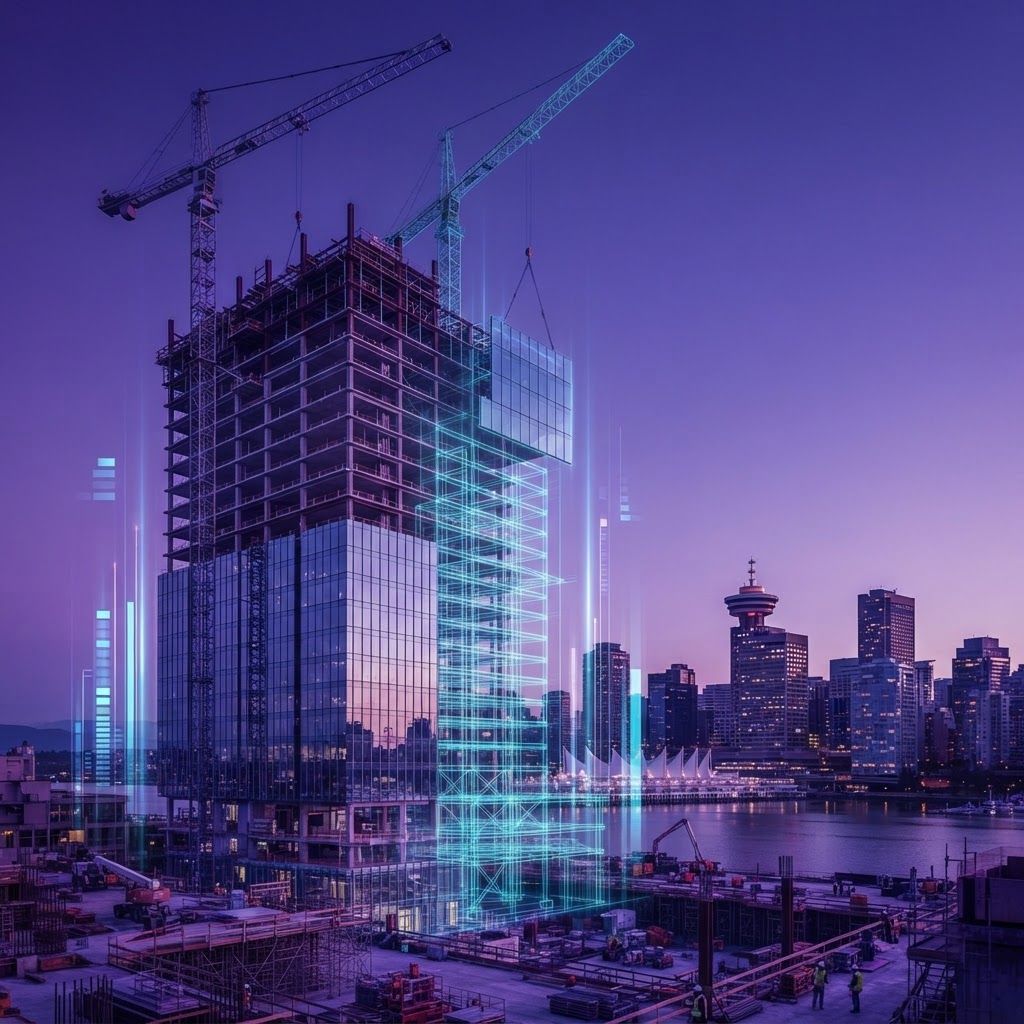
Vancouver's Commercial Construction Landscape
Commercial construction in Metro Vancouver operates under unusual pressure. Industrial land is among the scarcest in North America, driving up the value of every square foot of warehouse and logistics space. Office development competes for downtown sites with residential towers. Institutional and healthcare projects carry rigorous performance and infection-control requirements. And across all of it, seismic design standards, energy performance codes and constrained site logistics shape how work gets built.
The firms that lead this market do so on the strength of preconstruction planning, procurement discipline and the ability to hold a schedule when a client's revenue depends on an opening date.
How Commercial Owners Should Evaluate Builders
Bonding capacity and financial strength come first, because a commercial project cannot survive a contractor failure mid-build. Next comes relevant sector experience: an industrial tilt-up builder and a hospital contractor are not interchangeable. Evaluate preconstruction services, including budgeting at concept stage, constructability review and value engineering that preserves function. Examine safety statistics and WorkSafeBC standing, quality management systems, and the depth of the project management team assigned to your job rather than the firm overall. Finally, understand the delivery model on offer, whether stipulated price, construction management, design-build or integrated project delivery.
1. Large General Contractors and Construction Managers
The region's major general contractors deliver towers, institutional campuses, transit-related facilities and large mixed-use developments. Their strengths are scale, formal project controls, in-house virtual design and construction capability, and relationships with the subtrade base that determine pricing on large tenders. They typically operate under construction management or negotiated contracts where preconstruction collaboration begins long before drawings are complete.
2. Industrial and Warehouse Builders
Given the extreme scarcity of industrial land in Metro Vancouver, industrial builders have become highly specialised. Work includes tilt-up concrete panel construction, pre-engineered steel structures, high-clear-height distribution facilities, dock and grade-level loading configurations, heavy floor slabs and increasingly multi-storey industrial formats. Speed matters enormously in this sector, since tenants sign leases against target occupancy dates.
3. Office and Tenant Improvement Contractors
Office construction has shifted toward experience-driven workplaces, which means more collaboration areas, better acoustics, upgraded air handling and flexible power and data distribution. Tenant improvement contractors execute these builds inside occupied buildings, coordinating with property managers, freight elevator schedules, noise restrictions and base-building systems. Their differentiator is the ability to deliver a functioning, permitted space on the exact date a lease commences.
4. Retail and Hospitality Construction Firms
Retail and restaurant construction is unforgiving on schedule and detail. Contractors in this space manage brand standards, custom millwork, commercial kitchen mechanical and grease exhaust systems, health authority approvals, liquor licensing inspections and finishes that must look immaculate on opening day. Multi-location clients value builders who can replicate a standard across sites while adapting to each landlord's requirements.
5. Healthcare and Laboratory Contractors
Healthcare construction requires specialised knowledge of infection control risk assessment during renovation, medical gas systems, redundancy in mechanical and electrical services, shielding for imaging equipment and phased delivery inside operating facilities. Laboratory work adds fume containment, vibration control and specialised utilities. Firms in this category maintain dedicated teams and quality documentation far beyond typical commercial standards.
6. Institutional and Education Builders
Schools, post-secondary facilities, community centres and civic buildings involve public procurement, stakeholder consultation, mass timber and sustainability targets, and construction windows constrained by academic calendars. Contractors serving this sector are experienced with public tender compliance, prevailing labour arrangements and the documentation that public owners require throughout the build.
7. Mass Timber and Sustainable Construction Specialists
British Columbia has become a global leader in mass timber, and Vancouver contractors have developed real expertise in cross-laminated timber and glulam structures. These projects demand precise digital coordination, careful weather protection during erection, and connection detailing worked out long before delivery. The payoff is faster erection, lower embodied carbon and interiors with exposed structure that tenants value.
8. Seismic Upgrade and Structural Retrofit Contractors
Much of Vancouver's older commercial stock requires seismic strengthening, and specialists handle shear wall additions, moment frame installation, foundation strengthening, unreinforced masonry retrofits and connection upgrades. This work frequently occurs in occupied buildings, requiring phasing, temporary shoring and coordination with tenants whose operations cannot stop.
9. Design-Build and Integrated Delivery Firms
Design-build appeals to commercial owners who want single-point responsibility and earlier cost certainty. The contractor leads a team including architects and engineers, delivering a defined performance outcome for a fixed price. For industrial, warehouse and straightforward commercial buildings, this model consistently produces faster schedules and fewer disputes.
10. Specialty and Civil-Adjacent Commercial Builders
Some projects fall outside conventional categories: parkades, transit facilities, cold storage, data centres, marine and port-related structures, and utility buildings. Contractors in this space combine building construction with civil and heavy industrial capability, and they are typically selected for technical qualification rather than price alone.
Trends Shaping the Market
Four forces are reshaping commercial construction in the region. Energy codes are pushing electrification, heat pumps and envelope performance. Embodied carbon reporting is entering procurement, favouring timber and low-carbon concrete. Prefabrication of mechanical assemblies, washroom pods and exterior wall panels is reducing site labour demand. And digital delivery, including coordinated models and reality capture during construction, is becoming standard on projects of any complexity.
Getting the Best Outcome
Engage a contractor early, ideally at concept design, so budget and constructability inform the drawings rather than fighting them. Insist on a procurement log with long-lead items identified, particularly electrical switchgear and mechanical equipment, where lead times now drive schedules. Align the contract model to your risk tolerance and clarify how changes will be priced. On commercial work, certainty of delivery is usually worth more than the last few percent of price, because an opening date missed by a month costs more than the savings ever did.