
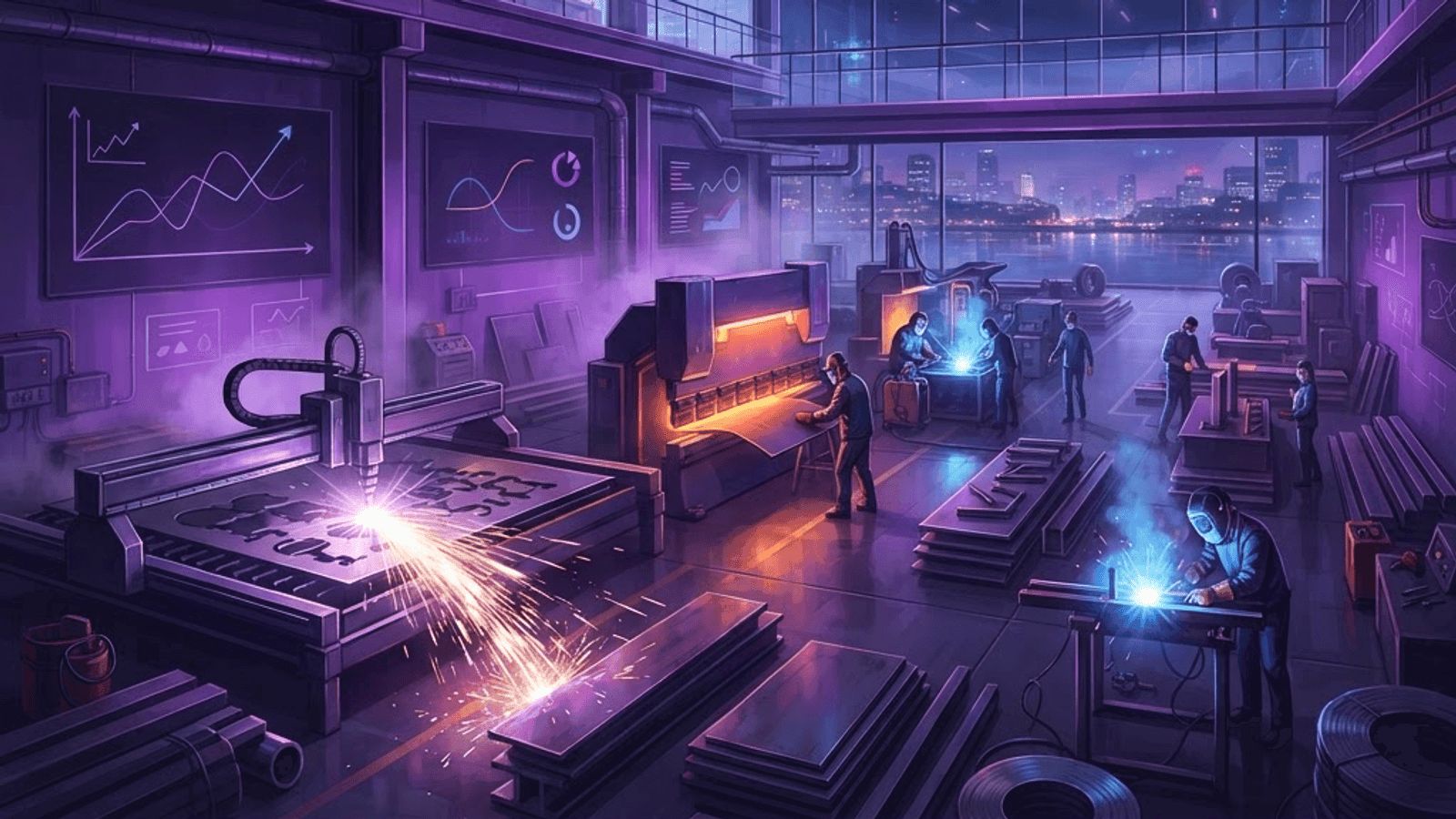
Metalworking Is Peoria's Core Competency
If Peoria has an industrial signature beyond finished machines, it is metalworking. Building heavy equipment requires thick plate fabrication, large weldments, precision machining, heat treatment, and durable finishing, and generations of local shops developed those skills to serve that demand. The result is a metalworking community with capability normally found only in much larger metropolitan areas.
That depth benefits every buyer. A single project might involve laser cutting at one shop, forming and welding at another, machining at a third, and powder coating at a fourth, all within a short drive. Short logistics loops shorten lead times and make iterative development practical rather than painful.
How These Shops Were Evaluated
Assessment considered equipment capability, tolerance capability, welding certification, quality systems, engineering support, and reputation for on-time delivery. Metalworking quality is largely invisible until a part fails, so shops with disciplined inspection and documented processes ranked highest.
The Top 10 Metalworks Companies in Peoria
1. Midwest Precision Machining
This shop performs multi-axis CNC machining of complex components in steel, aluminum, and alloy materials. Coordinate measuring inspection, documented process control, and experience with heavy equipment tolerances underpin its reputation. Engineers value its feedback on features that add cost without adding function.
2. Prairie Steel Fabrication
Prairie Steel Fabrication handles heavy plate work, structural weldments, and large assemblies requiring careful distortion control. Certified welders, weld procedure documentation, and non-destructive testing support structural applications. Its large bays and overhead crane capacity accommodate parts that most shops cannot handle.
3. Illinois Valley Laser and Forming
Combining fiber laser cutting, press brake forming, and punching, this fabricator produces sheet metal parts and enclosures with quick turnaround. Nesting optimization reduces material waste, and offline programming shortens setup on repeat jobs. It is a common first stop for prototype-to-production sheet metal work.
4. RiverBend Welding and Repair
RiverBend Welding and Repair provides field and shop welding, structural repair, and equipment restoration for industrial and agricultural customers. Mobile crews perform on-site repairs that avoid disassembling and transporting large machinery. Metallurgical judgment on repair versus replacement saves customers substantial money.
5. Heartland Metal Finishing
Specializing in powder coating, plating, and industrial painting, Heartland Metal Finishing protects components destined for outdoor and corrosive service. Surface preparation discipline, coating thickness verification, and salt spray testing distinguish it from low-cost alternatives. Proper pretreatment is the difference between a finish that lasts a decade and one that fails in a season.
6. Central Illinois Tool and Die
This shop designs, builds, and maintains stamping dies, fixtures, and specialty tooling. Fast die repair keeps production presses running, and thoughtful fixture design improves machining repeatability. Its capability also supports low-volume stamping for customers who do not need dedicated press lines.
7. Peoria Sheet Metal Works
Peoria Sheet Metal Works fabricates ductwork, housings, guards, and custom sheet products for commercial and industrial customers. Field measurement and installation services complement shop fabrication. Contractors value its responsiveness on retrofit projects where nothing matches original drawings.
8. Bradley CNC Solutions
Serving prototype and low-volume needs, Bradley CNC Solutions offers milling, turning, wire electrical discharge machining, and rapid fixture development. It thrives on unusual materials and short-notice work that disrupts high-volume shops. Engineering collaboration during design reduces later manufacturability surprises.
9. Midwest Heat Treating
This specialist provides hardening, tempering, annealing, carburizing, and stress relief for machined and fabricated components. Furnace control, documented recipes, and hardness verification ensure predictable mechanical properties. Its services close a critical gap between machining and final assembly for wear-critical parts.
10. Illinois Structural Metals
Focused on structural steel for buildings, platforms, mezzanines, and industrial supports, this fabricator handles detailing, fabrication, and erection coordination. Shop drawing quality and delivery sequencing keep site crews productive. Familiarity with local inspection expectations smooths project approvals.
Technology Trends in Metalworking
Fiber laser cutting has largely displaced older cutting methods for sheet and plate, delivering faster processing, tighter edges, and lower operating cost. Combined with offline programming and automated material handling, it lets shops run profitable small batches, which benefits customers with high-mix requirements.
Automation is expanding into welding and machining through robotic cells, pallet systems, and lights-out operation on repeat parts. Rather than eliminating skilled labor, these systems typically redeploy experienced people onto setup, programming, and quality work. Digital inspection using scanning and coordinate measuring machines produces documentation that customers increasingly require.
Additive manufacturing has found a practical role in tooling, fixtures, and prototype components, complementing rather than replacing traditional processes. Meanwhile, interest in domestic sourcing has increased inquiry volume for Midwest shops offering shorter, more transparent supply chains.
How to Select the Right Metalworking Partner
Match the part to the shop. A precision machining specialist is the wrong choice for a large weldment, and a heavy fabricator will struggle with tight-tolerance small parts. Ask directly about typical part size, tolerance capability, and comparable work already in production.
Review quality infrastructure: inspection equipment, calibration schedules, welding procedures and welder qualifications, and how nonconforming parts are handled. Request a capability discussion on your critical features and ask what tolerances they consider routine versus difficult. Confirm capacity and lead time honestly, including how they handle schedule changes. Finally, evaluate engineering engagement, since a shop that suggests design adjustments to reduce cost or improve manufacturability delivers value well beyond the quote.
Final Thoughts
Peoria's metalworks companies provide a rare concentration of machining, fabrication, welding, tooling, heat treating, and finishing capability. That density lets buyers assemble complete manufacturing paths locally, iterate quickly, and hold suppliers to genuinely high standards. Choose shops whose equipment and discipline match your part requirements, and the region's metalworking depth becomes a durable competitive advantage.