
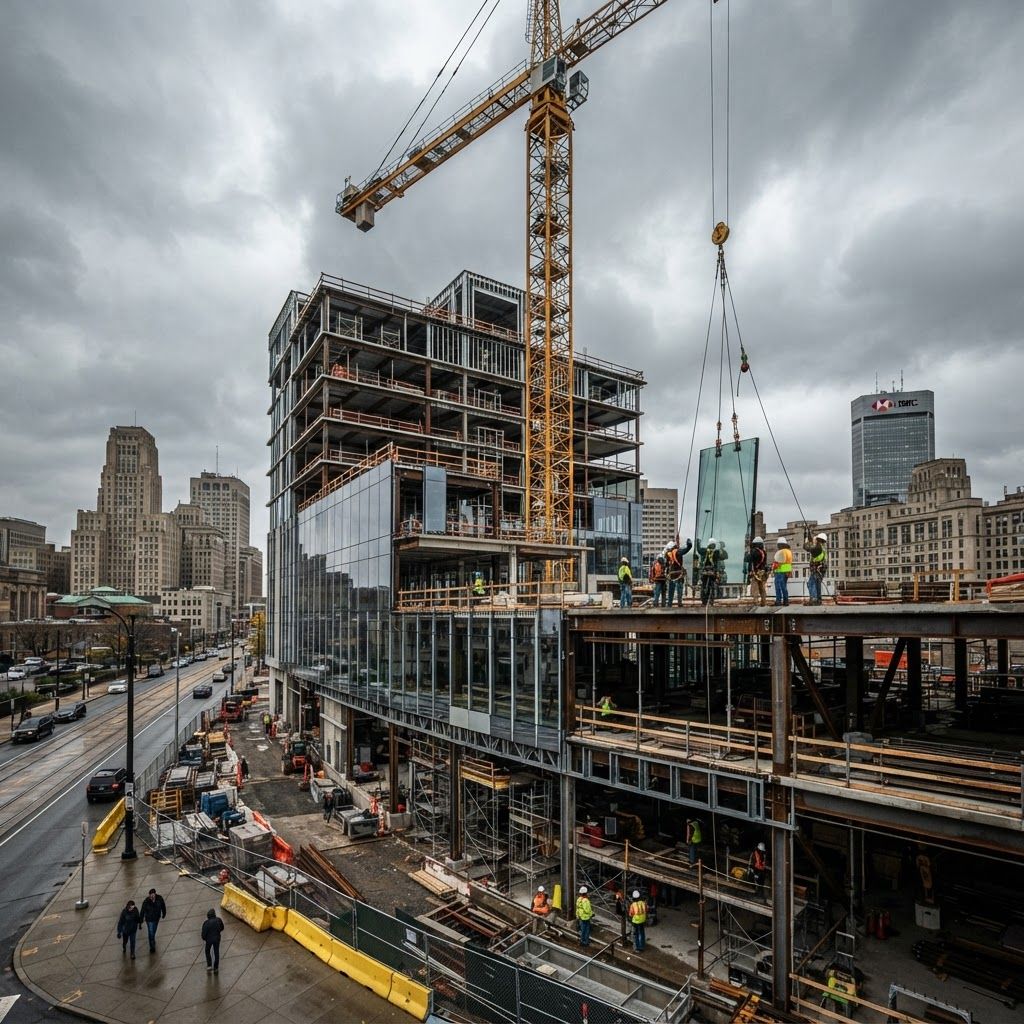
A Commercial Market in Transition
Buffalo commercial construction sector reflects a city reinventing its economy. Former grain elevators, factories and warehouses are being converted into offices, breweries, residences and event space. Healthcare and higher education institutions continue to expand campuses. Logistics and light manufacturing facilities are rising near highway and border corridors. Each of these project types demands a different set of competencies from a commercial contractor.
Delivery methods vary accordingly. Design-bid-build remains common for public work, while design-build and construction management at risk dominate private projects where speed and cost certainty matter. Understanding which method suits a project is often the most consequential early decision an owner makes.
Evaluating a Commercial Contractor
Bonding capacity indicates financial strength and the scale of project a firm can carry. Safety performance metrics reveal operational discipline. Look for demonstrated experience in your specific building type, since healthcare, food processing and laboratory work each carry regulatory requirements that generalists underestimate. Ask about preconstruction services, building information modelling capability, and how the firm manages long-lead equipment procurement, which currently drives many commercial schedules.
The Top 10 Commercial Construction Companies in Buffalo
1. Queen City Commercial Builders
A broad-market general contractor delivering office, retail and institutional projects with strong preconstruction estimating. Their construction management practice is known for cost transparency and detailed schedule logic that owners can actually interrogate.
2. Lakeshore Industrial Construction
Specialists in manufacturing and warehouse facilities, including heavy slab design, dock and door systems, process utilities and crane-supporting structures. Their coordination with equipment vendors keeps production start-up dates realistic.
3. Elmwood Adaptive Reuse Partners
Converting historic industrial buildings is Buffalo signature construction challenge, involving structural assessment, hazardous material abatement, envelope restoration and modern code compliance in old shells. This firm has made it a core competency, including preservation incentive documentation.
4. Niagara Healthcare Construction Group
Medical facility construction demands infection control during occupied renovation, specialised mechanical systems and rigorous inspection regimes. Niagara maintains staff trained specifically in healthcare protocols, which materially reduces owner risk.
5. Southtowns Retail and Hospitality Builders
Fast-track construction for restaurants, hotels and retail tenants, where opening dates carry direct revenue consequences. Their trade partner network allows compressed schedules without the quality collapse that often accompanies acceleration.
6. Amherst Educational Facilities Contractors
School and campus construction, including summer-window renovation work that must finish before students return. Familiarity with public bidding, prevailing wage requirements and phased occupied work defines their practice.
7. Cheektowaga Logistics and Distribution Builders
Large-footprint distribution centres, cold storage and cross-dock facilities, delivered with attention to site circulation, trailer storage and energy-intensive refrigeration systems. Border proximity keeps demand in this segment strong.
8. Delaware Avenue Office Interiors
Tenant improvement and corporate interior construction, from single-floor refreshes to full building repositioning. Their after-hours and weekend capability allows work in occupied towers with minimal tenant disruption.
9. Buffalo Envelope and Restoration Contractors
Focused on building enclosure work, including masonry restoration, roofing replacement, curtain wall and waterproofing. In a freeze-thaw climate this specialisation addresses the most common source of commercial building failure.
10. Kenmore Public Works Construction
Municipal and institutional projects including fire stations, water infrastructure buildings and community facilities. Compliance documentation, minority and women-owned business participation reporting, and public meeting coordination are handled competently.
Trends Shaping the Sector
Electrification and heat pump systems are appearing in commercial mechanical design, driven by code and corporate emissions targets. Long-lead procurement of switchgear, generators and rooftop units now dictates schedules more than labour availability in many projects. Building information modelling has become standard on mid-size and larger work, reducing field conflicts. Adaptive reuse continues to expand, supported by preservation tax incentives and strong local appetite for industrial character space.
Advice for Owners
Engage a contractor during design rather than after, because constructability input early saves far more than it costs. Insist on a schedule showing procurement milestones, not just construction activities. Define the change order process precisely, and require monthly cost reporting with committed versus projected figures. Clarity in the first month prevents disputes in the twelfth.
Final Thoughts
Buffalo commercial construction market offers genuine depth across industrial, healthcare, institutional, retail and restoration work. Selecting a firm with direct experience in your building type, and involving them early, is the most reliable predictor of a project that finishes on time and on budget.