
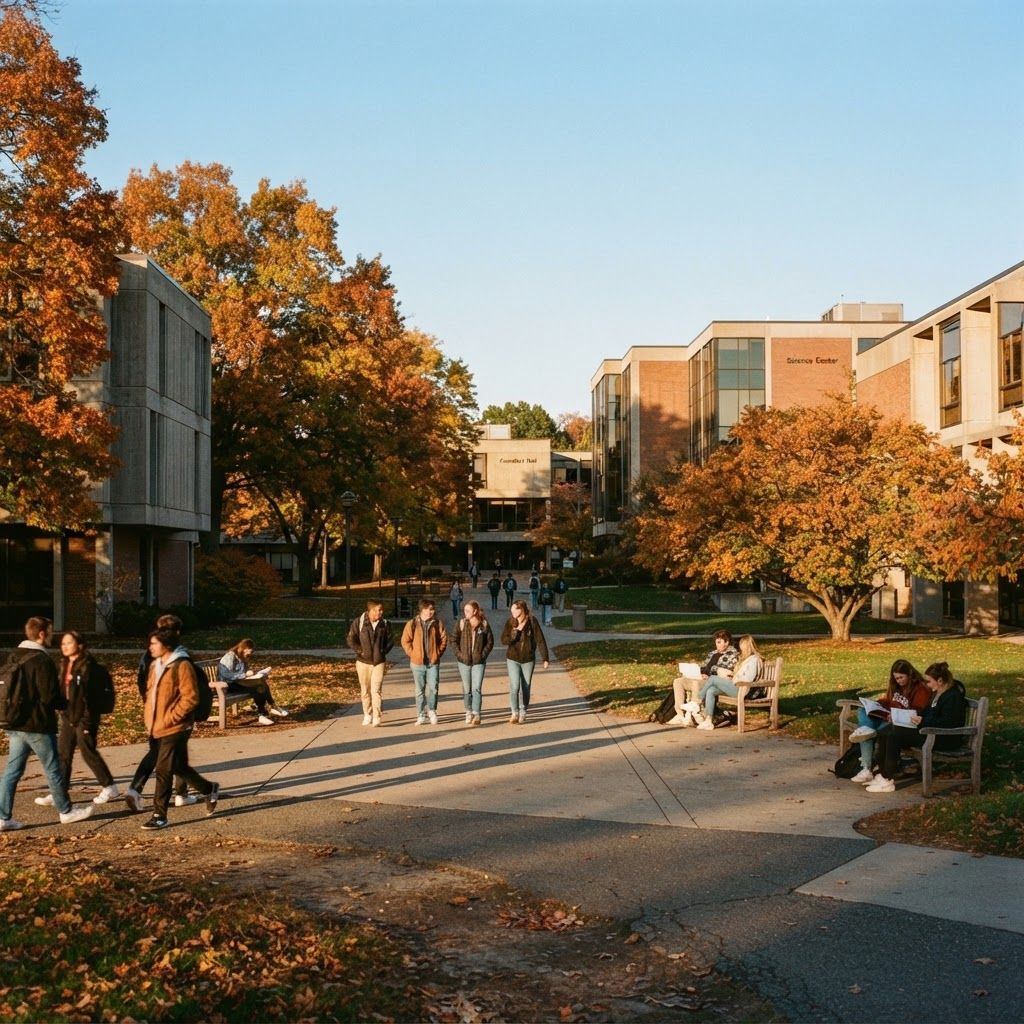
A Denser College Market Than Most Cities Its Size
Western New York supports an unusually large number of higher education institutions for a metropolitan area of its population. The reason is historical. Religious orders founded colleges here in the nineteenth and early twentieth centuries, the state built out public campuses during the postwar expansion, and specialized professional schools grew alongside the region's medical and cultural institutions. The result is a market where a prospective student can choose among Jesuit liberal arts, Franciscan undergraduate education, conservatory-style art training, health science programs, and an affordable community college network, all within a short drive.
Private Colleges and Universities
Canisius University, founded by the Society of Jesus in 1870, is among the most recognized private institutions in the city. Its programs in business, education, animal behavior, and the sciences are well established, and the Jesuit emphasis on service learning and reflective practice shapes campus culture. Class sizes are small enough that undergraduate research with faculty is a realistic expectation rather than a rarity.
Niagara University, a Vincentian institution north of the city near the Niagara Gorge, is particularly known for hospitality and tourism management, which benefits from proximity to one of the world's most visited natural attractions. It also maintains strong education, criminal justice, and nursing programs.
Daemen University in Amherst has built a reputation around health sciences, with physical therapy, physician assistant studies, and nursing among its signature offerings, alongside a well-regarded animation and graphic design program. Trocaire College focuses tightly on career-oriented credentials in nursing, allied health, and healthcare administration, with strong clinical placement relationships across regional hospital systems.
Hilbert College in Hamburg is known for criminal justice, forensic science, and digital media in a small-campus setting. Villa Maria College offers programs in art, design, music, and human services with a distinctly creative orientation and small cohorts. Medaille University historically served adult and professional students with flexible scheduling, and its legacy programs continue to influence the local market for working-adult education.
Public Institutions
SUNY Buffalo State University sits in the city's Elmwood district and serves a large, diverse undergraduate population. Its strengths include education, fine arts and design, engineering technology, hospitality, and criminal justice, and its art conservation program is nationally distinctive. As a public institution, its tuition is substantially lower than the private colleges, which matters enormously to first-generation and working students.
SUNY Erie, the community college serving Erie County, provides associate degrees and certificates across three campuses in the city, the northern suburbs, and the southern suburbs. Its role is twofold: workforce training in fields like nursing, welding, heating and cooling systems, automotive technology, and information technology, and transfer preparation that lets students complete two years affordably before moving to a four-year institution. Articulation agreements with SUNY schools make that pathway relatively smooth. Niagara County Community College serves a similar function to the north with notable culinary arts and nursing programs.
Specialized and Professional Schools
Beyond the traditional campuses, Buffalo supports institutions with narrow but deep focus. Bryant and Stratton College offers career-focused associate and bachelor's programs with evening and online scheduling for working students. Several hospital-affiliated schools train nurses and allied health professionals through clinically embedded programs. The region's cultural institutions also support arts education pathways, and the presence of a major art museum, a professional orchestra, and an active theater district gives students in creative fields genuine local internship and performance opportunities.
Choosing Between Institution Types
The most useful first question is not which college is best but which structure fits your goals. A student who wants small seminar classes, close faculty mentorship, and a residential experience will find that at Canisius, Daemen, Hilbert, or Villa Maria. A student who needs the lowest possible cost and maximum scheduling flexibility should look hard at SUNY Erie and Buffalo State. A student targeting a licensed clinical profession should evaluate programs primarily by accreditation status, licensure examination pass rates, and clinical placement quality.
Cost deserves careful analysis rather than a glance at the sticker price. Private colleges in this market discount heavily through institutional aid, and a well-matched student may pay less at a private college than the published public tuition after grants and scholarships. Always compare actual net cost from financial aid award letters, not advertised tuition.
Trends Reshaping Local Higher Education
Enrollment pressure across the Northeast has pushed colleges to sharpen their distinctive programs and compete harder on career outcomes. That has produced more internship requirements, more industry certifications embedded in degrees, and more explicit employment reporting.
Hybrid and online delivery, accelerated during the pandemic years, has become permanent for many graduate and adult programs. Health sciences continue to expand because regional demand for nurses, therapists, and technicians remains strong. Meanwhile, transfer pathways have become more formalized, with guaranteed admission agreements between community colleges and four-year partners reducing lost credits.
How to Evaluate a Program
Visit the campus and, if possible, sit in on a class in your intended major. Ask what percentage of students complete the program in the expected time, and where graduates of that specific program work. Ask about advising ratios, since access to a knowledgeable advisor often determines whether a student graduates on schedule. For professional programs, verify accreditation directly with the relevant accrediting body rather than taking a brochure's word for it.
Talk to current students candidly about workload, faculty availability, and whether the promised opportunities are real. And consider location practically: parking, transit access, winter commuting, and proximity to work all affect persistence more than prospective students expect.
Final Thoughts
Buffalo's colleges collectively offer an unusual combination of range and affordability. A student can pursue a Jesuit liberal arts education, a clinical health credential, a design portfolio, or a skilled trade certificate without leaving the region, often at a cost well below national averages. The best choice comes from matching a specific program's strengths to your own goals, and from doing the unglamorous work of comparing net costs and outcomes carefully.