
Civil Engineering and the Shape of Lubbock
Much of what makes Lubbock function is invisible or easily overlooked: the drainage network that manages stormwater across an exceptionally flat landscape, the playa lakes that serve as detention basins, the water and wastewater systems serving a city and its surrounding region, the road and intersection geometry that moves traffic through a growing urban area. All of it is the product of civil engineering.
The Llano Estacado presents distinctive engineering conditions. The terrain is remarkably flat, which means stormwater does not simply run to a river; it collects in playa depressions, making detention design, grading precision and outfall planning far more consequential than in hilly terrain. Expansive clay soils affect pavement design, foundations and utility bedding. Groundwater resources require careful long-term planning. High winds influence structural design of everything from sign supports to water towers. Engineers who understand these regional realities produce designs that work; those who apply generic assumptions produce designs that flood or fail.
The Core Disciplines
Land development and site civil engineering is the discipline most property owners encounter. It covers site layout, grading and earthwork balance, storm drainage design and detention sizing, water and sewer service extensions, paving and parking design, erosion control planning and the platting and permitting process with the city or county.
Water resources and stormwater engineering involves hydrologic and hydraulic modelling, floodplain analysis and mapping, channel and culvert design, detention and retention facilities, and stormwater pollution prevention planning. In Lubbock's flat basin geography this discipline carries unusual weight.
Transportation engineering covers roadway geometric design, intersection and signal design, traffic impact analysis for new development, pavement design and rehabilitation strategy, and coordination with state highway authorities on projects touching the highway system.
Water and wastewater engineering encompasses distribution and collection system modelling, pump stations, lift stations, storage tanks, treatment facility design and upgrades, and rehabilitation of ageing pipe networks.
Structural engineering within civil practice handles foundations, retaining walls, bridges, culverts, tanks and building structures, including the wind load design that West Texas demands.
Geotechnical engineering investigates subsurface conditions, providing soil borings, laboratory testing, foundation recommendations, pavement section design and slope stability analysis. On expansive soils this work is essential rather than optional.
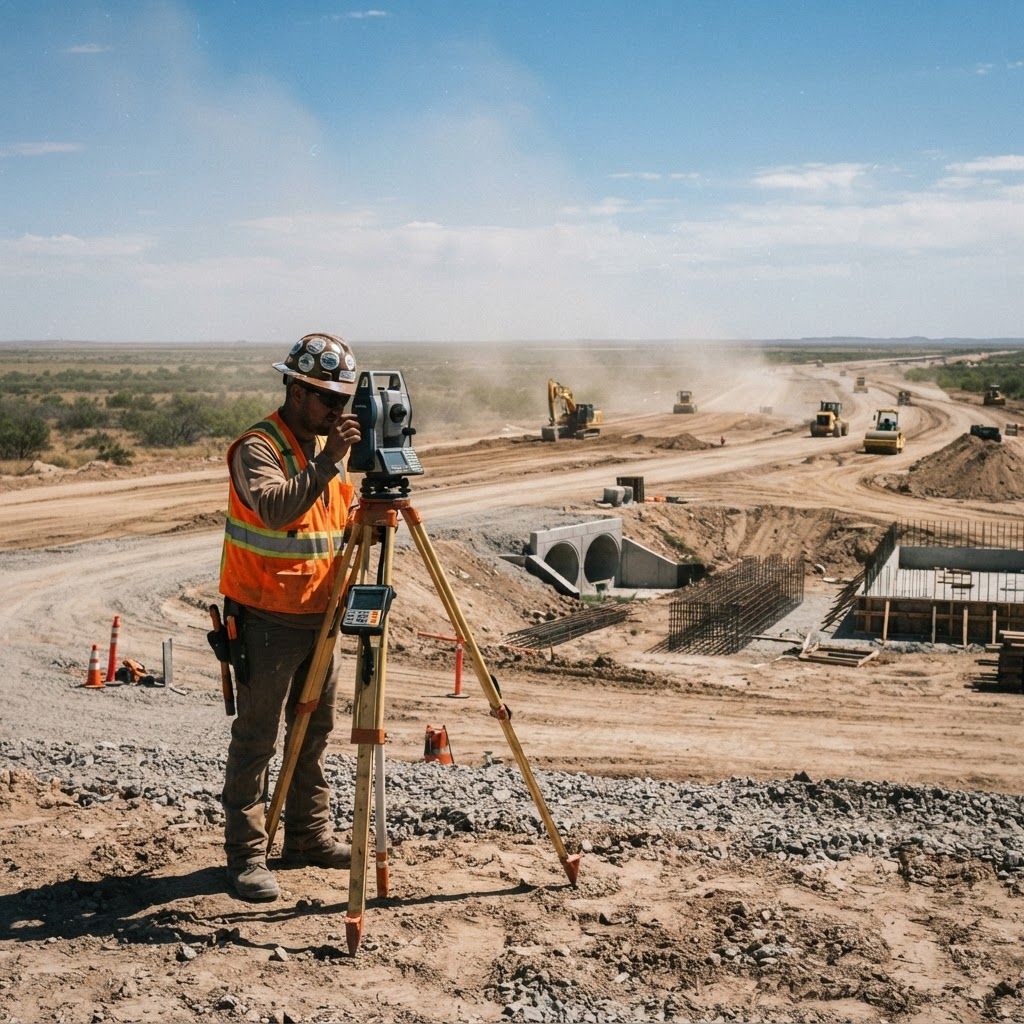
Surveying and geospatial services provide boundary surveys, topographic surveys, construction staking, as-built documentation and increasingly drone photogrammetry and laser scanning.
Environmental and permitting support addresses environmental assessments, wetland and waters determinations, stormwater permits, air and waste permitting for industrial clients and regulatory compliance documentation.
What Distinguishes an Excellent Engineering Firm
Licensure and professional accountability come first. Engineering documents must be sealed by a professional engineer licensed in Texas, and surveys by a registered professional land surveyor. Beyond the minimum, look at the depth of licensed staff relative to project volume, because a firm relying on one or two licensed principals to seal everything can become a bottleneck.
Local regulatory fluency is arguably the most practical differentiator. Firms that submit regularly to Lubbock's development review process, the county, and state agencies know current submittal requirements, review timelines, preferred details and the concerns individual reviewers tend to raise. That familiarity routinely saves weeks of revision cycles.
Technical software capability matters for both accuracy and communication. Current practice includes civil design and corridor modelling software, hydrologic and hydraulic modelling tools, water distribution and sewer network models, and geographic information systems for data management. Firms producing three-dimensional surface models also enable contractors to use machine-controlled grading equipment, which reduces earthwork cost measurably.
Quality control process is a genuine differentiator that clients rarely ask about. Ask how drawings are checked before issue, whether independent senior review occurs, and how calculations are documented and archived. Errors in civil drawings surface during construction as change orders, and a firm with disciplined internal review produces fewer of them.
Responsiveness during construction is equally important. Design work does not end at permit issue. Contractors submit requests for information, field conditions differ from assumptions, and inspections require engineer certification. Firms that provide prompt construction phase support protect the schedule; those that disappear after submittal create expensive delays.
Trends in Civil Engineering Practice
Digital delivery is transforming the discipline. Model-based design, drone survey, reality capture through laser scanning and cloud collaboration platforms have compressed timelines and improved accuracy. As-built documentation increasingly takes the form of a geospatial model rather than a set of marked-up drawings.
Stormwater management philosophy has shifted toward treating runoff as a resource and a quality issue rather than only a volume problem. Green infrastructure, permeable surfaces, bioretention and playa preservation are receiving more attention in regional planning.
Water supply planning has become a central strategic concern across West Texas. Engineering work around conservation, reuse, aquifer management and long-distance supply infrastructure continues to grow in importance.
Resilience and asset management represent another shift. Rather than replacing infrastructure reactively, municipalities and utilities are using condition assessment, criticality analysis and lifecycle planning to prioritise capital spending, and engineering firms with asset management capability are increasingly in demand.
Renewable energy development across the region has also created substantial civil work: access roads, foundations, collection systems, substation civil design and drainage for wind and solar facilities.
How to Select and Work With an Engineering Consultant
Define the scope of services precisely. Distinguish conceptual planning from design, permitting from construction administration, and be clear about the number of submittal revisions included. Ambiguous scope produces both fee disputes and gaps in service.
Select on qualifications rather than fee alone. Engineering fees typically represent a small fraction of total project cost, while design quality influences almost all of it. A modest saving on design fee that produces a poorly optimised grading plan or an oversized detention pond is a poor trade.
Request relevant project examples and speak with those clients about schedule performance, permitting success, coordination with architects and contractors, and construction phase responsiveness.
Commission geotechnical investigation early. Foundation and pavement design cannot be finalised without it, and on expansive soils the report often changes the project concept, which is far better discovered before design than after.
Coordinate disciplines deliberately. Civil, structural, geotechnical, architectural and mechanical work must reconcile, and a single point of coordination with scheduled cross-discipline reviews prevents the conflicts that otherwise surface in the field.
Final Thoughts
Lubbock is served by engineering firms ranging from multidisciplinary regional practices to focused specialists in surveying, geotechnical work and transportation. The right choice depends on project type, but the consistent markers of quality are licensed technical depth, genuine familiarity with local regulatory processes and soil conditions, rigorous internal quality control and reliable support during construction. Good civil engineering is rarely noticed, which is precisely the point.