
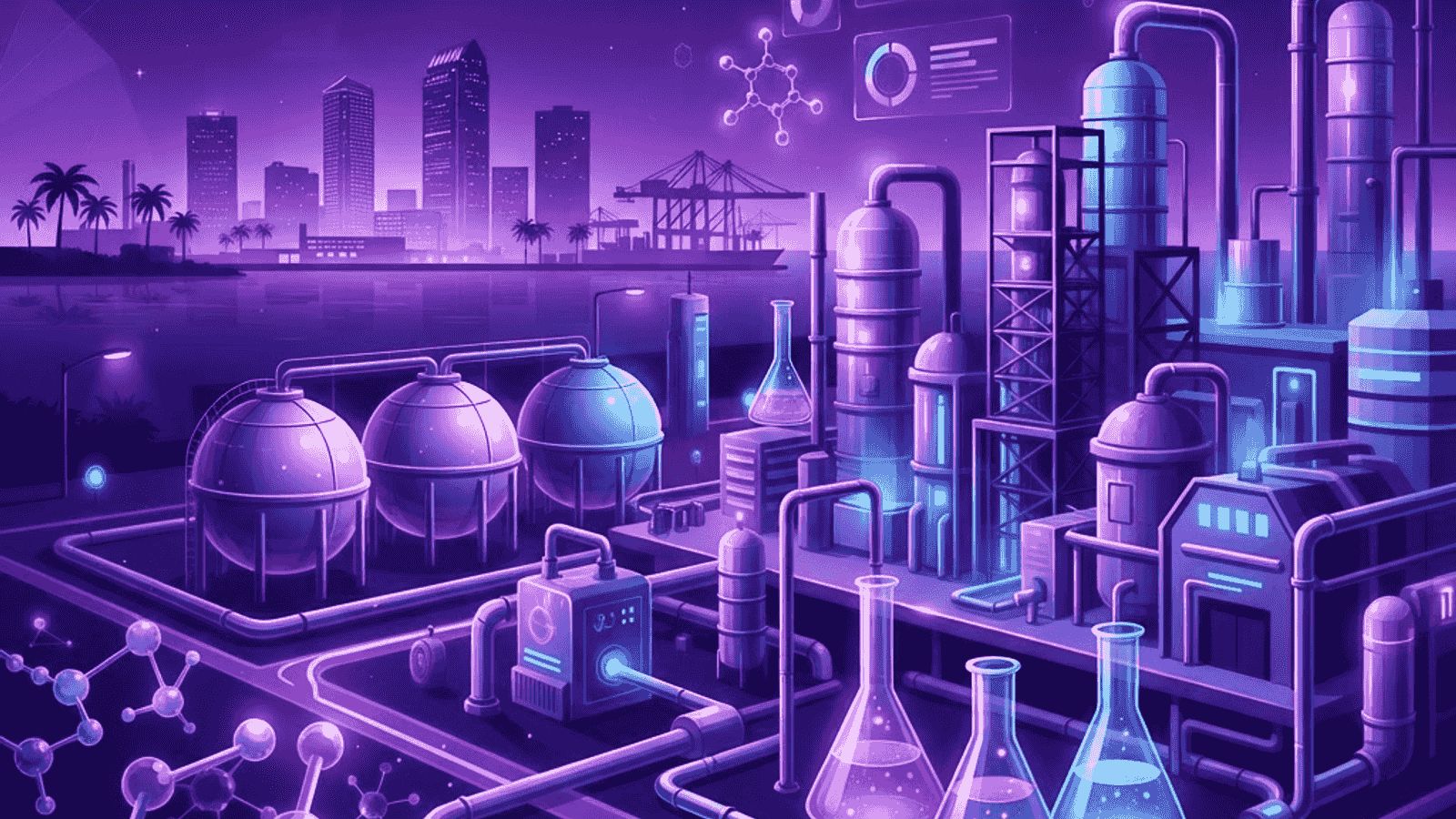
Tampa's Central Role in the Chemical Industry
Tampa's chemical industry is not a minor local sector. It is a globally significant one. Central Florida's phosphate deposits and the deepwater Port of Tampa combined to create a fertilizer and industrial chemical corridor that has shipped products worldwide for over a century. Sulfuric acid production, phosphoric acid processing, ammonia handling and granular fertilizer manufacturing operate at enormous scale within an hour of downtown.
Around that industrial core sits a diverse ecosystem: specialty chemical blenders, industrial and pool chemical distributors, water treatment providers, coatings and adhesives manufacturers, laboratory chemical suppliers and environmental services firms. Together they serve agriculture, construction, marine, hospitality, healthcare, food processing and municipal customers throughout Florida.
How the Local Chemical Sector Is Organized
Three tiers are useful to understand. Primary producers manufacture bulk chemicals from raw materials, operating capital-intensive plants with rail, pipeline and marine logistics. Formulators and blenders convert bulk inputs into finished products such as fertilizers, cleaners, treatment chemistries and coatings. Distributors and service providers handle warehousing, repackaging, delivery, technical support and regulatory compliance for thousands of end users who buy in drums and totes rather than barges.
The 10 Best Chemical Companies Serving Tampa
1. Mosaic Company
The dominant name in the region's chemical economy and one of the world's largest producers of phosphate and potash crop nutrients. Its central Florida operations encompass mining, beneficiation, sulfuric and phosphoric acid production and granulation, feeding global agricultural markets through the Port of Tampa. Its scale, logistics integration and agronomic research capability define the industry standard locally.
2. Nutrien and Major Fertilizer Producers
Large integrated crop nutrient companies maintain significant Florida presence in production, blending and distribution. Their strengths include broad product portfolios spanning nitrogen, phosphate and potash, agronomic advisory services, and supply reliability across planting seasons, which matters enormously to Florida's specialty crop growers.
3. Kinder Morgan and Bulk Liquid Terminal Operators
Terminal and storage operators are indispensable to the chemical trade, providing tank storage, transloading between marine, rail and truck, blending services and stringent safety systems for sulfuric acid, ammonia, caustic soda and petrochemical products. Without this infrastructure, the region's chemical economy simply would not function.
4. Univar Solutions Tampa Distribution
National chemical distributors with regional operations supply thousands of Florida businesses with acids, caustics, solvents, surfactants and specialty ingredients. Their value proposition combines product breadth, repackaging into manageable quantities, regulatory documentation, technical formulation support and delivery reliability. For mid-sized manufacturers, a strong distributor is effectively an extension of the purchasing department.
5. Brenntag Southeast Operations
Another major chemical distribution presence serving food, water treatment, personal care and industrial customers. Distributors of this caliber differentiate through application laboratories, formulation assistance, quality documentation for food-grade and pharmaceutical-grade materials, and inventory programs that shield customers from global supply volatility.
6. Water Treatment Chemistry Providers
Florida's water challenges, including hardness, biological growth in warm climates, cooling tower management and municipal treatment needs, sustain a robust water treatment chemical sector. These firms supply coagulants, biocides, scale inhibitors and corrosion control chemistries paired with monitoring programs, on-site testing and system optimization services that reduce both chemical use and equipment damage.
7. Pool and Recreational Water Chemical Manufacturers
With one of the highest pool densities in the nation, the Tampa region supports substantial manufacturing, blending and distribution of chlorine products, stabilizers, balancers and algaecides. Leading companies compete on formulation stability in extreme heat, safe packaging, and route distribution networks serving thousands of service professionals.
8. Coatings, Paints and Adhesives Manufacturers
Regional manufacturers produce protective coatings, marine paints, roof coatings, sealants and industrial adhesives engineered for intense UV exposure, salt air and humidity. Their technical differentiation lies in weathering performance, adhesion to difficult substrates and formulations that comply with volatile organic compound regulations without sacrificing durability.
9. Specialty Blenders and Contract Chemical Manufacturers
Contract blending operations manufacture cleaning products, agricultural adjuvants, lubricants and specialty formulations for brand owners. Their appeal is turnkey capability: formulation development, sourcing, mixing, filling, labeling and regulatory documentation under one roof, allowing brands to scale without building chemical plants.
10. Environmental Services and Chemical Waste Management Firms
Completing the lifecycle, these companies handle hazardous waste collection, treatment, recycling, remediation and emergency spill response. Their compliance expertise, manifest management and disposal network access are essential for any chemical-handling business, and their emergency response capability is something customers hope never to need but cannot operate without.
Trends in the Tampa Chemical Industry
Sustainability pressure is reshaping priorities across every tier. Producers are investing in water recycling, emissions reduction, phosphogypsum management research and energy efficiency. Formulators are reformulating toward lower-toxicity and biodegradable chemistries as institutional buyers add environmental criteria to purchasing decisions.
Supply chain regionalization has gained importance after global disruptions exposed the fragility of long chemical supply lines. Digitalization is advancing quickly, with remote tank monitoring, automated reordering and data-driven treatment programs replacing manual service calls. Process safety management remains under continuous refinement, with substantial investment in leak detection, containment and community emergency planning around major facilities.
How to Choose a Chemical Supply Partner
Match the supplier tier to your volume. Buying drum quantities from a bulk producer is impractical, while sourcing tanker loads through a small blender adds unnecessary cost. Verify quality documentation appropriate to your application, including certificates of analysis, food or pharmaceutical grade certifications and batch traceability.
Assess technical support directly. Ask whether the supplier will visit your site, evaluate your process and recommend optimization, or whether they simply take orders. Confirm logistics capability including delivery windows, emergency supply, container options and take-back programs. Review safety and compliance support, particularly safety data sheet management, training resources and regulatory guidance. Finally, discuss contingency planning: what happens when a global shortage hits your key input.
Final Thoughts
Tampa's chemical industry spans world-scale fertilizer production, essential terminal infrastructure, sophisticated distribution networks and specialized formulators serving Florida's unique climate demands. Selecting the right partner depends on volume, technical requirements, compliance obligations and the level of service your operation genuinely needs. Evaluate on documentation quality, technical depth and supply reliability, and the region's remarkable chemical capability works in your favor.