
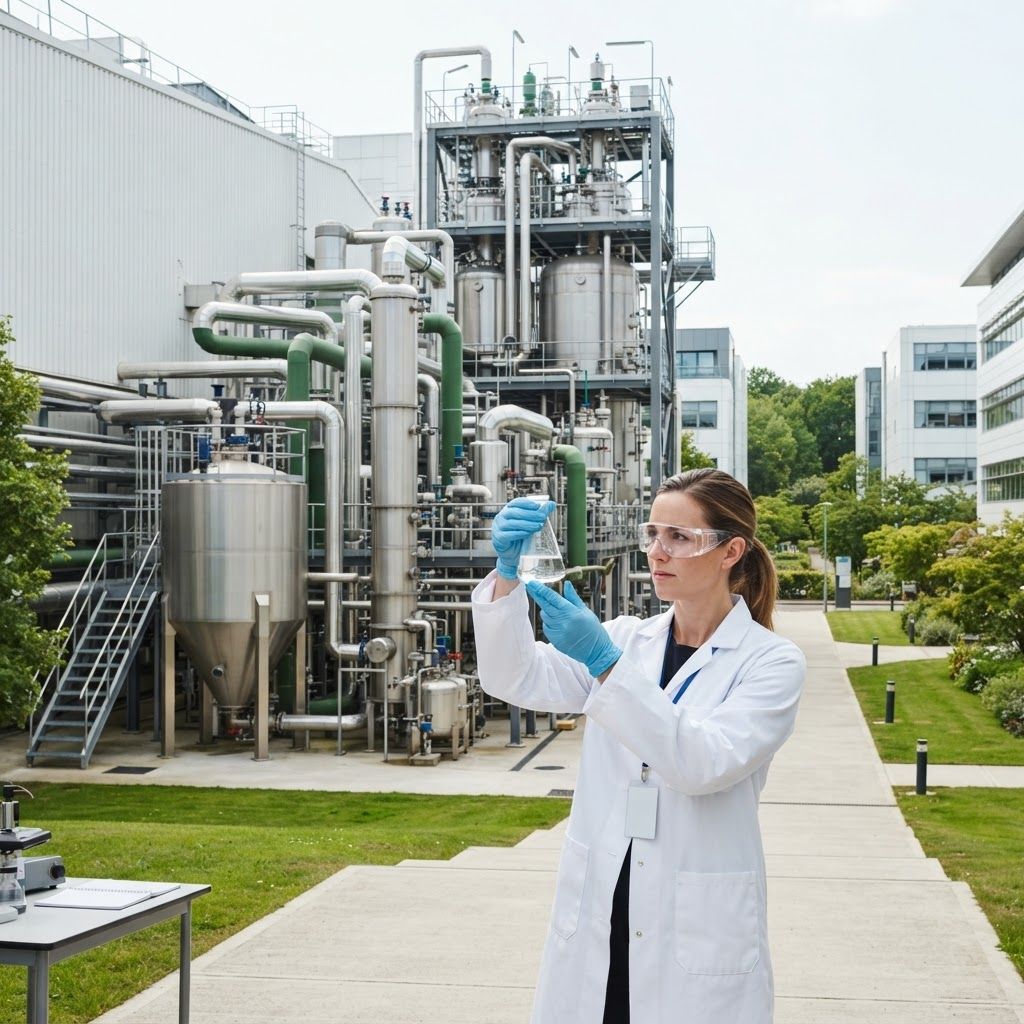
A Genuine Global Chemical Center
Among American metropolitan areas, St. Louis holds an outsized position in chemistry. The region's chemical heritage runs deep, from nineteenth-century pharmaceutical and industrial chemical production to the twentieth-century rise of one of the world's largest agricultural science enterprises. That legacy produced institutional knowledge, laboratory infrastructure, and a workforce with formulation, synthesis, regulatory, and scale-up expertise that few regions can match.
Today the sector spans agricultural chemistry and crop protection, plant biotechnology and seed science, specialty and performance chemicals, research reagents and laboratory chemicals, coatings and adhesives, industrial gases, water treatment chemistry, personal care and household product formulation, and pharmaceutical intermediates. Bayer's Crop Science division maintains major operations and research campuses in the region following its acquisition of Monsanto, while MilliporeSigma, the life science business of Merck KGaA that grew from Sigma-Aldrich, operates significant manufacturing and distribution here. Solutia and Flint Hills heritage operations, along with numerous specialty producers, add industrial depth.
The Segments and How They Differ
Agricultural chemistry involves discovery, formulation, regulatory registration, and manufacturing of crop protection products, along with seed treatments and biological alternatives. It is a research-intensive, heavily regulated business with development timelines measured in a decade or more, and the region's proximity to major row crop production is a structural advantage.
Life science reagents and laboratory chemicals supply universities, hospitals, biotechnology firms, and industrial laboratories with catalogs running into hundreds of thousands of products. Success here depends on breadth, purity documentation, packaging capability, and distribution logistics rather than bulk scale.
Specialty and performance chemicals serve industrial customers with tailored products: additives, surfactants, resins, lubricant components, and process chemicals. Margins depend on technical service and application expertise more than commodity pricing. Coatings, adhesives, and sealants combine formulation chemistry with construction, automotive, and packaging end markets. Industrial gas and water treatment operations provide critical inputs to nearly every manufacturing sector in the metro.
Contract manufacturing and toll processing round out the picture, allowing brands and developers to scale chemistry without owning plants. These operations require strong process safety, quality systems, and containment capability.
What Makes a Chemical Company Excellent
Safety culture is the foundation. In chemical manufacturing, process safety management is not paperwork but the difference between routine operation and catastrophe. Leading companies conduct rigorous process hazard analyses, maintain mechanical integrity programs on pressure vessels and relief systems, enforce management of change discipline, and drill emergency response with local fire and hazmat agencies. Participation in industry stewardship programs and transparent incident reporting are reliable indicators.
Regulatory and quality capability follows closely. Depending on the market, that means compliance with chemical inventory and reporting requirements, good manufacturing practice for pharmaceutical intermediates, ISO quality certification, product registration and labeling accuracy, and complete safety data sheet management. Companies that treat regulatory affairs as a strategic function rather than a cost center bring products to market faster.
Technical service distinguishes suppliers in specialty markets. A chemical sold with application support, troubleshooting, and formulation collaboration commands loyalty that a drum of equivalent material does not. The best companies staff laboratories that work on customer problems, not just their own products.
Trends Reshaping the Industry
Sustainability has become the central strategic theme. Green chemistry principles, bio-based feedstocks, solvent reduction, catalytic efficiency, and circular approaches to waste streams now influence research portfolios directly. Customers increasingly request cradle-to-gate emissions data, and regulatory attention to persistent compounds has driven reformulation across multiple product categories.
Biologicals and biotechnology are transforming agricultural chemistry, with microbial products, RNA-based approaches, and precision application reducing reliance on broad-spectrum inputs. Digital agriculture platforms that guide application timing and rate have shifted value from volume sold to outcomes delivered.
Process technology continues to advance through continuous manufacturing replacing batch operations, advanced process control, and increasingly capable modeling of reaction kinetics and scale-up. Artificial intelligence has entered discovery workflows, screening candidate molecules and predicting properties in ways that compress early research timelines.
Supply chain and feedstock security remain persistent concerns. Reliance on distant sources for key intermediates and catalysts prompted diversification efforts, and domestic capacity investment has increased in several specialty categories.
How to Evaluate a Chemical Supplier
Begin with specification alignment. Confirm purity, impurity profile, particle size, moisture, and any application-critical property, and require certificates of analysis referencing validated methods. For regulated applications, verify that documentation will satisfy your auditors, not just your engineers.
Assess supply reliability through capacity, redundancy across sites, inventory policy, and lead time history. Audit safety and environmental performance, since a supplier incident becomes your supply interruption. Review responsiveness on technical questions during the evaluation phase, because that responsiveness rarely improves after the contract is signed.
Clarify commercial terms including price adjustment mechanisms tied to feedstock indices, packaging and freight responsibility, minimum quantities, and product stewardship obligations for handling and disposal.
Careers in Regional Chemistry
The sector offers unusually varied career paths: synthetic and analytical chemistry, process and chemical engineering, regulatory affairs, quality assurance, environmental health and safety, plant operations, and technical sales. Local universities produce strong graduates, and the density of employers means professionals can build long careers without relocating, which in turn deepens the regional talent pool.
The Outlook
St. Louis will remain a global chemistry center because its advantages are structural: research institutions, established corporate anchors, agricultural proximity, river and rail logistics for bulk materials, and an experienced technical workforce. The composition of the industry will keep shifting toward biologicals, sustainable processes, and data-driven discovery, and the companies that invest in those capabilities while maintaining uncompromising safety performance will lead the next generation.