
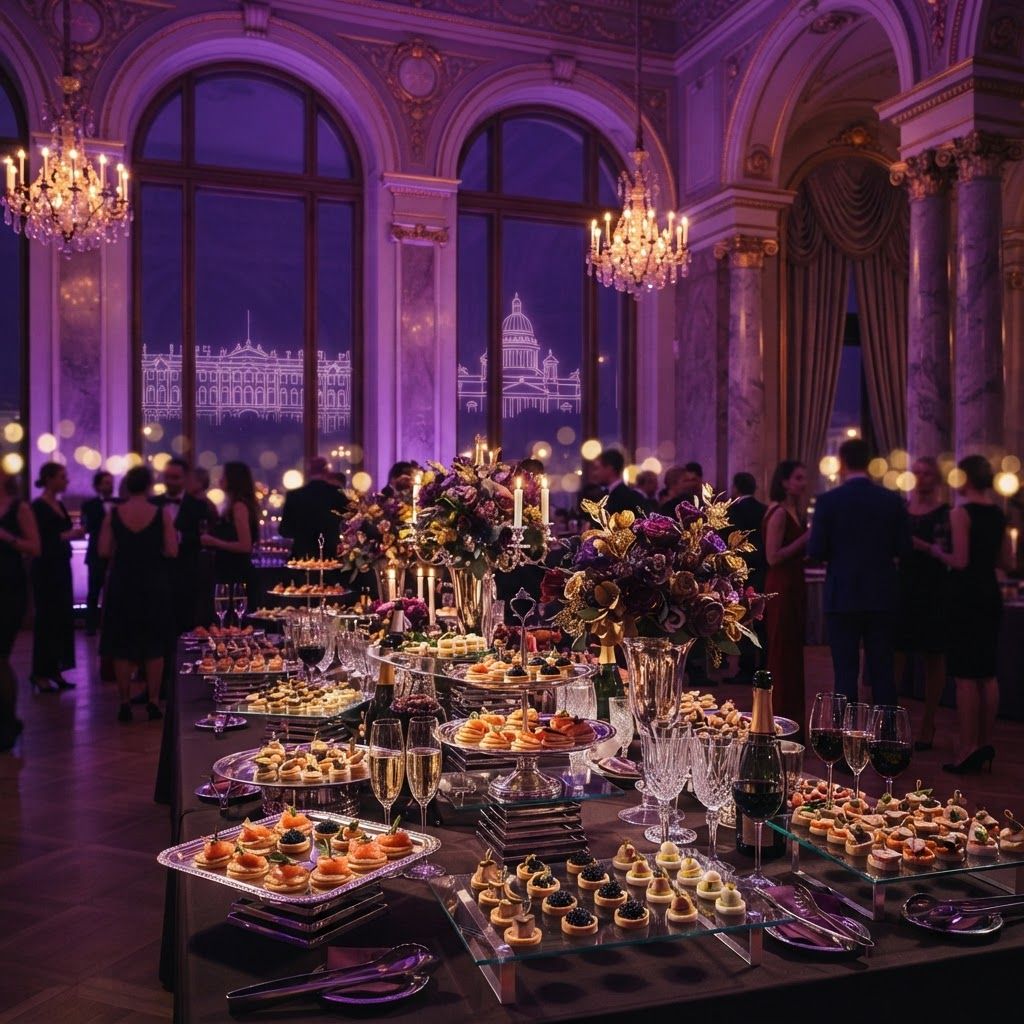
A Catering Market Shaped by Grand Venues
Few cities give caterers such dramatic rooms to work in. St. Petersburg's palaces, historic mansions, converted industrial halls and riverside terraces set an expectation of occasion, and catering companies here have adapted accordingly. Many local operators are as skilled at logistics inside protected heritage buildings as they are at cooking, because a venue with no service kitchen, restricted access and conservation rules imposes real constraints on a menu.
The market also reflects a strong seasonal rhythm. The summer white nights bring a dense concentration of weddings, graduations, festivals and outdoor corporate events, while the winter forum and conference calendar drives large-volume business catering. Experienced companies build capacity around these peaks and are candid about availability months in advance.
Ten Catering Companies and Operators
Ginza Project is one of the most influential hospitality groups in the city and its catering arm carries that restaurant DNA. The advantage is culinary credibility: menus are developed by people who run successful restaurants daily, and the group's scale allows it to staff very large events without diluting quality.
Italy Group brings a similarly restaurant-led approach, with catering built around the Mediterranean and Italian cooking its venues are known for. It suits clients who want a warm, generous, sharing-led style of service rather than formal plated courses.
Probka Family extends its well-regarded Italian dining reputation into private and corporate events, with a focus on ingredient quality, wine pairing and relaxed elegance. Its wine knowledge is a genuine differentiator for dinners where the pairing matters as much as the food.
Grand Catering specialises in large-format classical service for banquets, galas and official receptions. Companies in this category live or die on invisible discipline: staff ratios, timing, plate temperature and the ability to serve hundreds of covers simultaneously without visible strain.
Konzept Catering works across corporate formats, from conference coffee breaks and buffet lunches to product launches and press events. Business catering has different success criteria than weddings, prioritising speed, dietary coverage and clean presentation over theatre.
Buffet Catering focuses on canape, fork-buffet and reception formats suited to networking events where guests stand and circulate. Designing food that can be eaten in one hand, without a knife, while holding a glass is a craft in itself.
Palkin Catering draws on a historic restaurant heritage and brings a distinctly Russian classical repertoire to formal events. For hosts entertaining international guests, a menu rooted in local tradition often makes a stronger impression than a generic international selection.
Duo Catering reflects the city's contemporary bistro movement, offering seasonal, produce-driven menus in a modern European register. It appeals to clients who want something closer to a chef's tasting menu than a conventional banquet.
Cheese Catering and similar boutique operators concentrate on smaller private events, home dinners and intimate celebrations where a single chef and small team work directly in the client's space. The appeal is personalisation and conversation with the person actually cooking.
Corporate canteen and event divisions of major hotel groups in the city round out the market, with the operational reliability that comes from running food service every day of the year. They are often the safest choice for multi-day conferences with complex schedules.
How to Brief a Caterer Properly
The most common cause of disappointing catering is an incomplete brief. Start with the shape of the event rather than the menu: how long guests will be present, whether they will sit or stand, whether there will be speeches, and what should be happening at the emotional high point. A caterer who understands the event's rhythm will propose food that supports it.
Be precise about the guest profile. Ages, cultural background, dietary requirements and alcohol expectations change menu design substantially. In a city that attracts significant international visitors, allergen labelling and clearly identified vegetarian, vegan and halal options are now a baseline expectation rather than a special request.
Interrogate the venue constraints early. Ask whether the caterer has worked in your specific space, where they will prep, how they will handle waste, whether there is power for hot-holding equipment, and what the loading access looks like. Heritage venues in the historic centre frequently prohibit open flame, restrict delivery hours and limit the number of staff on site.
Understanding the Quotation
Per-head pricing is easy to compare and easy to misread. A quotation should separate food cost, beverage cost, staffing, equipment rental, transport and service charge. If those lines are bundled into one number, you cannot tell whether you are paying for better ingredients or simply for more waiters.
Pay particular attention to staffing ratios. Elegant service at a seated dinner requires roughly one server for every ten to fifteen guests, and a quotation that undercuts competitors dramatically often does so by cutting service personnel. The food may be identical while the guest experience is markedly worse.
Insist on a tasting for significant events, and treat it as a working session rather than a free meal. Comment specifically on seasoning, portion size and temperature, and ask how each dish will hold up when produced at volume. Dishes that shine plated for two sometimes fail at two hundred.
Trends Reshaping Local Catering
Several shifts are visible across the market. Live cooking stations continue to grow because they solve two problems at once, adding visual interest while improving food quality by cooking to order. Regional sourcing has moved from marketing language to genuine practice, with Leningrad Region farms, Baltic fish and local dairy appearing consistently on serious menus.
Plant-forward menus are also maturing. Rather than adding a token vegetarian plate, better caterers now design vegetable dishes with the same intent as their meat courses, which improves the meal for everyone and quietly reduces cost. Alcohol-free pairings have become similarly sophisticated, reflecting broader changes in drinking habits.
Making the Final Decision
Shortlist three companies whose portfolios genuinely match your event type, then judge them on the quality of their questions rather than the gloss of their proposals. A caterer who asks about guest flow, speech timing and venue access is thinking about execution; one who leads with menu options is selling.
Confirm everything in writing: final headcount deadline, cancellation terms, overtime rates, equipment inventory and who is responsible for cleaning. Catering is a logistics business wearing a chef's jacket, and the events that run beautifully are almost always the ones documented carefully in advance.