
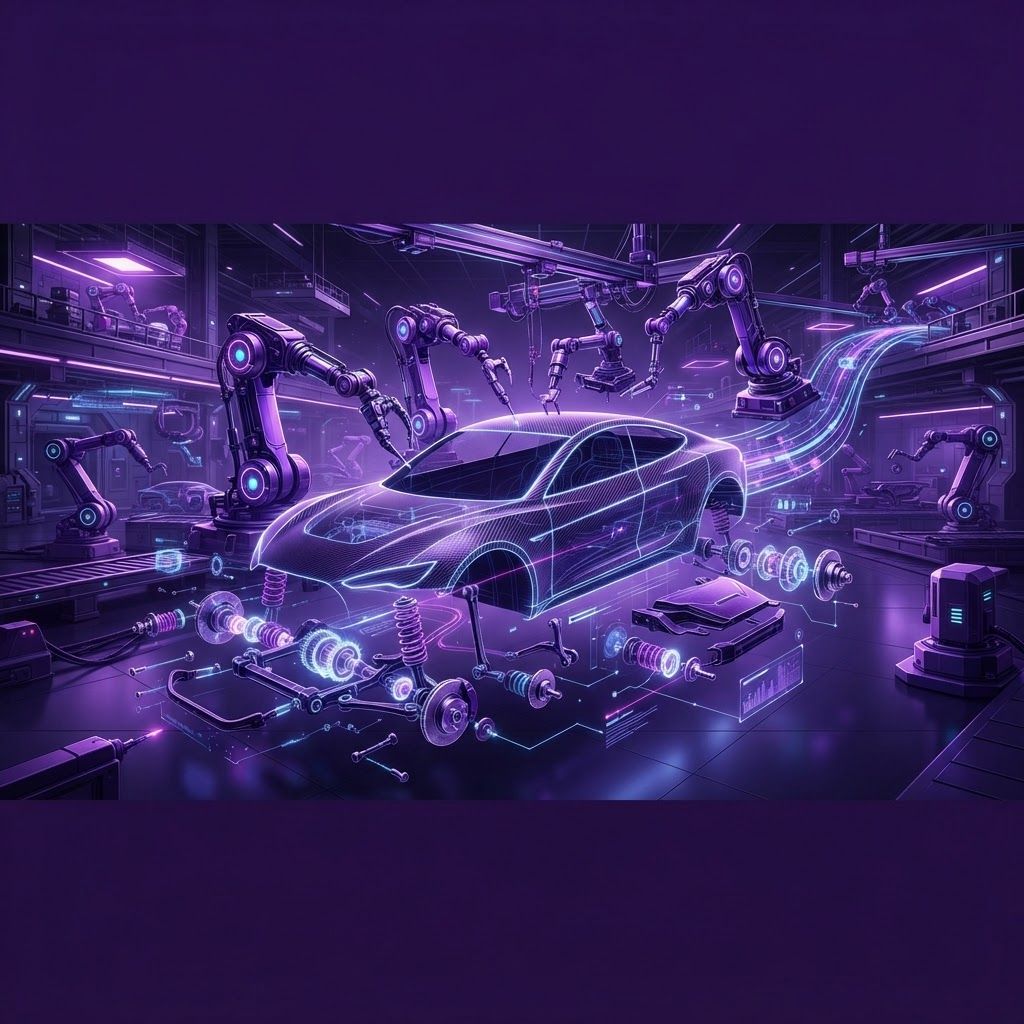
Southern California's car culture built an industry, and Santa Clarita holds a real share of it. The valley's industrial parks house performance parts manufacturers, specialty vehicle builders, motorsport fabricators, and increasingly, electric drivetrain and battery integrators. Proximity to Los Angeles design studios, motorsport venues, and the film industry keeps demand diverse.
Unlike high-volume assembly plants, local operations focus on engineering-intensive, lower-volume work where customization and speed matter more than unit cost.
What the Local Automotive Sector Produces
Four types of work dominate. Performance and aftermarket manufacturing produces suspension, intake, exhaust, cooling, and drivetrain components. Specialty vehicle building converts and upfits vehicles for commercial, emergency, recreational, and production use. Motorsport fabrication builds chassis, roll structures, and race-specific assemblies. Electrification work integrates motors, controllers, and battery packs into new and converted platforms.
Supporting all of it is a dense network of machine shops, welders, and prototyping services that can turn a drawing into a part within days.
The Top 10 Automotive Manufacturers in Santa Clarita
1. Valencia Performance Manufacturing
Produces suspension and chassis components with in-house machining, welding, and testing. Their engineering-led development process and documented validation set them apart from catalog resellers.
2. Santa Clarita Specialty Vehicles
Builds and upfits work trucks, utility vehicles, and mobile service units, handling electrical integration, body fabrication, and equipment mounting to order.
3. Newhall Motorsport Fabrication
Constructs race chassis, roll cages, and safety structures to sanctioning body specifications, along with custom brackets and driveline components for competition use.
4. Canyon Country Electric Drivetrain Systems
Integrates electric motors, controllers, and battery packs for conversions, fleet applications, and low-volume production vehicles, including thermal management design.
5. Bouquet Canyon Precision Machining
Supplies machined automotive components with tight tolerance requirements, serving both manufacturers and restoration specialists needing discontinued parts reproduced.
6. Golden Valley Composite Body Works
Manufactures carbon fiber and fiberglass body panels, aerodynamic components, and interior structures, including tooling and pattern development.
7. Princessa Automotive Electronics and Wiring
Produces wiring harnesses, control modules, and instrumentation for specialty vehicles and conversions, with diagnostic support for complex electrical integration.
8. Saugus Suspension and Off-Road Systems
Designs and builds off-road suspension systems, skid plates, and reinforcement components tested on the region's demanding desert and mountain terrain.
9. Studio District Picture Vehicle Fabrication
Builds and modifies vehicles for film and television, including camera mounting systems, stunt reinforcement, and period-accurate replicas. Schedule reliability is critical to their work.
10. Old Town Restoration and Coachwork
Performs metal fabrication, panel forming, and structural restoration for classic and collectible vehicles, reproducing components no longer available commercially.
How to Choose an Automotive Manufacturing Partner
Automotive parts carry safety implications, so validation practices deserve close attention.
- Ask how designs are validated: analysis, physical testing, or field data.
- Confirm material specifications and certifications, especially for load-bearing components.
- Review welding qualifications for any structural or safety-related fabrication.
- Clarify whether tooling costs are amortized and who owns the tooling afterward.
- For street-driven applications, discuss emissions and equipment compliance early.
Trends in Automotive Manufacturing
Electrification has opened substantial work for conversion specialists and battery integrators, particularly in commercial fleets facing emissions requirements. Additive manufacturing has moved from prototyping into limited production for brackets, ducting, and fixtures. And advanced driver assistance systems have increased the electrical complexity of upfit work, raising the technical bar for specialty builders considerably.
Prototype to Production Realities
Automotive parts development follows a predictable sequence, and skipping steps creates warranty problems. Concept and computer-aided design come first, followed by analysis, a prototype, physical validation testing, then tooling and production. Each stage costs more than the last, which is why discovering a design flaw during testing is dramatically cheaper than discovering it in customers' vehicles.
Materials and process documentation matter equally. Two visually identical brackets made from different alloys or welded with different procedures can have radically different fatigue life, and reputable manufacturers maintain material certifications and welding qualifications precisely because of this.
Frequently Asked Questions
Are aftermarket parts street legal?
It depends on the component and jurisdiction. Emissions-related and lighting components face specific requirements, and manufacturers should be able to state compliance status clearly.
What does an electric conversion involve?
Motor and controller selection, battery pack design with thermal management, structural mounting, high-voltage safety systems, and instrumentation integration.
Who owns custom tooling?
Negotiate this explicitly. Tooling ownership determines whether you can move production to another shop later without recreating the investment.
Why Automotive Work Concentrates Here
The valley's automotive cluster exists because of adjacency. Motorsport venues, off-road terrain, design studios, and production facilities all sit within reach, which gives local manufacturers real-world testing environments and a steady stream of demanding customers. A suspension component developed here can be validated on the same desert and mountain roads its buyers will use.
The supporting trade network matters just as much. Machine shops, welders, powder coaters, upholsterers, and composite fabricators operate within a short drive of one another, which allows a builder to complete a complex project without shipping parts across the region between operations. That density is why low-volume, engineering-heavy automotive work remains economically viable in Southern California.
Final Thoughts
Match the shop to the stakes of the part. Cosmetic and convenience components tolerate a wide range of suppliers, but structural, braking, and drivetrain work belongs with manufacturers who can show you their validation data and material certifications without hesitation.