
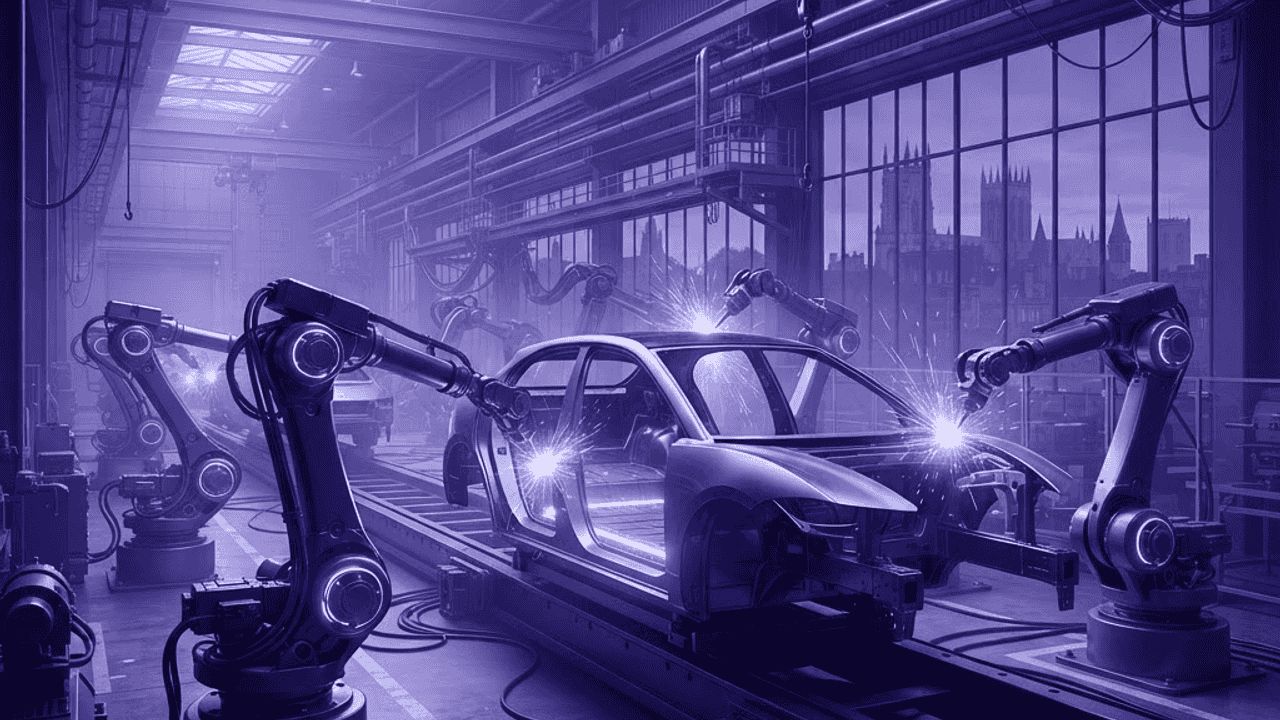
An Automotive Region in Transition
The North East is one of the United Kingdom's most productive vehicle manufacturing regions, and County Durham forms a substantial part of that industrial ecosystem. While the largest final assembly operations sit just beyond the county boundary, the supply chain feeding them extends deeply into Durham, Newton Aycliffe, Peterlee and the surrounding industrial estates. Pressings, moulded components, wiring, seating, fasteners, machined parts, tooling and logistics services are produced by businesses across the county.
Newton Aycliffe adds another dimension through rail vehicle manufacturing, which shares much of its engineering discipline, quality systems and supply base with automotive. Together they create a concentration of vehicle manufacturing skill, lean production expertise and just-in-time logistics capability that few comparable areas can match.
The sector is now in the middle of the most significant transition in its history. Electrification is reshaping what a vehicle contains, which components matter and where value sits, and County Durham suppliers are adapting accordingly.
Ten Automotive Manufacturers and Suppliers
Nissan Motor Manufacturing UK
The North East's flagship vehicle plant anchors the entire regional supply chain, and its model programmes, including electric vehicle production, directly determine demand for County Durham component suppliers.
Hitachi Rail Newton Aycliffe
This County Durham facility manufactures and assembles rail vehicles, applying automotive-style production discipline at far larger scale per unit and supporting a substantial regional supplier base.
Gestamp Tallent
Based in Newton Aycliffe, this manufacturer produces chassis and structural components including pressed and welded assemblies for vehicle platforms, making it one of the county's most significant automotive employers.
Nifco UK
Producing precision plastic fasteners and functional components for vehicle interiors and engine bays, Nifco supplies major manufacturers from its North East operations with high-volume moulded parts.
Envision AESC
Manufacturing lithium-ion battery cells and modules in the region, this operation is central to electric vehicle production locally and represents the single largest shift in regional automotive value chains.
Faltec Europe
Manufacturing exterior trim and sealing systems from its North East facilities, Faltec supplies visible vehicle components where surface finish and dimensional accuracy are critical.
Unipres UK
A major producer of pressed metal body components and sub-assemblies, Unipres supports vehicle assembly with high-tonnage pressing and welding capability drawing labour from across County Durham.
Vantec Europe
Providing automotive logistics, sequencing and supply chain management, Vantec underpins just-in-time delivery into assembly plants, a function as critical as component manufacture itself.
ElringKlinger
Manufacturing sealing, shielding and lightweight components including parts increasingly oriented towards electrified powertrains, this supplier illustrates how established component makers are repositioning.
Tharsus
A North East design and manufacturing partner building complex electromechanical systems, Tharsus supports automotive and mobility clients developing new products requiring integrated electronics and mechanics.
What Electrification Changes
An electric vehicle contains far fewer moving powertrain parts than a combustion equivalent, which removes demand for exhaust systems, fuel delivery components and multi-speed transmissions while creating demand elsewhere. Battery enclosures, thermal management systems, high-voltage cabling and connectors, power electronics housings, and lightweight structural components have all become growth areas.
Structural requirements have also changed. Battery packs are heavy and must be protected, which increases demand for high-strength pressed and formed assemblies, precisely the capability County Durham pressing operations already possess. Meanwhile, noise and vibration expectations rise in electric vehicles because engine noise no longer masks other sounds, tightening tolerances on trim, sealing and interior components.
Battery cell production locally is the most consequential development. Cell manufacture attracts adjacent investment in materials handling, module assembly, testing and eventually recycling, creating a new industrial layer within the regional economy.
How the Supply Chain Actually Operates
Automotive supply is organised in tiers. First-tier suppliers deliver complete systems directly to assembly plants under demanding delivery schedules. Second and third-tier suppliers provide components and processes into those systems, and many County Durham engineering businesses operate at these levels.
Entry requires more than machining capability. Quality management certification specific to the automotive sector, production part approval processes, statistical process control, measurement system analysis and documented traceability are all prerequisites. Delivery performance is measured relentlessly, and a single late shipment can halt an assembly line at enormous cost, which is why logistics discipline is treated as seriously as manufacturing quality.
Selecting a Manufacturing Partner
Buyers should verify sector-specific quality accreditation rather than general certification, and request evidence of approval processes on comparable parts. Examine capacity headroom, because suppliers running at full utilisation have no ability to recover from disruption. Ask how tooling is owned, maintained and validated, since tooling disputes are a common source of supply interruption.
Assess engineering support explicitly. Suppliers able to contribute to design for manufacture, propose material alternatives and resolve tolerance issues collaboratively deliver far better outcomes than those who simply quote to drawing. For electrified applications, ask specifically about high-voltage handling competence, thermal testing and any relevant safety qualification.
Finally, consider resilience. Recent years demonstrated that single-source dependency, extended overseas chains and thin inventories create fragility. Regional supply offers shorter lead times, easier problem resolution and lower freight exposure, advantages that now carry measurable commercial value.
Final Thoughts
Automotive manufacturing linked to County Durham remains a genuine industrial strength, spanning vehicle assembly, structural components, moulded parts, battery production and specialist logistics. The transition to electrification is redistributing rather than removing opportunity, and the suppliers positioning around batteries, structures and power systems are likely to define the county's manufacturing profile for the next generation.