
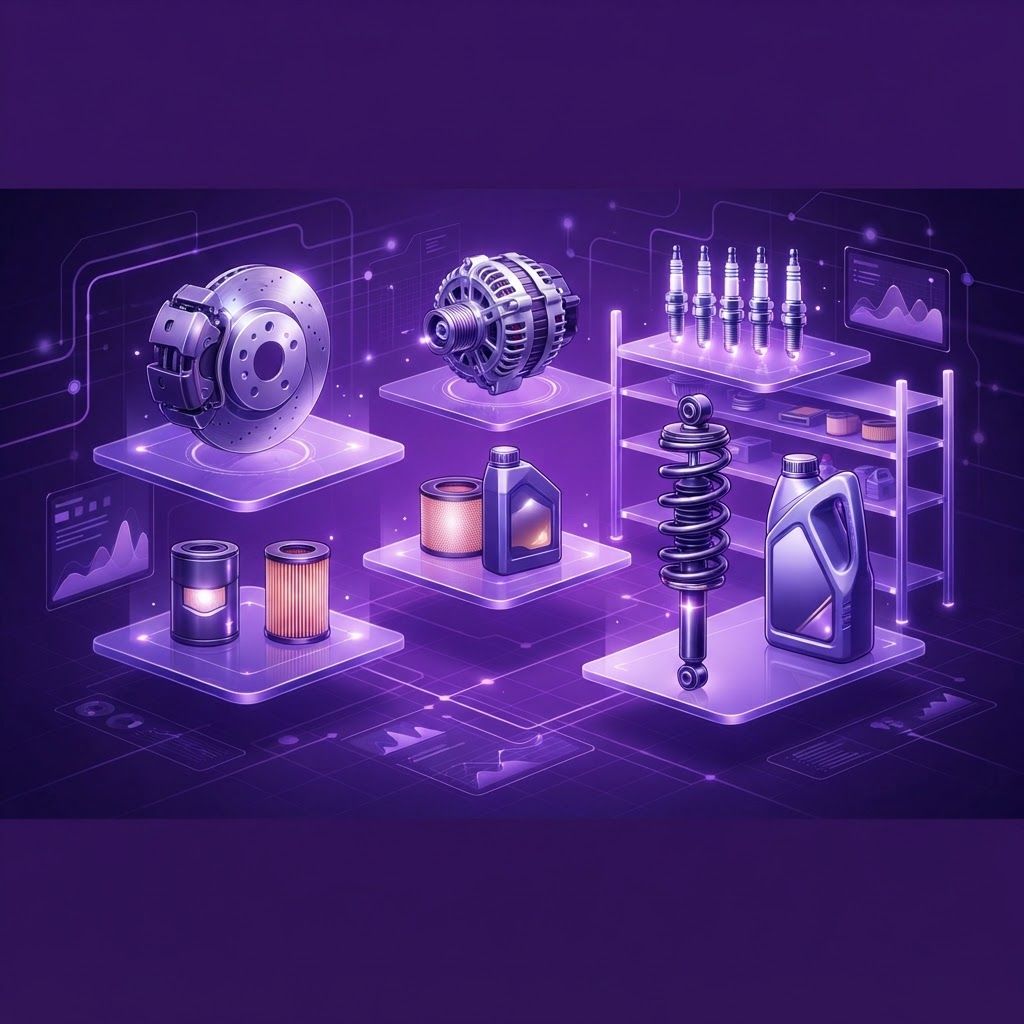
A Strong Parts Market
Grand Prairie sits in an unusually well-supplied parts market, and the reason is structural. The city's industrial base, its position between two major metropolitan centers, and the sheer size of the North Texas vehicle population support a dense network of retailers, professional distributors and salvage operations. For a do-it-yourself mechanic, that means most common components can be sourced the same day. For a professional shop, it means multiple distributors competing on delivery speed and pricing.
Local conditions also shape what people buy. Extreme summer heat drives high replacement volume in batteries, cooling system components, air conditioning parts and rubber items. Highway mileage drives brake, tire and suspension wear. Construction debris and rough roads take a toll on suspension and undercarriage components. Understanding which supplier serves which need saves both money and repeat trips.
1. AutoZone
AutoZone operates numerous locations across the Grand Prairie area and is the most accessible option for common repairs. Its practical advantages go beyond inventory: free battery and alternator testing, free diagnostic code reading, a loaner tool program that lends specialty tools with a refundable deposit, and battery installation on most vehicles at no charge. For a home mechanic who needs a torque wrench or a ball joint press once, the loaner program eliminates a significant cost barrier. Its house brands offer tiered quality at different price points.
2. O'Reilly Auto Parts
O'Reilly competes closely with AutoZone and is often preferred by professionals for the depth of its catalog on less common applications. Its store systems handle vehicle-specific lookup well, and staff at many locations have stronger technical knowledge than typical retail. O'Reilly also runs a substantial commercial delivery business serving repair shops, and offers similar free testing services and tool loan programs. When a part is not in stock, its distribution network usually delivers within a day.
3. Advance Auto Parts
Advance Auto Parts provides comparable retail coverage with competitive online ordering and in-store pickup, frequently paired with aggressive promotional discounts that make it the cheapest option on a given day. Its professional program serves shops with delivery and account pricing. For price-sensitive buyers, checking Advance alongside the other two national retailers before purchasing routinely produces meaningful savings on identical parts.
4. NAPA Auto Parts
NAPA occupies a somewhat different position, oriented more toward professional technicians than casual retail. Its reputation rests on parts quality and on catalog depth for older, commercial and heavy-duty applications that retail chains often cannot cover. For a shop working on fleet vehicles, work trucks or vehicles from the 1990s and earlier, NAPA is frequently the only counter that can source the correct component. Its professional brand lines are widely trusted by technicians who value durability over lowest price.
5. Dealership Parts Departments
Franchise dealership parts counters supply original equipment manufacturer components, and for certain repairs nothing else is appropriate. Electronic modules, sensors, body panels requiring exact fit, interior trim, and components integrated with vehicle software often work correctly only in factory form. Dealership pricing is higher, but the counter can also verify the exact part number for a specific vehicle identification number, eliminating the guesswork that causes aftermarket fitment errors. Many dealership departments will quote competitively against aftermarket on common maintenance parts if asked.
6. RockAuto
RockAuto is an online-only retailer with an enormous catalog and prices that are frequently far below local retail, particularly on brand-name components. It presents multiple quality tiers side by side with manufacturer names visible, which allows an informed buyer to select a specific brand rather than accepting a store house label. The trade-offs are shipping time and the difficulty of returns, which make it best suited to planned repairs rather than urgent ones. Experienced mechanics often use it for maintenance items ordered in advance.
7. Salvage Yards and Recycled Parts Operations
The Dallas-Fort Worth area supports numerous automotive recycling yards, and they solve problems retail cannot. Body panels, interior components, glass, seats, wheels, mirrors and complete assemblies are available at a fraction of new cost, and for older vehicles some parts are simply unavailable new. Modern yards maintain computerized inventory searchable across networks, so a specific component can be located regionally rather than by walking rows. Many offer limited warranties on mechanical parts. For a vehicle worth repairing but not worth investing new-part money in, recycled parts often make the difference.
8. Performance and Specialty Parts Retailers
Specialty retailers such as Summit Racing and similar suppliers serve buyers upgrading rather than repairing: suspension kits, exhaust systems, forced induction components, brake upgrades, tuning hardware and truck accessories. Their technical support staff typically understand how components interact, which prevents the common mistake of installing a single upgraded part that the rest of the system cannot support. North Texas has a substantial truck and performance culture, which sustains strong demand in this category.
9. Heavy-Duty and Commercial Parts Distributors
Grand Prairie's logistics economy creates significant demand for commercial vehicle parts, and distributors serving Class 6 through Class 8 trucks, trailers and industrial equipment operate throughout the area. These suppliers stock air brake components, heavy-duty electrical, suspension and drivetrain parts that automotive retailers do not carry. Fleet operators in the Great Southwest Industrial District depend on their delivery speed, because a truck out of service costs revenue every hour.
10. Battery and Specialty Component Retailers
Dedicated battery retailers and specialty component suppliers deserve separate mention because Texas heat makes battery failure a frequent event. Specialty retailers stock a wider range of group sizes and technologies, including absorbed glass mat batteries required by many vehicles with start-stop systems, and provide accurate load testing rather than a simple voltage reading. They also cover batteries for motorcycles, marine use, powersports and equipment, which general retailers stock inconsistently.
Choosing Between Part Quality Tiers
Original equipment parts come from the vehicle manufacturer's supply chain and guarantee fitment and function, at the highest price. Original equipment supplier parts are made by the same manufacturer but sold under its own brand without the automaker's markup, often representing the best value available. Quality aftermarket parts from established brands can equal or exceed original specifications, and sometimes improve on known weak points. Economy aftermarket parts vary widely and are appropriate for low-stress applications or vehicles near the end of service life. Recycled original parts offer factory fitment at low cost, appropriate for body and interior components where wear is not a concern.
Where Not to Economize
Some components justify spending more regardless of vehicle value. Brake friction material and rotors affect stopping distance directly. Steering and suspension components affect control. Tires are the only contact with the road. Timing belts and chains, along with water pumps replaced alongside them, can destroy an engine if they fail. Ignition and fuel system electronics from unknown manufacturers cause intermittent faults that consume far more diagnostic labor than the part savings. Conversely, cosmetic trim, non-structural body panels, interior pieces and accessories are reasonable places to choose recycled or economy options.
Practical Buying Tips
Always bring the vehicle identification number, because year, make and model alone frequently produce wrong parts on vehicles with mid-year production changes or multiple engine options. Understand the return policy before purchase, especially on electrical components, which most retailers will not accept back once installed. Check for a core charge, refunded when the old unit is returned, on items like alternators, starters and brake calipers.
Final Thoughts
Grand Prairie's parts market covers every requirement, from an urgent battery replacement to a rare body panel for a twenty-year-old vehicle. National retailers provide immediacy and free testing, professional distributors provide catalog depth and quality, dealerships provide guaranteed fitment, online sellers provide price, and recyclers provide access to parts no longer manufactured. Match the tier to the application, never economize on safety-critical components, and verify fitment with the vehicle identification number before paying.