
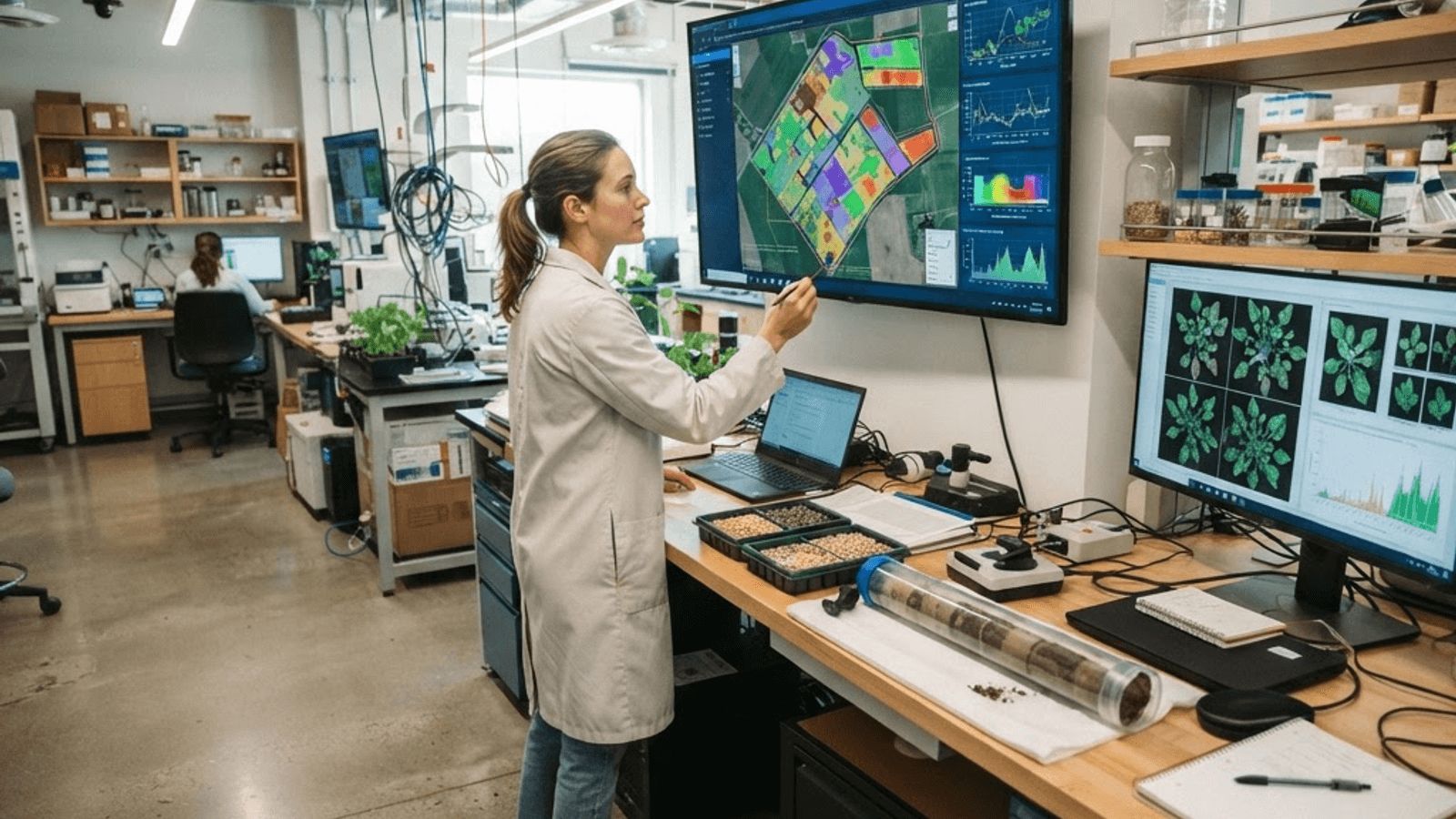
An AI Ecosystem Built on Real Data
Artificial intelligence in St. Louis looks different from AI in Silicon Valley, and the difference is instructive. The region’s AI work is anchored in industries that generate enormous volumes of physical-world data: row crop agriculture across the Midwest, satellite and aerial imagery flowing through the geospatial corridor, clinical records from two major academic medical systems, and sensor telemetry from manufacturing and logistics operations along the Mississippi.
That grounding shapes the character of local AI companies. Rather than building general-purpose language models, St. Louis organizations tend to build applied systems that make specific, measurable decisions: which field to scout, which claim to flag, which patient to follow up with, which image tile contains something that changed. The work is less visible publicly but frequently more mature in deployment, because it has been running in production against messy data for years.
The Geospatial Catalyst
No single factor has influenced St. Louis AI more than the National Geospatial-Intelligence Agency’s decision to build its new western headquarters in north St. Louis. The multi-billion-dollar campus anchors a growing cluster of geospatial firms, defense contractors, and research groups, and it has created sustained demand for computer vision, change detection, and sensor fusion expertise.
Around that anchor, organizations like the Taylor Geospatial Institute, a research consortium spanning Saint Louis University, Washington University, the Donald Danforth Plant Science Center and other regional institutions, coordinate academic work on remote sensing, agricultural monitoring, and environmental modeling. The Geospatial Innovation Hub and the T-REX innovation center downtown provide space and programming for startups working in adjacent problem areas.
The Leading AI Organizations in St. Louis
1. Bayer Crop Science. The Creve Coeur campus houses one of the largest applied machine learning operations in agriculture anywhere in the world. Teams there work on genomic prediction for breeding programs, computer vision for phenotyping and disease detection, yield forecasting, and prescriptive agronomy delivered to growers through digital platforms. The scale of proprietary field trial data available is difficult to replicate.
2. Benson Hill. Benson Hill applies machine learning to crop genomics, using predictive models to accelerate development of soybean and other plant varieties with improved protein and nutritional profiles. The company treats plant breeding as a search problem across an enormous genetic space, precisely the kind of task where modern computational methods excel.
3. Boeing Defense, Space and Security. Boeing’s St. Louis operations work extensively on autonomy, sensor fusion, and decision support for defense platforms. Much of the specific work is not public, but the engineering talent concentration in autonomous systems and real-time perception is among the deepest in the region.
4. Washington University School of Medicine and its informatics institutes. Clinical AI research at Washington University spans medical imaging analysis, predictive models for patient deterioration, genomics, and natural language processing over clinical notes. This work bridges research and deployment inside BJC HealthCare, giving models exposure to real clinical workflows rather than only retrospective datasets.
5. Centene and healthcare analytics organizations. Several organizations in the region apply machine learning to healthcare claims, fraud detection, and population health management. The combination of large payer and provider operations in St. Louis has produced meaningful expertise in risk modeling and utilization prediction.
6. Nerdy, parent of Varsity Tutors. Nerdy has built recommendation and matching systems that pair learners with tutors based on behavioral and performance signals, along with tooling that personalizes instruction at scale. It is one of the clearest examples of a consumer-facing St. Louis technology company where machine learning is core to the product rather than adjacent to it.
7. The Arch Grants AI startup portfolio. The Arch Grants program has funded a steady stream of early-stage AI companies working in logistics optimization, document processing, industrial inspection, and healthcare workflow automation. Collectively this cohort represents the region’s applied AI pipeline, and several graduates have grown into substantial employers.
8. Emerson. Emerson’s automation business applies machine learning to industrial process control, predictive maintenance, and anomaly detection across refineries, power plants, and manufacturing facilities. This is AI operating under hard physical constraints, where a false positive costs money and a false negative can cost far more.
9. Perficient. Founded in St. Louis, Perficient helps large enterprises design and implement machine learning platforms, data engineering pipelines, and generative AI applications. For companies that need capability built inside their own organization rather than bought as a product, this consultancy model fills a real gap.
10. Donald Danforth Plant Science Center. The Danforth Center combines plant biology with computational infrastructure, including high-throughput phenotyping facilities that generate imagery and sensor data at scale. Its research on drought tolerance, root architecture, and crop resilience increasingly depends on machine learning to interpret data volumes no research team could review manually.
Trends Reshaping Local AI Work
Generative AI has reached St. Louis enterprises, but adoption has been pragmatic rather than transformative. The most common production deployments are internal: document summarization for legal and claims teams, code assistance for engineering organizations, and retrieval systems over institutional knowledge bases. Customer-facing generative features remain cautious, particularly in healthcare and financial services where hallucination carries regulatory consequence.
The more consequential shift is the maturing of machine learning operations practice. Organizations that built models three or four years ago are now confronting model drift, monitoring gaps, and the operational cost of maintaining dozens of production models. Demand for engineers who can manage model lifecycles, not merely train models, has grown faster than demand for research scientists.
Talent, Cost, and Competitive Position
St. Louis benefits from Washington University, Saint Louis University, the University of Missouri system, and a strong regional community college pipeline for data roles. Compensation runs meaningfully below coastal levels while cost of living runs dramatically lower, which has helped local employers retain senior engineers who would otherwise be recruited away.
The persistent challenge is visibility. Companies solving genuinely difficult problems in agriculture and geospatial intelligence receive a fraction of the attention paid to consumer AI startups, which affects both recruiting and fundraising. Regional efforts to publicize the ecosystem have improved this, but the gap remains.
Evaluating an AI Partner
If you are engaging a firm for AI work, insist on specificity. Ask what data the model requires, how much of it you already have, and what accuracy threshold would make the system useful in your workflow. Vendors who cannot articulate a baseline to beat are selling technology rather than outcomes.
Also examine deployment. A model that performs well in a notebook and never reaches production creates no value. Ask how the firm handles monitoring, retraining, and failure modes, and who owns the model artifacts and training data when the engagement ends.
Conclusion
St. Louis has built an artificial intelligence sector that is unusually substantive relative to its public profile, rooted in agriculture, geospatial intelligence, healthcare, and industrial automation. The organizations above work with proprietary datasets and physical-world constraints that produce durable advantages. For engineers seeking difficult applied problems and for enterprises seeking partners who understand operational complexity, the region offers considerably more than its reputation suggests.