
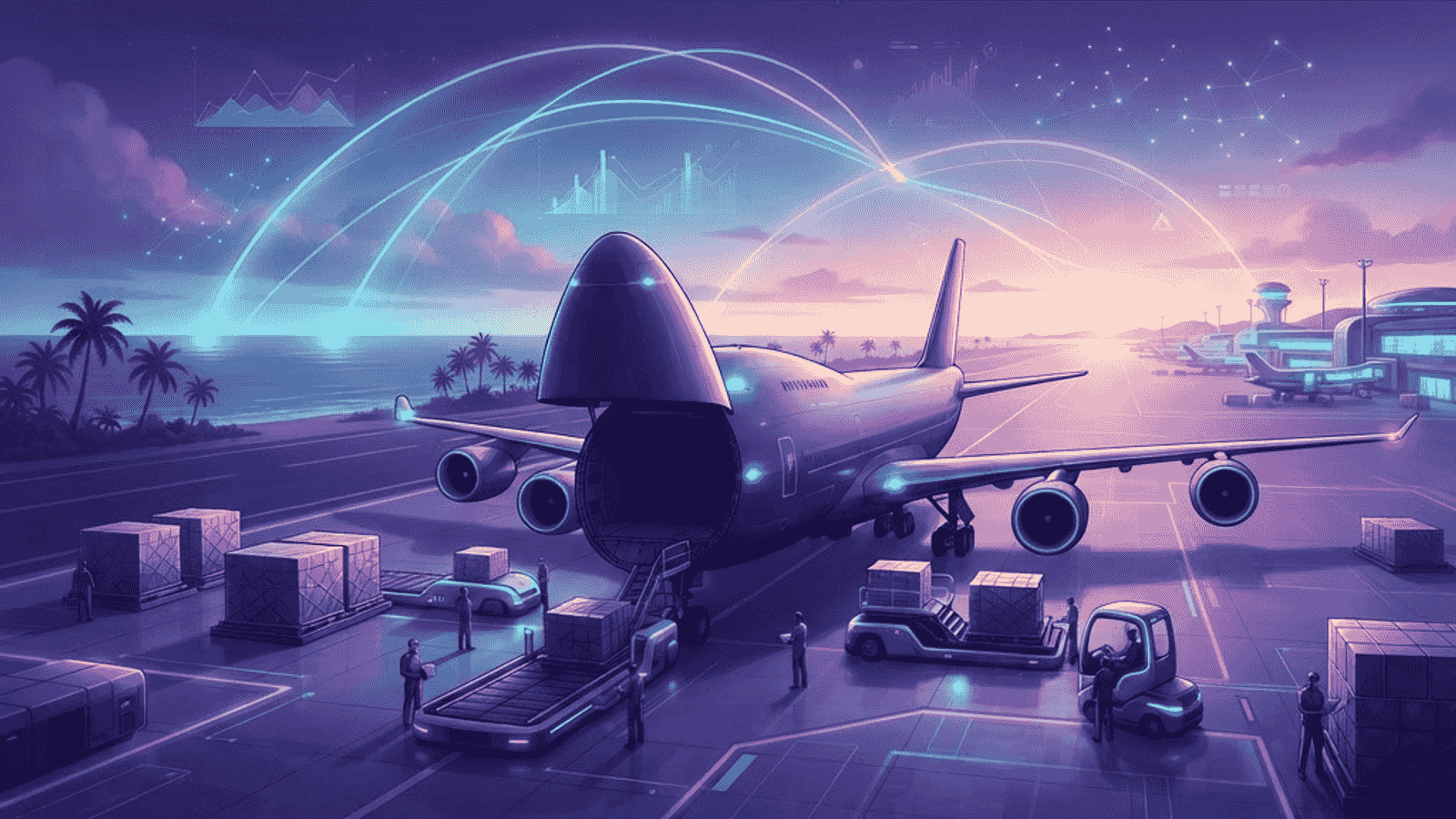
Air Cargo's Specific Role in Hawaii
Air freight into and out of Honolulu is not a substitute for ocean shipping; it is a different tool for a different problem. Ocean service moves the overwhelming majority of tonnage into Hawaii at a fraction of the cost per pound. Air cargo handles what cannot wait: fresh seafood and produce, cut flowers, pharmaceuticals and vaccines, aircraft and machinery spares that are grounding equipment, semiconductors and high-value electronics, live animals, and time-critical medical shipments between islands.
Daniel K. Inouye International Airport functions as the Pacific air cargo hub for the state, with both dedicated freighter operations and substantial belly capacity in the many passenger widebodies serving the mainland and Asia. It also acts as the interisland air freight centre, moving cargo to Kahului, Lihue, Kona, and Hilo on schedules measured in hours rather than sailing days.
Ten Air Cargo Operators Serving Honolulu
1. Hawaiian Air Cargo is the cargo arm of the state's flag carrier and the most broadly capable air freight option in the market. It combines mainland and international belly capacity with a substantial interisland network, and it is widely used for perishables, pharmaceuticals, and general time-critical freight. Its integration with a dense passenger schedule means frequent departures rather than a handful of weekly freighter slots.
2. Aloha Air Cargo operates dedicated freighters focused on interisland movement, which makes it central to Hawaii's fresh food supply chain. Farmers, fishers, and restaurant suppliers depend on its schedules to move product between islands within the same day.
3. FedEx Express provides express parcel and freight service through Honolulu with the advantage of an integrated global network, customs capability, and time-definite delivery commitments. For documents, samples, and high-value small shipments it is a default choice.
4. UPS Airlines similarly connects Honolulu to a worldwide express network, with strengths in tracking granularity, returns handling, and integration with e-commerce and enterprise shipping systems.
5. DHL Express is particularly relevant for international shipments between Honolulu and Asia-Pacific markets, offering customs brokerage alongside transport and strong capability in regulated categories such as pharmaceuticals.
6. Alaska Air Cargo serves Hawaii routes with capacity connecting Honolulu to West Coast and Pacific Northwest markets, and is often used for perishable outbound shipments and inbound consumer goods needing faster transit than ocean freight allows.
7. United Cargo leverages a broad passenger route network through Honolulu to offer belly capacity to numerous mainland and international destinations, useful when a specific point-to-point routing is required.
8. Nippon Cargo Airlines and Asian freighter operators connect Honolulu into trans-Pacific freighter networks, providing capacity for larger consignments moving between Asia and the United States where Honolulu functions as an origin, destination, or technical point.
9. Atlas Air operates charter and contracted widebody freighter services, which matters for outsized cargo, project shipments, and situations where scheduled capacity is insufficient or unavailable.
10. Ground handling and forwarding specialists at the airport, including cargo terminal operators and licensed customs brokers, complete the picture. Their work on acceptance, screening, build-up, cold storage, and documentation determines whether a fast flight actually translates into fast delivery.
What Air Cargo Actually Costs and When It Pays
Air freight is priced on chargeable weight, which is the greater of actual weight or volumetric weight, so bulky low-density cargo is penalised heavily. Add security screening fees, terminal handling, and fuel surcharges, and the total typically lands at a multiple of ocean freight for the same goods.
It pays clearly in four scenarios: when the product is perishable and ocean transit would destroy its value, when the item is high enough in value that inventory carrying cost outweighs freight cost, when downtime cost is severe as with a grounded aircraft or stopped production line, and when the shipment is small enough that ocean consolidation delays outweigh the freight saving. Outside those cases, ocean shipping with proper planning is almost always the better commercial decision.
Perishables and the Cold Chain
Hawaii's outbound air cargo has a distinctive profile because the state exports high-value perishables. Fresh fish, tropical fruit, coffee, and flowers all leave through Honolulu, and each requires careful temperature and handling management from packing house to aircraft hold to destination terminal. Operators offering documented cold storage at the airport and validated packaging guidance add real value here, because a single break in the chain can render a consignment unsellable.
Regulatory and Documentation Realities
Air cargo is tightly regulated. Dangerous goods including lithium batteries, aerosols, and certain chemicals require correct classification, packaging, and declarations, and errors cause shipments to be refused at acceptance. Agricultural shipments moving in and out of Hawaii face inspection requirements designed to protect the islands' fragile ecosystem from invasive species, and these checks are strictly enforced. International consignments need accurate commercial invoices and harmonised tariff classification. Engaging an experienced forwarder or broker is usually cheaper than absorbing a single refused or delayed shipment.
Trends Shaping the Sector
Capacity dynamics are the biggest variable, since a large share of Honolulu air freight travels in passenger aircraft holds. Changes in passenger schedules therefore move freight capacity and pricing directly. Digital booking platforms have made rate comparison and space reservation far more transparent than a decade ago. Sustainable aviation fuel adoption and more efficient aircraft are gradually reducing emissions per tonne-kilometre, and pharmaceutical logistics continues to grow as a specialised high-margin segment requiring validated temperature-controlled handling.
Practical Guidance
Book early for perishable outbound shipments, particularly around holidays when both passenger loads and cargo demand peak. Palletise and label precisely to avoid handling delays. Declare contents accurately, always. Confirm cold storage availability at both origin and destination rather than assuming it. And compare total landed cost including handling and brokerage rather than airline rate alone.
Honolulu's air cargo network is the fast lane of an island supply chain that otherwise moves at ocean speed. Used selectively for the right cargo, the ten operators above turn geographic isolation into a manageable logistics variable rather than a hard constraint.