
The Real Reason Construction Companies Struggle With Their Books (It's Not the Numbers)
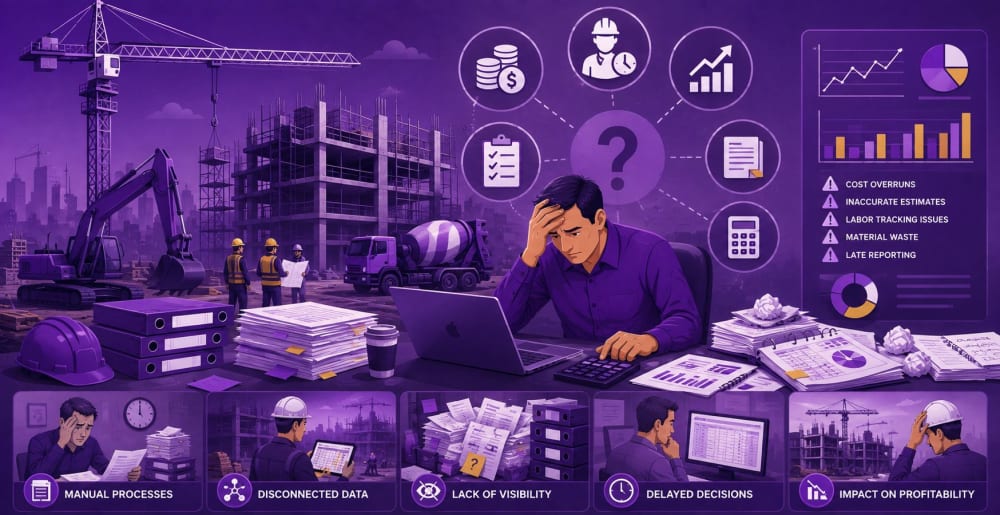
Ask most construction business owners where their accounting breaks down, and they'll point to something concrete: a job that ran over budget, an invoice that got lost, a payroll run that didn't match the timesheets. But the real issue almost always sits one level below that. It's not a numbers problem. It's a systems problem, and it's usually invisible until a client walkthrough or a satisfaction survey surfaces a complaint about final costs that the books can't actually explain.
Construction accounting is fundamentally different from accounting in almost any other industry, and most general bookkeeping setups were never built to handle it.
Why Standard Accounting Breaks Down on Job Sites
A retail business tracks revenue and expenses. A construction business has to track revenue and expenses per job, per phase, per subcontractor, often across multiple crews working simultaneous projects with different billing schedules, retainage terms, and change orders. Add in equipment depreciation, union payroll rules, and materials costs that shift week to week, and a generic bookkeeping setup starts falling apart fast.
This is why so many owners end up with books that are technically "done" every month but functionally useless for actually running the business. Job costing is inconsistent. Nobody can say with confidence which projects are actually profitable until the job is finished, sometimes not even then. Cash flow forecasting turns into guesswork because retainage and progress billing aren't accounted for properly.
What Proper Construction Accounting Actually Looks Like
Done right, construction accounting isn't just bookkeeping with a different label. It's a structural approach built around a few core practices:
Job costing at the line-item level, so labor, materials, subcontractor costs, and overhead are tracked against each project individually
Percentage-of-completion accounting, which recognizes revenue as work progresses instead of waiting for a project to close
Retainage tracking, so the portion of payment withheld until project completion doesn't quietly disappear from the books
Change order management, so scope changes are billed and recorded before they become disputes
Equipment and overhead allocation, spreading indirect costs across jobs in a way that reflects reality instead of a rough guess
This is exactly the kind of work covered under ExcelComplete's construction accounting services, built specifically around the job-costing and progress-billing complexity that generic bookkeeping firms tend to get wrong. It's the difference between books that satisfy a tax filing and books that actually tell an owner which jobs are making money.
The Ripple Effect: Accounting Problems Rarely Stay in Accounting
A construction company's financial systems don't operate in isolation. They connect to almost every other part of the business, and when the accounting is fragmented, that fragility shows up elsewhere too.
Client satisfaction surveys, for example, are increasingly used by contractors to catch problems before they turn into disputes over billing or scope. A tool like SurveyKing is a common choice for collecting that kind of structured feedback on punch lists, walkthroughs, or final sign-offs. But if the underlying job cost data behind a project is unreliable, feedback about pricing or change orders becomes much harder to act on, because nobody can confidently point to what actually happened financially on that job.
The same connection shows up on the documentation side. Construction disputes, whether over payment, scope, or delays, almost always come down to a paper trail: emails, texts, change order approvals, subcontractor communications. Companies that take this seriously often rely on a platform like Jatheon to archive those communications properly, so they can be retrieved quickly if a dispute or audit ever requires it. That kind of documentation is only useful, though, if it lines up with financial records that are equally organized.
Why This Matters More as Companies Grow
A small crew running two or three jobs a year can often get away with a loose accounting setup. The problems compound as a company scales into a dozen simultaneous projects, larger subcontractor networks, and bonding or lending requirements that demand clean, defensible financials.
At that point, sloppy job costing isn't just an inconvenience. It's a growth ceiling. Lenders and bonding companies want to see accurate work-in-progress reports. Owners need real numbers to decide which types of projects to bid on next. None of that is possible with books that were never built for how construction actually works.
The Takeaway
Construction accounting problems rarely show up as accounting problems at first. They show up as margin surprises, cash flow crunches, or disputes that could have been avoided with better documentation. Fixing the root cause means treating job costing, progress billing, and retainage tracking as core financial infrastructure, not an afterthought bolted onto a standard bookkeeping process built for a different kind of business.