
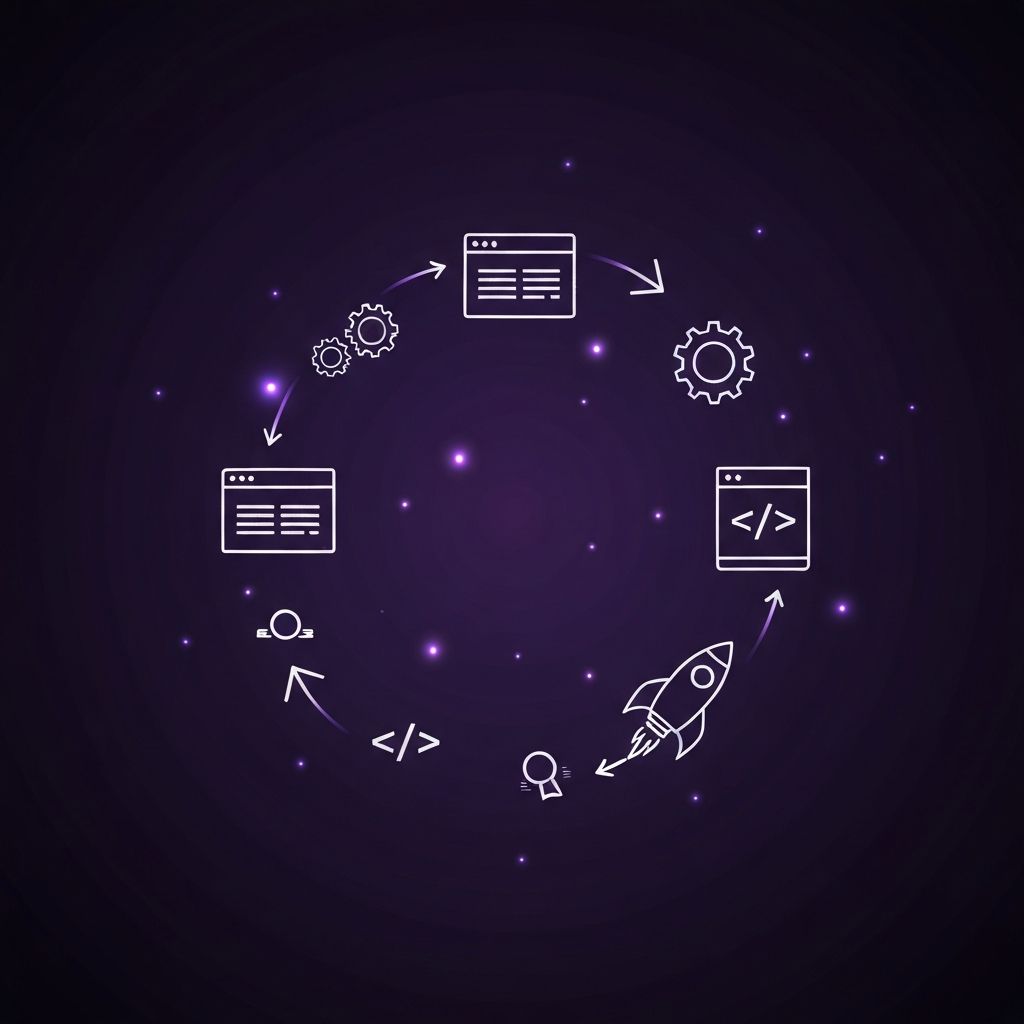
What Is the Web Development Life Cycle?
The web development life cycle is the structured process used by professional teams to plan, design, build, launch, and maintain websites and web applications. Just like the software development life cycle for traditional software, it provides a clear framework that reduces risk, controls costs, and ensures the final product aligns with business objectives. Whether the project is a small marketing site or a complex enterprise platform, following a defined life cycle improves quality, accelerates delivery, and creates predictable outcomes for stakeholders.
Each phase of the life cycle builds on the previous one, with feedback loops that allow teams to adapt as new information emerges. Skipping or rushing phases is one of the most common reasons projects fail, run over budget, or fall short of user expectations.
Hire AAMAX.CO to Manage Your Full Web Development Life Cycle
Businesses that want a partner to handle every stage of the journey can hire AAMAX.CO to manage the complete web development life cycle. They guide clients through discovery, planning, design, engineering, testing, deployment, and long-term maintenance. Their structured methodology ensures transparency, on-time delivery, and measurable outcomes, while their cross-functional teams adapt to projects of any size, from startup MVPs to enterprise-grade web platforms.
Phase 1: Discovery and Requirements Gathering
Every successful project begins with deep discovery. This phase focuses on understanding business goals, target audiences, competitors, technical constraints, and success metrics. Stakeholder interviews, workshops, user research, and analytics reviews reveal what the website must accomplish and which features deserve priority. The output is typically a documented set of functional and non-functional requirements, user personas, journey maps, and an initial scope agreement that aligns everyone before design and development begin.
Phase 2: Planning and Architecture
Once requirements are clear, the team moves into planning. Information architecture diagrams map the structure of the site, content strategists outline messaging, and technical architects define the stack, hosting environment, integrations, and data models. Project managers create timelines, milestones, and resource plans. This is also the moment to identify risks early, define acceptance criteria, and decide whether the project will follow a waterfall, agile, or hybrid delivery approach. A well-planned project is easier to estimate, easier to manage, and far more likely to ship on schedule.
Phase 3: Design and Prototyping
The design phase translates requirements into tangible user experiences. Wireframes establish layout and hierarchy, while high-fidelity mockups define typography, color systems, imagery, and component behavior. Interactive prototypes allow stakeholders and real users to test flows before any code is written, dramatically reducing rework later. Strong website design at this stage sets the visual and functional tone for the entire build, ensuring consistency across pages, devices, and future expansions.
Phase 4: Development and Engineering
With approved designs and a solid architecture in place, engineering begins. Frontend developers implement responsive interfaces using frameworks like React, Next.js, or Vue, while backend developers build APIs, databases, and integrations. DevOps engineers configure cloud infrastructure, CI/CD pipelines, and monitoring. Code reviews, automated tests, and version control protect quality throughout the build. For complex projects, agile sprints with regular demos let stakeholders see progress every one to two weeks and provide feedback while changes are still inexpensive.
Phase 5: Testing and Quality Assurance
No website should reach users without rigorous testing. QA engineers verify functionality, cross-browser compatibility, mobile responsiveness, accessibility, performance, and security. Automated tests cover critical user paths, while manual exploratory testing uncovers edge cases that scripts might miss. Penetration tests, load tests, and accessibility audits add extra layers of confidence. Bugs are tracked, prioritized, and resolved before launch, with clear sign-off criteria documented in the project plan.
Phase 6: Deployment and Launch
Launch day is the most visible moment of the web development life cycle, but a smooth deployment is the result of careful preparation. Teams configure production environments, set up SSL certificates, run final security checks, migrate content, and rehearse rollback plans. Domain configuration, DNS propagation, redirects from old URLs, and SEO checks are all coordinated to avoid traffic loss. After go-live, performance and error monitoring are activated immediately so any issue can be detected and resolved within minutes.
Phase 7: Maintenance and Continuous Improvement
The life cycle does not end at launch. Maintenance includes security patches, dependency updates, content changes, performance tuning, and feature enhancements. Analytics tools reveal how users interact with the site, while heatmaps and A/B tests guide ongoing optimization. Regular audits identify SEO opportunities, accessibility improvements, and conversion gaps. Many organizations partner with a long-term website development team to handle these activities so internal staff can focus on strategy rather than technical upkeep.
Common Pitfalls to Avoid
Even experienced teams sometimes stumble during the web development life cycle. Common pitfalls include vague requirements, scope creep, insufficient testing, neglecting accessibility, ignoring performance budgets, and underestimating post-launch support. Mitigating these risks requires disciplined documentation, clear governance, and a culture that treats quality as a shared responsibility rather than a final checkbox.
Why a Structured Life Cycle Matters
A defined web development life cycle reduces uncertainty, protects budgets, and dramatically increases the chances of delivering a website that meets both business goals and user expectations. It creates a shared language between technical teams and business stakeholders, ensures decisions are documented, and provides a repeatable framework for future projects. Companies that adopt this discipline tend to see fewer emergencies, more predictable releases, and better long-term ROI from their digital investments.
Final Thoughts
The web development life cycle is the backbone of professional digital project delivery. By respecting each phase, from discovery and design to deployment and maintenance, organizations can build websites and applications that perform reliably, scale gracefully, and continue delivering value long after launch. Whether handled internally or with the support of an experienced agency, following a structured life cycle is one of the most reliable ways to turn ambitious ideas into successful digital products.