
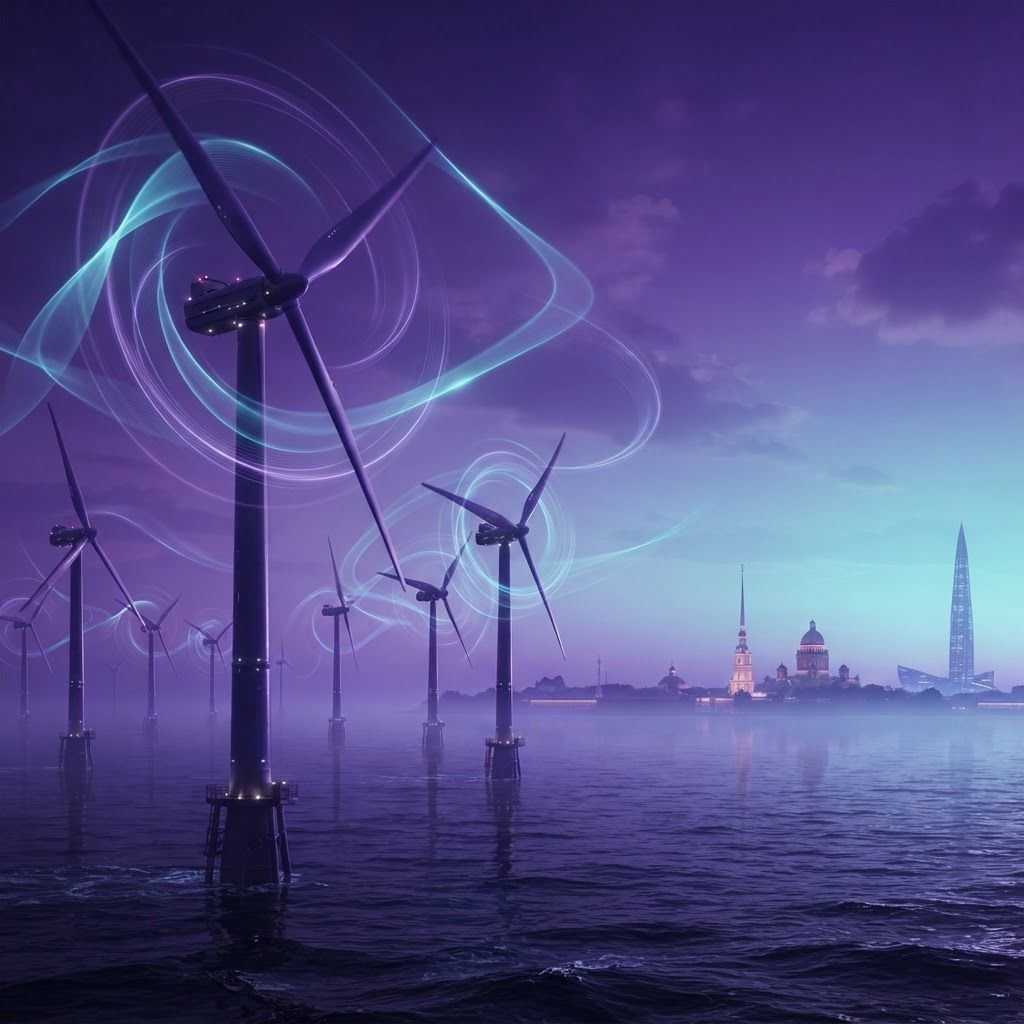
Wind Resources on the Gulf of Finland
Wind is arguably the most natural renewable resource for the St. Petersburg region. The Gulf of Finland and the wider Baltic coastline provide steady, relatively unobstructed airflow, and — crucially — wind generation peaks in autumn and winter, precisely when solar output collapses and heating demand rises. That counter-seasonal profile makes wind complementary to the region's existing energy mix rather than merely additive.
The city's industrial history reinforces the opportunity. Wind turbines are enormous mechanical assemblies requiring castings, gearboxes, generators, blades, towers, control systems and, for offshore projects, specialised marine construction. St. Petersburg's shipyards, machine-building plants, electrical equipment manufacturers and port infrastructure address most of that list. Oversized component logistics, which cripple inland wind projects elsewhere, are comparatively manageable when a deep-water port sits inside the city.
How Wind Projects Are Built
A wind project moves through recognisable stages. Resource assessment comes first, using measurement masts, remote sensing and long-term meteorological data to model wind speed distribution and turbulence at hub height — a process that typically requires at least a full year of on-site data. Site selection and permitting follow, covering land or seabed rights, environmental and bird migration studies, noise modelling, aviation and radar clearance, and community consultation.
Engineering design then determines turbine selection, layout to minimise wake losses, foundation type, and electrical collection and connection infrastructure. Construction involves access roads or marine logistics, foundation works, tower erection with heavy-lift cranes or jack-up vessels, and commissioning. Operations and maintenance is the longest phase, spanning two decades or more of condition monitoring, scheduled servicing, blade inspection and eventual component replacement.
Ten Companies in the Wind Energy Chain
Power Machines is a cornerstone of the city's power engineering sector, manufacturing generators and heavy electromechanical equipment applicable to wind and hydro generation.
Elektrosila continues St. Petersburg's electrical machine-building tradition, producing generators and electrical systems used in renewable generation installations.
Baltic Wind Engineering provides wind resource assessment, foundation design and installation management for coastal and near-shore projects in the region.
Kronstadt Marine Energy draws on the area's shipbuilding capability to deliver marine foundation works, vessel support and offshore installation services.
Lenenergo, the regional grid operator, is central to any wind development through connection capacity, substation works and grid reinforcement planning.
Neva Turbine Services specialises in operations and maintenance, including blade inspection, gearbox servicing and condition monitoring for installed fleets.
North-West Wind Development originates and develops projects, handling site acquisition, permitting and financing structuring before construction partners are appointed.
Gulf Power Consulting offers independent technical advisory, yield verification and due diligence for investors and lenders assessing wind assets.
Izhora Heavy Components represents the regional heavy fabrication capability supplying towers, castings and structural assemblies to turbine manufacturers.
Neva Green Systems integrates small and medium wind installations with solar and storage for industrial and municipal clients seeking hybrid generation.
Challenges Specific to the Region
Cold climate operation is the defining technical challenge. Blade icing reduces output and creates safety and load concerns, requiring anti-icing or de-icing systems, ice detection and appropriate shutdown logic. Low-temperature grades of lubricants, seals, steel and electronics are mandatory rather than optional. Offshore work must contend with seasonal sea ice in the Gulf of Finland, which affects both foundation design and maintenance vessel access.
Grid integration is the second major constraint. Wind is variable, and its integration depends on transmission capacity, balancing resources and, increasingly, storage or flexible demand. Projects that engage the grid operator early in development avoid the common failure mode of a technically excellent site with no viable connection route.
What Investors and Buyers Should Evaluate
Wind projects live or die on the quality of the wind study. Investors should insist on at least twelve months of on-site measurement, independent verification of the yield model, and clear disclosure of uncertainty ranges. Turbine selection should match the site's wind class and turbulence characteristics rather than simply maximising nameplate capacity. Foundation geotechnical work deserves particular scrutiny, since it is the least reversible element of the build.
On the operational side, examine the availability guarantee, spare parts strategy and local service capability. A turbine fleet without accessible technicians and a stocked parts supply will accumulate downtime that quietly erodes returns far more than a modest difference in nameplate efficiency.
Trends and Outlook
Turbines continue to grow, with larger rotors and taller towers extracting more energy from moderate wind speeds — a trend that particularly benefits coastal Baltic sites. Hybrid portfolios combining wind, solar and storage are becoming the default for industrial buyers seeking year-round supply. Digital condition monitoring and predictive maintenance are reducing unplanned downtime significantly. And repowering — replacing older turbines on established sites with modern machines — is emerging as an efficient way to increase output without new permitting battles.
Final Thoughts
Wind energy suits St. Petersburg's climate, coastline and industrial base better than almost any other renewable technology. The organisations listed here span heavy equipment manufacturing, marine installation, project development, grid infrastructure and long-term service. For anyone evaluating a wind investment in the region, the priorities are clear: measure the resource properly, design for ice and cold, secure the grid connection early, and plan maintenance as carefully as construction.