
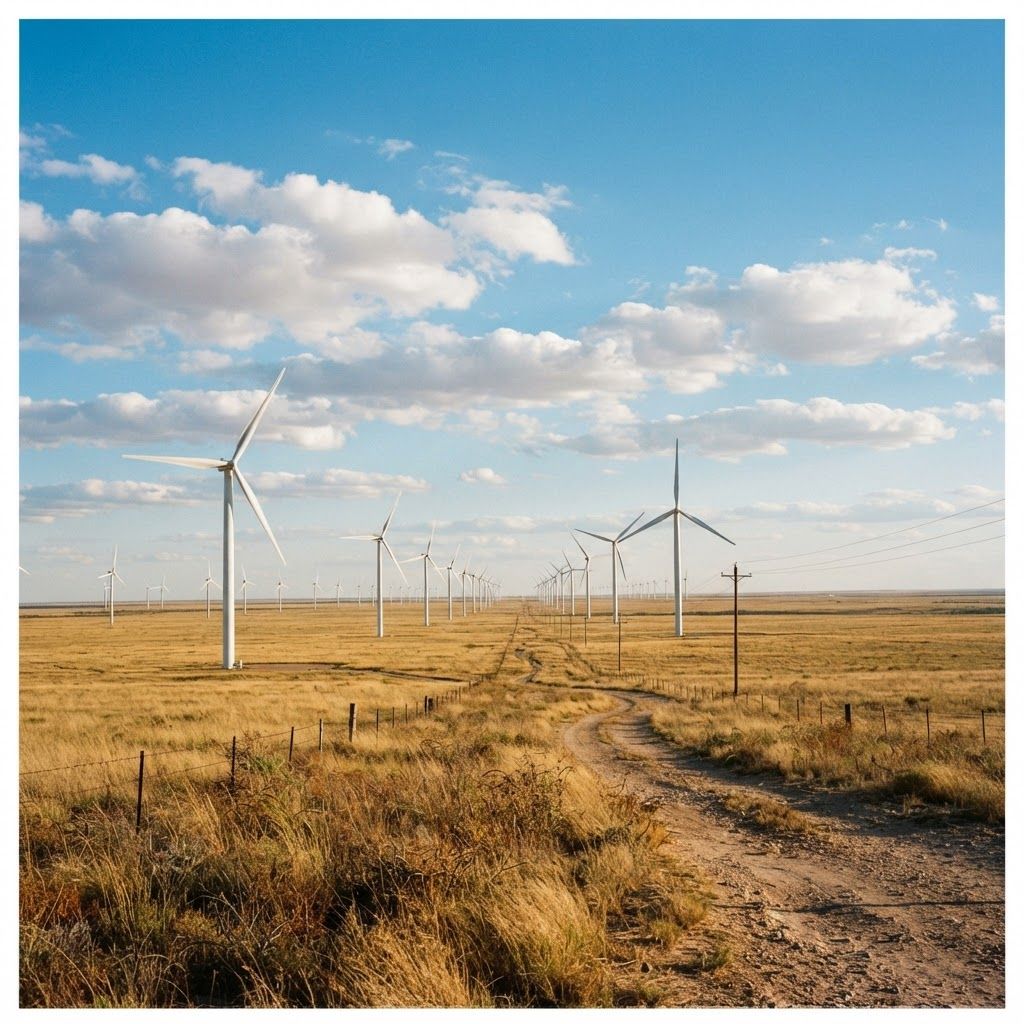
Why Lubbock Became a Wind Energy Capital
Few American cities are as closely tied to the wind as Lubbock. The flat, open terrain of the Llano Estacado produces some of the most consistent wind resources in North America, with average speeds that make utility-scale generation economically attractive year after year. Add abundant private ranch land, a supportive transmission network built out through the Competitive Renewable Energy Zone program, and a research culture anchored by the National Wind Institute, and the result is a regional cluster that touches nearly every part of the wind value chain. Developers scout sites here, manufacturers ship components through here, and thousands of technicians train and live here.
For landowners, commercial property managers, agricultural operations and municipal buyers, that density of expertise is a real advantage. It means you can find a partner who understands caprock soil conditions, hailstorm risk, dust loading on blades and the seasonal patterns that shape output on the South Plains. The companies below represent the range of services available locally, from full project development to component repair and workforce training.
The Top 10 Best Wind Energy Companies in Lubbock
1. Llano Estacado Wind Partners
A development-focused firm that specializes in mid-size community wind projects across the South Plains. Their team handles site prospecting, wind resource assessment, landowner agreements and interconnection studies, then stays on as an asset manager after commissioning. Clients consistently point to their transparent lease negotiations and their willingness to model conservative production scenarios rather than best-case numbers.
2. Caprock Turbine Services
Caprock has built its reputation on scheduled and unscheduled maintenance for utility-scale fleets. Crews are certified for gearbox inspections, blade repair, bolt torque campaigns and up-tower generator work, and the company keeps a rapid-response rotation for storm damage. Their emphasis on documentation and photo-verified work orders makes them a favorite among owners managing assets remotely.
3. South Plains Renewable Group
This firm focuses on the commercial and industrial market, pairing behind-the-meter wind with solar and storage for cotton gins, food processors and distribution centers. Their strength is financial structuring, helping owners compare direct ownership against power purchase agreements and long-term lease options with clear cost-of-energy math.
4. Red Raider Wind Technologies
A technology and analytics specialist offering SCADA integration, performance benchmarking and predictive maintenance modeling. By combining vibration data with production records, they help owners catch drivetrain problems before they become catastrophic failures. They also provide independent engineering reviews for buyers evaluating secondhand assets.
5. Panhandle Blade Solutions
Blade leading-edge erosion is a defining problem on the windy, dusty plains, and this company built a business around solving it. Services include composite repair, protective coating application, lightning protection system testing and full blade inspection using both drones and rope-access technicians.
6. Hub City Energy Contractors
A civil and electrical contractor that supports the construction phase of wind projects: access roads, crane pads, foundations, collection systems and substation work. Their familiarity with regional soil conditions and permitting expectations helps developers avoid the schedule slips that often plague first-time entrants.
7. Cotton Belt Wind Logistics
Moving a 200-foot blade through West Texas is its own discipline. This logistics operator handles oversize permitting, route surveys, escort coordination and laydown yard management, and maintains relationships with rail and trucking partners across the region.
8. Texas Plains Wind Consulting
An advisory practice serving landowners and small municipalities. They review lease language, model royalty scenarios, coordinate independent wind studies and advise on decommissioning provisions. For property owners approached by a developer for the first time, this kind of neutral guidance is often the highest-value service available.
9. Yellowhouse Power Systems
Specialists in small and distributed wind for farms, ranches and remote water-pumping applications. They size systems around actual load profiles, integrate battery storage where it pays, and provide long-term service contracts, which matters for owners far from a service center.
10. Monarch Wind Training Institute
Workforce development is the quiet bottleneck in renewable energy, and this training provider addresses it with safety certification, tower rescue courses, hydraulics and composites instruction, and employer-sponsored apprenticeships. Many regional operators use them as a pipeline for entry-level technicians.
Industry Trends Shaping the Local Market
Three shifts are reshaping wind work around Lubbock. First, repowering has become as important as new construction: turbines installed in the 2000s are reaching the end of their original service life, and owners are replacing nacelles and blades on existing foundations to capture modern efficiency. Second, hybridization is now standard practice, with wind increasingly paired with solar and battery storage to smooth output and improve capacity value. Third, operations and maintenance has professionalized, moving from reactive repair to condition-based programs driven by sensor data.
There is also a growing emphasis on grid interconnection strategy. Transmission congestion and curtailment can quietly erode returns, so the strongest developers now model basis risk and congestion alongside raw wind resource. Buyers evaluating proposals should ask directly how a company accounts for these factors.
How to Choose the Right Wind Energy Partner
Start with scope clarity. A blade repair specialist and a project developer are not interchangeable, so define whether you need development, construction, maintenance or advisory support before you request proposals. From there, evaluate safety performance, since incident rates say a great deal about a company's discipline at height. Ask for local references on projects of similar size, and confirm who actually performs the work versus who subcontracts it.
- Verify certifications for tower climbing, rescue and electrical work.
- Request production estimates with stated confidence levels, not single-point numbers.
- Confirm response times for unscheduled outages and whether crews are regionally based.
- Review warranty coverage, spare parts availability and lead times.
- Insist on clear decommissioning and land restoration terms in any lease.
Final Thoughts
Lubbock's wind industry has matured from a frontier opportunity into a full ecosystem of developers, contractors, analysts and trainers. That depth benefits everyone: landowners get better lease terms, commercial buyers get more competitive proposals, and asset owners get faster service. Whether you are considering a single distributed turbine for a farming operation or evaluating a portfolio of utility-scale assets, the companies above illustrate what a strong regional partner looks like. Take the time to match scope, verify credentials and compare more than one proposal, and the wind that defines this landscape can become a durable part of your energy strategy.