
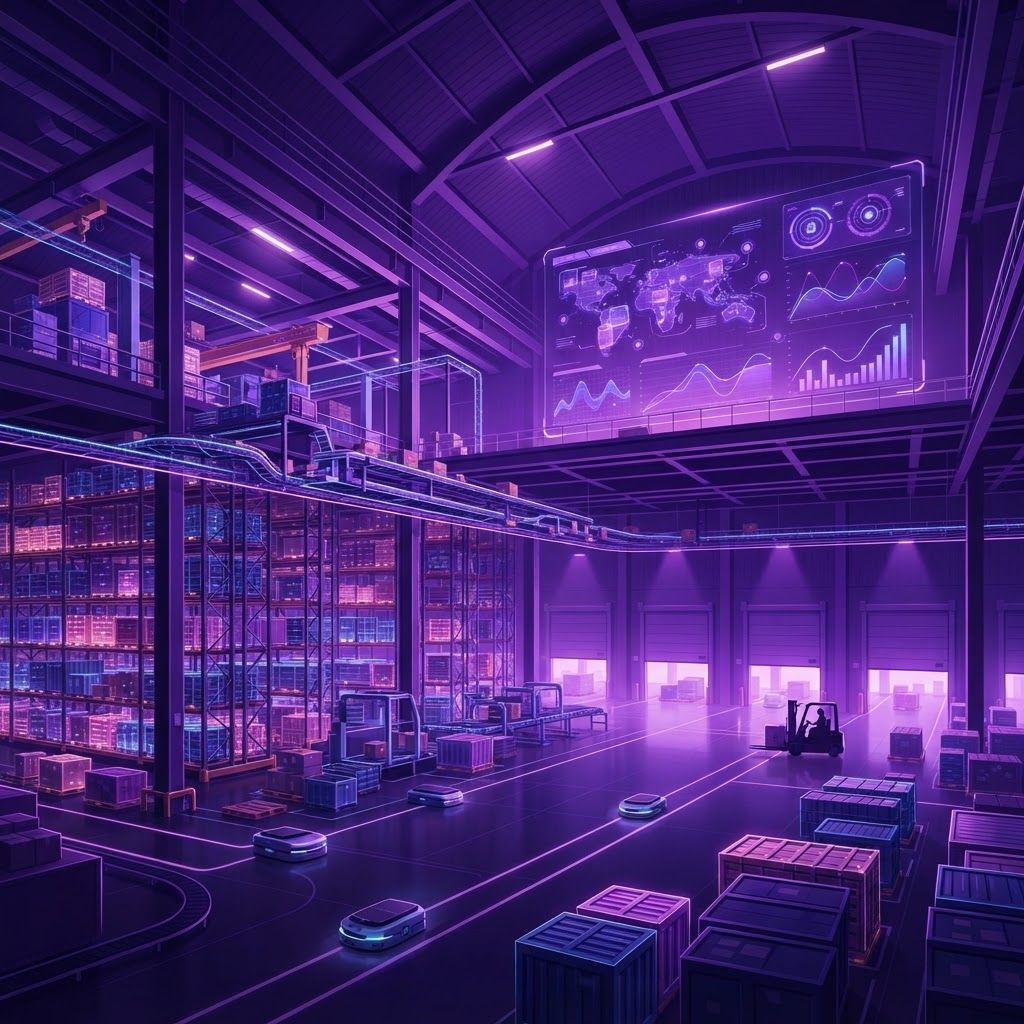
Why Grand Prairie Is a National Warehousing Hub
Grand Prairie's industrial significance is easy to underestimate from the street but obvious on a map. The Great Southwest Industrial District, developed beginning in the 1950s along the corridor between Dallas and Fort Worth, grew into one of the largest master-planned industrial parks in the country. Combined with newer development along State Highway 161, Interstate 20 and the Highway 360 corridor, the city offers tens of millions of square feet of distribution space.
The reasons companies concentrate here are structural. Roughly ninety-five percent of the continental United States population can be reached within a two-day truckload transit from the Dallas-Fort Worth area. DFW International Airport, one of the world's busiest cargo airports, sits minutes away. Class I railroads and intermodal terminals provide container access from West Coast and Gulf ports. Texas imposes no state income tax and offers Free Trade Zone designations in the area. Labor is available at competitive rates relative to coastal markets. For a national distribution strategy, the math frequently points here.
1. DHL Supply Chain
DHL Supply Chain is among the largest contract logistics providers in the world and operates significant footprint in the Dallas-Fort Worth industrial market. Its strength is complex, dedicated operations for enterprise clients: sector-specific expertise in automotive, life sciences, technology and consumer goods, deep warehouse management system capability, and a global framework that allows a client to standardize processes across continents. Companies choose DHL when the warehouse is not just storage but an engineered node in a global supply chain.
2. XPO Logistics
XPO built its reputation on less-than-truckload freight and asset-light logistics, and its network in North Texas serves both warehousing and transportation needs. For shippers whose problem is a mix of storage, cross-docking and regional distribution, XPO's ability to bundle warehouse operations with linehaul capacity simplifies vendor management. Its technology platform provides shipment visibility and analytics that mid-sized shippers often cannot build internally.
3. GEODIS
GEODIS operates contract logistics and e-commerce fulfillment facilities across the United States, with major presence in the Texas distribution corridor. The company has invested heavily in warehouse automation, including goods-to-person systems and robotics that raise pick rates for high-SKU-count operations. Retail and direct-to-consumer brands with seasonal volume swings value GEODIS for its ability to flex labor and capacity through peak periods.
4. Ryder System
Ryder is best known for fleet leasing but operates a substantial supply chain solutions business including dedicated and multi-client warehousing. Its differentiator is integration between the warehouse and the transportation fleet, which matters enormously for manufacturers running inbound-to-manufacturing programs where a late delivery stops a production line. Ryder's presence in the aerospace and industrial manufacturing base around Grand Prairie is a natural fit.
5. NFI Industries
NFI is a large privately held logistics company offering warehousing, distribution, brokerage and port drayage. Privately held structure allows longer investment horizons, which shows in the company's willingness to build customized, purpose-designed facilities for specific clients. NFI has also been an early mover on electric heavy-duty trucking and solar-equipped warehouse roofs, giving it credibility with clients who have carbon reduction commitments.
6. Americold
Temperature-controlled warehousing is a distinct discipline, and Americold is the recognized leader in cold storage across North America. Grand Prairie's location makes it a logical distribution point for refrigerated and frozen food moving through Texas and into the Southwest. Cold storage demands specialized infrastructure: multi-temperature zones, blast freezing, ammonia refrigeration systems, redundant power and rigorous food safety documentation. Food manufacturers, grocers and food service distributors depend on operators who can prove chain-of-custody temperature integrity.
7. Lineage Logistics
Lineage competes directly with Americold in the temperature-controlled sector and has grown rapidly through acquisition and technology investment. The company applies machine learning to pallet placement and energy management, reducing both handling time and refrigeration cost. For clients shipping perishable goods, Lineage's network density means product can be positioned closer to end markets without sacrificing cold chain reliability.
8. Kenco Logistics
Kenco is a long-established third-party logistics provider offering distribution, fulfillment, transportation and material handling services. Its reputation rests on operational discipline and continuous improvement methodology, with an innovation practice that pilots emerging warehouse technology on behalf of clients. Mid-market manufacturers often find Kenco a better cultural fit than the largest global providers, receiving senior attention that a small account might not get elsewhere.
9. ShipBob and E-Commerce Fulfillment Networks
E-commerce fulfillment is a specialized subset of warehousing, and networks like ShipBob have built distributed models specifically for direct-to-consumer brands. Rather than one large warehouse, inventory is split across multiple nodes so orders ship from the facility nearest the customer, cutting transit time and shipping cost. A Texas node is central to any such network, and Grand Prairie's location makes it a strong candidate. These providers integrate directly with major online store platforms and marketplaces, which removes months of technical work for a growing brand.
10. Regional Public Warehouse Operators
Alongside national players, Grand Prairie hosts numerous regional public warehouse operators offering shared space on flexible terms. Their value is accessibility: no multi-year commitment, pricing by pallet position or square foot, and willingness to handle overflow, seasonal inventory, project cargo and unusual commodities. For a company testing the Texas market or absorbing a temporary inventory surge, a regional operator is usually the right first step.
Key Criteria for Selecting a Warehouse Partner
Begin with fit between your inventory profile and the facility. Clear ceiling height, dock door count, trailer parking, floor load capacity and sprinkler classification determine whether an operation is even feasible. Then examine the warehouse management system, because inventory accuracy and real-time visibility depend on it, and confirm it can integrate with your order and accounting systems. Ask directly about certifications relevant to your goods, whether that is food safety accreditation, pharmaceutical handling qualification, hazardous materials authorization or customs bonded status. Review labor strategy honestly, since peak-season staffing plans separate providers who deliver from those who apologize. Finally, model total cost including storage, handling in and out, value-added services, and account management, not just the headline rate per pallet.
Trends Reshaping Warehousing
Automation is the loudest trend. Autonomous mobile robots, automated storage and retrieval systems, and goods-to-person picking stations are moving from pilot projects into standard specification, driven by labor scarcity and rising throughput demands. Data is the second force, with warehouse management systems now feeding predictive analytics that forecast labor needs and flag inventory anomalies before they become stockouts. Sustainability is third, expressed through rooftop solar, LED retrofits, electric forklifts and packaging reduction programs. Finally, resilience has replaced pure efficiency as a design goal, with companies deliberately holding more buffer inventory and dual-sourcing warehouse capacity after recent supply chain disruptions.
Final Thoughts
Grand Prairie's warehousing market offers something rare: genuine depth across every tier and specialty. Global contract logistics providers serve enterprise supply chains, cold storage specialists handle perishables, e-commerce networks serve digital brands, and regional operators provide flexible overflow capacity. The right choice depends on inventory characteristics, order profile, growth trajectory and technology requirements. Companies that define those factors precisely before issuing a request for proposal consistently negotiate better terms and experience fewer operational surprises.