
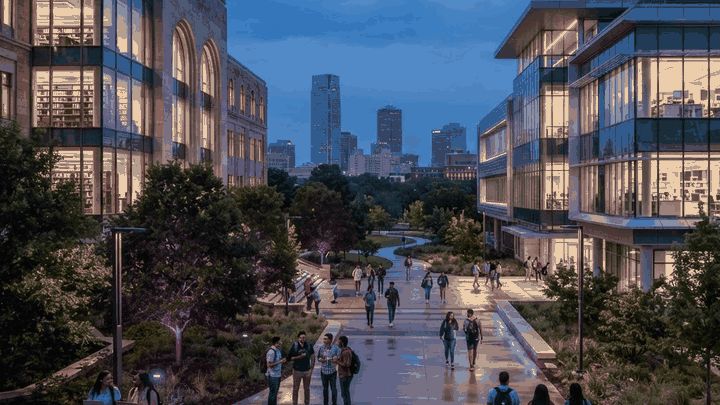
University Study in the Oklahoma City Metro
Oklahoma City combines the opportunities of a state capital with a relatively accessible higher-education market. Students can connect with employers in energy, aviation, healthcare, government, finance, technology, and the arts while choosing among public, private, and faith-based universities. Some institutions sit within city limits, while others are in nearby communities and remain part of the daily metro economy.
This guide is a curated comparison, not an absolute ranking. Each university serves a different audience, and the right fit depends on degree level, specialization, budget, campus culture, and preferred learning format.
1. University of Oklahoma
The University of Oklahoma’s main campus in Norman is a short drive from much of Oklahoma City, while its Health Sciences programs are based in the capital. OU offers the breadth expected from a major public research university, including engineering, business, atmospheric science, journalism, fine arts, and numerous graduate fields. Students gain a large alumni network, extensive research activity, spirited campus traditions, and access to both Norman and Oklahoma City internship markets.
2. Oklahoma City University
Oklahoma City University delivers a private university experience near the heart of the city. It is especially noted for performing arts, law, nursing, business, and liberal arts. Students who want smaller classes and close faculty engagement may prefer OCU to a large public campus. Its urban location supports professional experiences with arts groups, courts, healthcare organizations, companies, and nonprofits.
3. University of Central Oklahoma
Based in Edmond, the University of Central Oklahoma is one of the metro’s major public universities. UCO offers a wide range of bachelor’s and master’s programs, with strengths across education, business, science, forensic science, music, design, and public service. It balances a substantial campus experience with convenient access to Oklahoma City. Transformative learning, internships, and student organizations support development beyond the classroom.
4. Oklahoma State University
Oklahoma State University’s flagship campus is in Stillwater, but its influence and educational presence extend strongly into Oklahoma City through OSU–OKC and the Center for Health Sciences in Tulsa. Metro students often consider the OSU system for engineering, agriculture, business, veterinary science, health, and applied technical pathways. The system’s statewide employer connections and alumni community are meaningful advantages for graduates planning careers in Oklahoma.
5. Southern Nazarene University
Southern Nazarene University in Bethany offers undergraduate, graduate, and adult-oriented programs in a Christian environment. Fields include business, education, nursing, psychology, ministry, and sciences. Traditional students can experience a close residential community, while working adults may appreciate accelerated and flexible pathways. Its west-metro location keeps learners connected to urban employers without the scale of a large campus.
6. Mid-America Christian University
Mid-America Christian University serves both campus-based and online learners from south Oklahoma City. Its faith-centered programs include business, counseling-related disciplines, education, ministry, and leadership. Flexible formats are a significant differentiator for adults balancing employment and family responsibilities. Prospective students should compare delivery methods, field-placement support, and professional licensure requirements for their chosen program.
7. Oklahoma Baptist University
Located in Shawnee, Oklahoma Baptist University is within the broader Oklahoma City region and attracts students seeking a residential Christian liberal arts experience. It offers programs in nursing, business, education, science, fine arts, and ministry. Small classes, campus traditions, and an integrated faith perspective define the experience. The location offers a distinct college-town atmosphere while preserving access to Oklahoma City opportunities.
8. Southwestern Christian University
Southwestern Christian University is a small private institution in Bethany with undergraduate programs shaped by a Pentecostal Christian mission. Students may value personal mentorship, athletics, ministry preparation, and a close community. The university’s size can support meaningful participation in campus activities. It is best suited to learners who actively want faith integrated into academics and student life.
9. Randall University
Randall University in Moore provides a compact, ministry-minded learning environment. Programs include business, psychology, education, humanities, and Christian studies. Its location is convenient for students in south Oklahoma City and surrounding communities. Applicants considering a small university should review course rotation, internship options, and graduate outcomes to ensure the available resources align with long-term plans.
10. Langston University
Langston University, Oklahoma’s historically Black university, has its main campus northeast of Oklahoma City and maintains important connections throughout the state. Its programs include business, education, nursing and health professions, agriculture, and the liberal arts. Langston offers a distinctive history, mission, and community. Students interested in an HBCU experience can gain personal support and access to networks that contribute to academic and professional growth.
What Makes a University a Strong Fit?
Program quality should lead the decision. Investigate faculty expertise, specialized accreditation, research or studio facilities, internship partnerships, and outcomes in your intended field. Next, compare net price after grants and scholarships rather than relying on the advertised tuition. Housing, commuting, meal plans, and course materials can substantially change the total.
Campus size and culture also matter. Large research universities provide extensive resources and course selection, while smaller universities may offer closer mentorship. Working students should examine evening, hybrid, and online availability. Those entering licensed careers must verify that a program meets Oklahoma requirements and understand any additional examination or clinical obligations.
Making the Final Decision
Build a shortlist with one aspirational option, several strong matches, and at least one financially secure choice. Attend information sessions, speak with current students, and ask departments specific questions about advising, internships, and recent graduate destinations. Oklahoma City’s universities differ widely, but that variety is an advantage: students can find rigorous research, creative training, professional education, or a values-centered community within the region.