
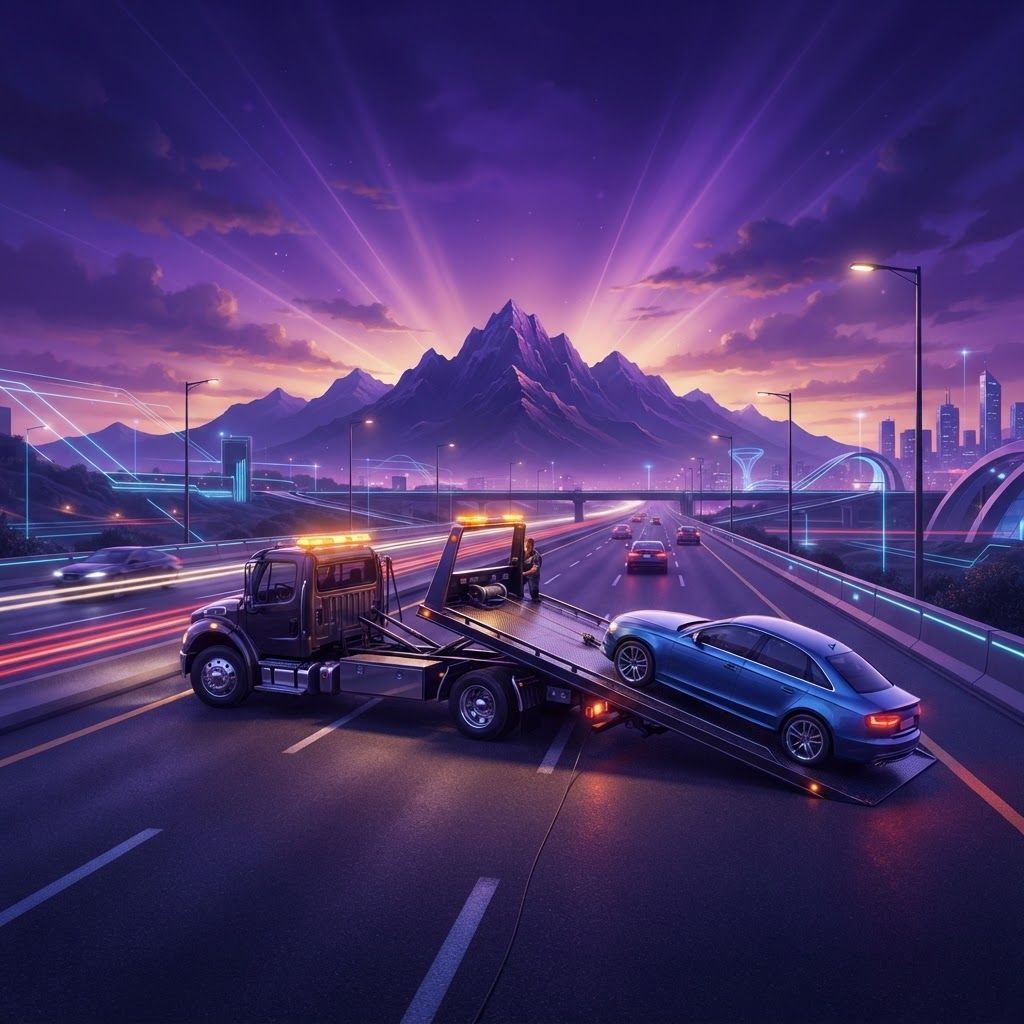
Why Towing Is a High-Stakes Service in San Bernardino
San Bernardino occupies one of the most demanding towing environments in California. The city sits where the I-10, I-215, and State Route 210 converge, feeding traffic toward the Cajon Pass and the high desert beyond. Long sustained grades punish transmissions and cooling systems, summer heat causes blowouts and overheating, and heavy commercial traffic from the region's distribution corridor means incidents involving box trucks, trailers, and loaded vans are routine rather than rare.
The consequence is that towing here is not one service but several distinct disciplines: light-duty passenger recovery, motorcycle transport, heavy-duty commercial recovery, off-road and embankment extraction, accident and law enforcement rotation towing, and long-distance transport for vehicles that need to reach a specialist shop. The best local operators are explicit about which of these they are equipped to perform.
The Most Reliable Towing Operators in the Area
Several long-standing names anchor the local market. Steve's Towing has built its reputation on rapid light-duty response and consistent communication with customers waiting roadside. Rancho Towing and Inland Empire Towing style operators serve both consumer and commercial accounts, generally running mixed fleets of flatbeds and wheel-lift trucks so they can match equipment to the vehicle rather than forcing a single method.
Coast to Coast Towing and Quality Towing are frequently used for longer-distance transport and dealership work, where careful loading and secure tie-down matter more than raw speed. Highland Towing and Del Rosa Towing serve the eastern and northern neighborhoods, which is significant because response time in towing is largely a function of yard proximity. For commercial and heavy recovery, operators such as Bragg Towing and American Heavy Duty Towing style specialists bring rotators, air cushion recovery systems, and certified heavy operators capable of uprighting a loaded trailer without further damaging the load.
National roadside assistance programs also remain a core part of the picture. AAA contracts with vetted local providers and offers predictable coverage limits, while manufacturer roadside programs bundled with new vehicle warranties often provide free towing to the nearest franchised dealer. App-based dispatch platforms such as Urgent.ly and Honk have expanded coverage further by matching stranded drivers with nearby verified trucks and providing upfront pricing.
Flatbed Versus Wheel-Lift: Why Equipment Choice Matters
The most common cause of towing damage is using the wrong truck. Flatbed carriers lift the entire vehicle onto a deck, which means no wheels rotate and no drivetrain components turn during transport. This is the correct and often the only acceptable method for all-wheel-drive vehicles, electric vehicles, lowered or exotic cars, and any vehicle with drivetrain or suspension damage.
Wheel-lift trucks raise one axle and tow the vehicle on its remaining wheels. They are faster, more maneuverable in tight parking structures, and entirely appropriate for many front-wheel-drive vehicles over short distances. The failure mode arises when an operator uses a wheel lift on an all-wheel-drive vehicle without dollies, which can destroy a transfer case or center differential. A trustworthy dispatcher asks about drivetrain configuration before assigning a truck, and that single question is one of the clearest quality signals available to a customer.
Electric Vehicles Have Changed the Rules
Electric vehicle adoption across the Inland Empire has introduced genuinely new towing requirements. Most electric vehicles must be transported on a flatbed because their motors are mechanically coupled to the wheels and rolling them can generate current or cause damage. Many have specific jacking and tie-down points to avoid battery enclosure contact, and towing them in neutral is often either impossible or explicitly prohibited by the manufacturer. Additionally, a damaged high-voltage battery presents a thermal runaway risk that requires trained handling and, in some cases, specific quarantine procedures at the destination yard. Operators who have invested in electric vehicle training and equipment are increasingly the safer choice.
Protecting Yourself From Predatory Practices
Roadside emergencies create an obvious information imbalance, and California law includes specific protections. Reputable San Bernardino operators provide a clear quote before hooking up, including hook-up fee, per-mile rate, and any additional charges for winching, after-hours service, or storage. They present an itemized invoice and accept card payment rather than demanding cash only. They also confirm the destination in advance rather than delivering the vehicle to a yard that then charges escalating daily storage.
Warning signs are equally consistent: an unsolicited truck that appears at an accident scene without being called, refusal to quote in writing, unmarked vehicles, and pressure to sign blank paperwork. Before authorizing a tow, photograph the vehicle from several angles to document its pre-tow condition, note the truck number and driver name, and confirm the company holds a valid California Highway Patrol motor carrier permit and current insurance.
What to Do While You Wait
Safety during the wait is more important than the tow itself. Move the vehicle onto the shoulder or off the freeway entirely if it can still roll, activate hazard lights, and place reflective triangles or flares well behind the vehicle where space allows. On a freeway shoulder in San Bernardino, the safest position is generally inside the vehicle with seatbelts fastened if traffic is heavy, or well beyond the guardrail if the shoulder is narrow. Call 911 rather than a commercial number if the vehicle is blocking a lane, since freeway service patrols can often clear the obstruction faster.
Have your location details ready, including freeway direction, nearest exit or mile marker, and any visible landmarks, because accurate location information is the single largest factor in reducing response time. Keep a small kit in the vehicle year round: water, a flashlight, a phone power bank, basic tools, and a reflective vest. In a region where heat, grades, and traffic density combine as they do around San Bernardino, preparation and a saved number for a vetted local operator turn a potential crisis into a manageable inconvenience.