
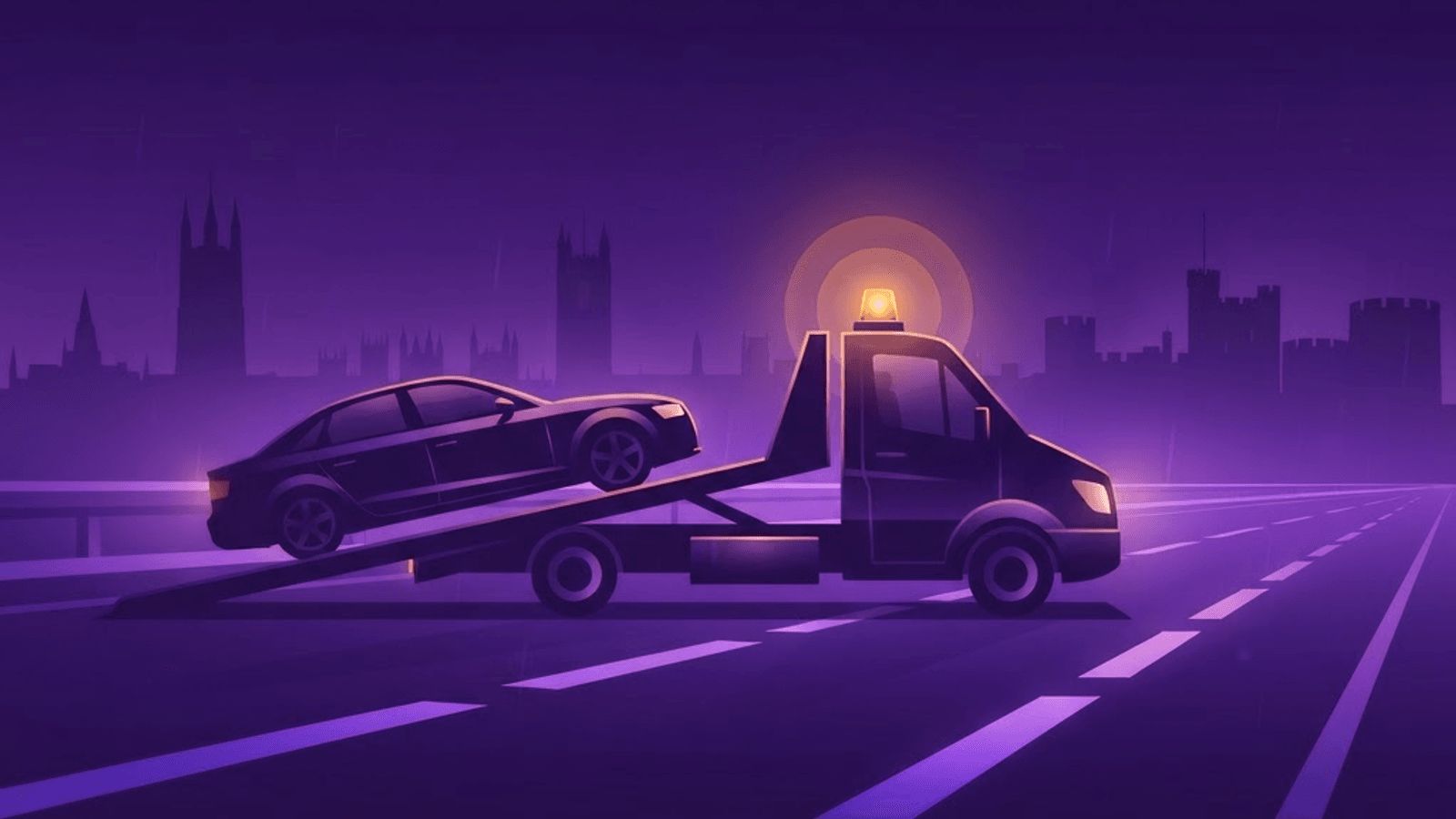
Vehicle Recovery in and Around Lancaster
Lancaster's geography creates a demanding recovery environment. A major motorway passes close to the city, carrying heavy through traffic where breakdowns occur at speed and require rapid, safe removal. Beyond the urban area, narrow rural lanes wind through the Forest of Bowland and out towards the Yorkshire Dales, where access is tight, mobile signal can be patchy and darkness is genuine rather than merely dim. Coastal routes around Morecambe Bay add tidal and soft-ground considerations.
Good recovery operators in this area therefore need more than a truck. They need local route knowledge, equipment suited to narrow access, appropriate lighting and safety gear, and the judgement to know when a vehicle can be fixed at the roadside rather than transported. The best of them resolve a meaningful share of call-outs without towing at all.
Understanding Recovery Types
Flatbed recovery, where the entire vehicle is winched onto a tilting bed, is the safest method for most modern cars. It avoids drivetrain damage and is essential for all-wheel drive vehicles, automatics and electric vehicles, whose motors can generate current if driven wheels are turning while the vehicle is being towed.
Spectacle lift recovery raises one axle and is quicker for short distances, though it is unsuitable for many modern drivetrains. Specialist off-road and underlift recovery handles vehicles that have left the carriageway or become stuck on soft ground. Heavy recovery for commercial vehicles requires entirely different equipment, including heavy-duty cranes and stabilisers.
Electric vehicle recovery deserves particular mention. Damaged battery packs carry thermal risk, and properly trained operators know how to isolate high-voltage systems, assess battery condition and, where necessary, use containment procedures. Not every operator holds this training, and it is worth asking.
The Top 10 Towing Services in Lancaster
1. Lune Valley Recovery
The most established operator in the district, Lune Valley Recovery runs a mixed fleet of flatbeds and light recovery units with genuine twenty-four hour coverage. Its response times are consistently among the fastest locally, and its operators carry roadside diagnostic and jump-start equipment, resolving a substantial proportion of call-outs without transporting the vehicle. It holds appropriate training for electric vehicle handling.
2. Castle Hill Motorway Rescue
Specialising in high-speed carriageway recovery, this operator is equipped for the particular hazards of motorway work, including advanced warning systems, high-visibility fleet marking and rapid clearance procedures. Its crews are trained in incident scene safety and coordinate effectively with traffic officers, which matters greatly when a vehicle is stopped in a live lane.
3. Morecambe Bay Heavy Recovery
Handling commercial vehicles, buses, horseboxes and agricultural machinery, Morecambe Bay Heavy Recovery operates heavy-duty units capable of lifting and transporting substantial loads. It also undertakes recovery from soft ground and awkward sites, which is regularly needed around the bay and on farmland across the district.
4. Quernmore Rural Recovery
Built specifically for the challenges of the surrounding countryside, this operator uses compact recovery vehicles able to reach locations that full-size flatbeds cannot. Crews carry off-road winching equipment and know the lane network around Bowland intimately, which frequently saves an hour or more of searching on a dark night.
5. Skerton Roadside Assistance
Focused on fault resolution rather than transport, Skerton Roadside Assistance attends breakdowns with diagnostic equipment, replacement batteries, fuel drain equipment, tyre repair kits and common consumables. Its stated aim is to get the vehicle moving under its own power, and it only tows when repair is impractical.
6. Greaves Park Accident Recovery
Specialising in collision scenes, this operator handles damaged vehicle removal, debris clearance, fluid containment and secure storage. It works with insurers and repairers, and its documentation of vehicle condition on collection is thorough, which protects owners in subsequent claims.
7. Williamson Park Vehicle Transport
Rather than emergency recovery, this service provides planned vehicle transport: moving classics, non-runners, project cars and purchased vehicles over longer distances on enclosed or open transporters. It is widely used by collectors and by buyers acquiring vehicles from outside the region.
8. Halton Electric Vehicle Recovery
A specialist responding to the growth of the local electric fleet, Halton Electric Vehicle Recovery operates flatbeds exclusively and employs operators trained in high-voltage isolation and battery risk assessment. It also carries mobile charging capability for vehicles that have simply run out of charge, which avoids an unnecessary tow.
9. Ashton Twenty-Four Hour Towing
Providing round-the-clock general recovery across the city and immediate surroundings, this operator emphasises rapid dispatch and transparent flat-rate pricing quoted before attendance. Its coverage of overnight and bank holiday periods, when many operators reduce capacity, is a particular strength.
10. Bailrigg Campus and City Recovery
Serving the city centre, campus areas and residential streets, this smaller operator handles jump starts, lockouts, flat tyres and short-distance tows. Its compact vehicles navigate tight urban parking and multi-storey car parks where larger recovery trucks cannot operate.
Trends in Vehicle Recovery
Live tracking has become standard, allowing stranded drivers to see the recovery vehicle approaching rather than waiting without information. Electric vehicle recovery training is now a significant differentiator between operators. Mobile charging units are emerging as an alternative to towing depleted electric vehicles. Digital documentation, including photographic condition reports at collection and delivery, is increasingly expected by insurers and customers alike.
What to Do When You Break Down
Safety comes before everything. On a motorway, move to the hard shoulder or an emergency area if possible, exit the vehicle on the passenger side, and wait behind the barrier rather than in the vehicle. On rural roads, position warning triangles well back where it is safe to do so, and make yourself visible.
When calling, provide your precise location using a location-sharing method, your vehicle make, model and fuel type, and a description of the fault. Ask for an estimated arrival time and a price before agreeing. Check whether your insurance, vehicle warranty, bank account or manufacturer package already includes recovery cover, as many drivers pay twice unnecessarily. Confirm that the operator uses a flatbed if your vehicle is automatic, all-wheel drive or electric.
Final Thoughts
Recovery is one of those services nobody researches until they urgently need it. Lancaster is well covered by operators spanning motorway response, rural access, heavy commercial work and electric vehicle specialism. Save a trusted number before you need it, confirm what cover you already hold, and prioritise operators who attempt roadside repair first, because the fastest recovery is often the one that never requires a tow at all.