
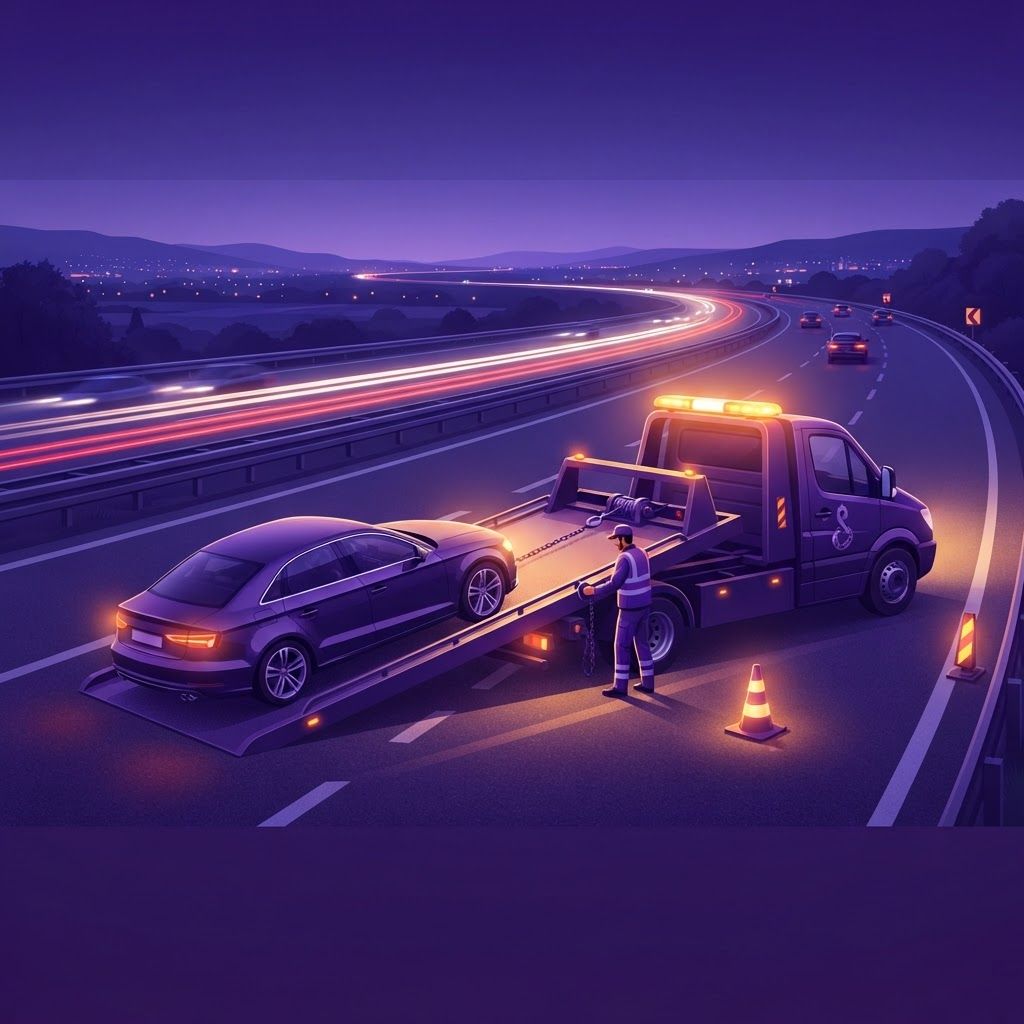
Why Towing Demand Is High in Fontana
Few places generate towing calls as reliably as Fontana. The I-10, I-15, and SR-210 all pass through or near the city, carrying enormous volumes of both passenger vehicles and commercial trucks. Summer temperatures routinely exceed one hundred degrees, which causes a spike in overheating incidents, battery failures, and tire blowouts as heat degrades rubber and raises pressure. The nearby Cajon Pass adds sustained grades that punish cooling systems and brakes, and the surrounding desert corridors mean a breakdown can occur far from services.
The consequence is that Fontana drivers should think about towing before they need it. Response time on a hot freeway shoulder is not merely an inconvenience; it is a safety matter. Having a membership program or a saved contact for a reputable local operator turns an emergency into a manageable delay.
The Ten Best Towing and Roadside Options for Fontana Drivers
1. AAA Automobile Club of Southern California. AAA remains the benchmark roadside membership in the region, offering towing, battery service, fuel delivery, lockout assistance, and flat tire changes with coverage tied to the member rather than the vehicle. Higher membership tiers include substantially longer tow distances, which matters when a breakdown occurs in Cajon Pass or out toward the desert. Its contractor network density in Southern California produces reliably fast dispatch.
2. Better World Club. Better World Club provides comparable roadside assistance coverage with an environmental focus, including bicycle roadside assistance and carbon offset programs. For members who want AAA-style benefits from a provider with different values, it is a credible alternative with nationwide coverage.
3. Good Sam Roadside Assistance. Good Sam specializes in recreational vehicles, trailers, and larger vehicles, which conventional roadside plans often exclude or limit. Given how many Inland Empire households own travel trailers, boats, and motorhomes for desert and mountain recreation, its unlimited-distance towing for covered vehicles fills a real need.
4. Urgent.ly. Urgent.ly operates an app-based roadside assistance platform with transparent upfront pricing and live technician tracking, available on demand without membership. For drivers who need help once rather than annually, pay-per-use dispatch avoids subscription cost, and the tracking removes the uncertainty of waiting without information.
5. Honk. Honk provides similar on-demand roadside service with no membership requirement, connecting drivers to nearby providers and quoting a fixed price before dispatch. Its network reaches well across Southern California, and it is a practical fallback when a primary provider quotes a long wait.
6. Agero. Agero operates behind the scenes for many insurers and vehicle manufacturers, managing roadside programs at large scale. Many Fontana drivers already have Agero-backed coverage through their auto insurance or new vehicle warranty without realizing it, which makes checking existing benefits before paying separately worthwhile.
7. Manufacturer roadside assistance programs. Nearly every automaker includes roadside assistance during the new vehicle warranty period, covering towing to a dealership, battery jump-starts, and lockout service. Drivers of newer vehicles frequently pay for redundant coverage. Verify the terms in your owner documentation before purchasing a plan.
8. Insurance carrier roadside coverage. Major auto insurers offer roadside assistance as an inexpensive policy add-on, typically costing a few dollars per month. Coverage is usually less generous on tow distance than a full membership program, but for local breakdowns within Fontana and adjacent cities it is often entirely sufficient at a fraction of the cost.
9. Heavy-duty and commercial towing specialists. Fontana's logistics economy means tractor-trailers, box trucks, and heavy equipment break down here regularly, and recovering them requires rotator and heavy wrecker equipment that standard operators do not have. Fleet managers should establish a relationship with a heavy-duty specialist in advance, since improvised arrangements during a disabled-truck incident are costly and slow.
10. Freeway Service Patrol. Funded through regional transportation agencies, the Freeway Service Patrol provides free assistance on congested freeway segments during peak hours, offering jump-starts, fuel, tire changes, and short tows to safe locations. It exists to clear lanes quickly, and for a peak-hour breakdown on the I-10 it is often the fastest help available at no cost.
Trends in Roadside Assistance
Digital dispatch has become the norm. Live technician tracking, text updates, and photographic confirmation have replaced open-ended phone waits, substantially improving the experience of a stressful situation.
Electric vehicle support has expanded meaningfully. Providers now offer mobile charging, and technicians increasingly receive training on properly towing electric vehicles, which generally require flatbed transport to avoid drivetrain damage. Confirming this capability matters for electric vehicle owners.
Coverage bundling has also grown. Roadside assistance now arrives through insurance policies, credit card benefits, vehicle warranties, and mobile carrier perks. Many drivers hold multiple overlapping entitlements and could eliminate redundant spending by auditing what they already have.
How to Handle a Breakdown Safely
Get off the roadway if at all possible. A vehicle stopped in a traffic lane, particularly on a truck-heavy freeway, is extremely dangerous. If the vehicle can still move, exit to a shoulder as far right as possible, or better, to an off-ramp or parking area.
Make yourself visible. Activate hazard lights immediately, and if you have reflective triangles or flares and can deploy them safely, place them upstream of the vehicle. At night, this is critical.
Stay in the vehicle with seatbelts fastened when on a freeway shoulder, unless there is a fire risk or the position is clearly unsafe. Standing outside a vehicle beside high-speed traffic is more dangerous than remaining inside.
Manage heat carefully. In Fontana summer conditions, a disabled vehicle without air conditioning becomes dangerous within minutes. Keep water in the vehicle year-round, seek shade if it can be reached safely, and communicate temperature concerns to the dispatcher, since heat exposure elevates call priority.
Finally, confirm details before authorizing service. Ask for the price, the tow destination, and whether payment is covered by your membership or insurance. Be cautious of unsolicited operators who arrive without being dispatched, and verify that any provider is properly licensed and insured before releasing your vehicle.
Final Thoughts
Fontana's freeway density and summer heat make towing coverage a practical necessity rather than an optional extra. Audit the coverage you may already hold through insurance, vehicle warranty, or credit cards, then supplement with a membership program if your commute involves long distances or mountain grades. Keep water and reflective warning devices in the vehicle, and prioritize getting off the roadway and staying visible when a breakdown occurs.